JEE MAIN 2026 · 23 JAN S2+4 / −1
JEE Main 2026 Chemistry question — Nucleophilic substitution (SN1 and SN2)
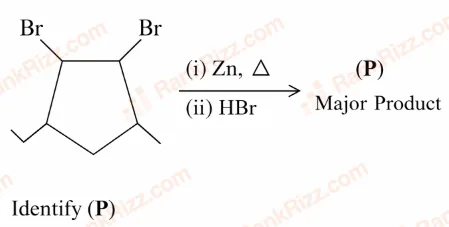
SOLUTION
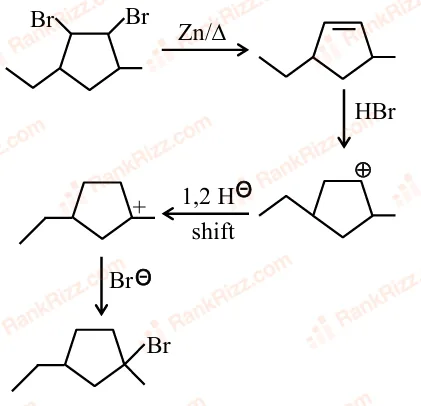
Step 1: Debromination with (, )The reaction of a vicinal dibromide (1,2-dibromo compound) with zinc dust and heat undergoes an elimination reaction. The zinc removes the two bromine atoms to form a carbon-carbon double bond.
- Intermediate: 3,5-dimethylcyclopent-1-ene.
Step 2: Hydrobromination with ()The intermediate alkene then reacts with (). This is an electrophilic addition reaction following Markovnikov's rule.
- Protonation: The double bond attacks the () from (), forming the most stable carbocation.
- Carbocation Formation: In this symmetrical-looking substituted cyclopentene, the carbocation forms at one of the substituted positions to benefit from secondary/tertiary stability (though here they are equivalent).
- Nucleophilic Attack: The bromide ion ()) attacks the carbocation.