JEE Main 2004 Chemistry question — Optical isomerism and chirality
Which of the following compound is not chiral?
SOLUTION
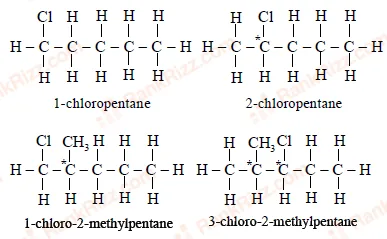
- A molecule is chiral if it contains at least one chiral center (carbon bonded to four distinct groups) and lacks an internal plane of symmetry.
- A molecule is achiral if none of its carbons are bonded to four different groups, or if it possesses an internal plane of symmetry.
Structure and Asymmetric Carbon Analysis:
-
Option A: 1-Chloropentane
Let's check the carbons: C1 is bonded to two atoms; C2, C3, and C4 are bonded to two atoms each; C5 is bonded to three atoms. Since no single carbon is attached to four unique groups, the molecule has zero chiral centers.
Result: Achiral (Not Chiral)
-
Option B: 3-Chloro-2-methylpentane
The C3 carbon () is bonded to four completely different groups: a hydrogen atom (), a chlorine atom (), an isopropyl group (), and an ethyl group ().
Result: Chiral
-
Option C: 1-Chloro-2-methylpentane
The C2 carbon () is bonded to four different groups: a hydrogen atom (), a methyl group (), a chloromethyl group (), and a propyl group ().
Result: Chiral
-
Option D: 2-Chloropentane
The C2 carbon () is bonded to four different groups: a hydrogen atom (), a chlorine atom (), a methyl group (), and a propyl group ().
Result: Chiral
Because 1-chloropentane does not contain any asymmetric carbon atoms, it is completely achiral.
Answer: Option A — 1-chloropentane