JEE MAIN 2020 · 05 SEP S1Drugs and medicines
If a person is suffering from the deficiency of nor-adrenaline, what kind of drug can be suggested?
- A
Anti-inflammatory
- B
Antidepressant
- C
Antihistamine
- D
Analgesic
Drugs and medicines has been asked 65 times in JEE Main, in 14 different years between 2005 and 2024, and in 3 of the last five exam years (2022–2026), 31 questions in all. That is 82% of Chemistry in Everyday Life, its most-asked topic. Last asked in JEE Main 06 Apr 2024, Shift 1. 59 are multiple choice and 6 numerical-value; 52 easy and 5 medium by our difficulty labels. All of them are below, newest first, free to read.
Questions
65
Years asked
14
Since
2005
Of the chapter
82%
41–60 OF 65 · NEWEST FIRST
If a person is suffering from the deficiency of nor-adrenaline, what kind of drug can be suggested?
Anti-inflammatory
Antidepressant
Antihistamine
Analgesic
The following molecule acts as an:
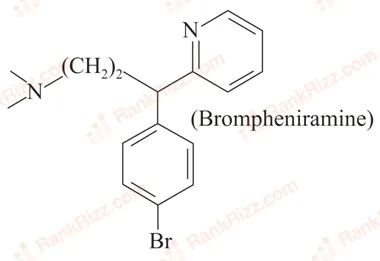
Antiseptic
Anti-depressant
Anti-bacterial
Anti-histamine
The mechanism of action of "Terfenadine" (Seldane) is:
Activates the histamine receptor
Inhibits the secretion of histamine
Helps in the secretion of histamine
Inhibits the action of histamine receptor
The antifertility drug "Novestrol" can react with:
/ HCl; ; Alcoholic HCN
/ water, / HCl;
Alcoholic HCN; NaOCl; / HCl
/ water, / HCl; NaOCl
Match the following drugs with their therapeutic actions:
(i) Ranitidine (a) Antidepressant
(ii) Nardil (Phenelzine) (b) Antibiotic
(iii) Chloramphenicol (c) Antihistamine
(iv) Dimetane (Brompheniramine) (d) Antacid
(e) Analgesic
(i)-(a); (ii)-(c); (iii)-(b); (iv)-(e)
(i)-(d); (ii)-(a); (iii)-(b); (iv)-(c)
(i)-(e); (ii)-(a); (iii)-(c); (iv)-(d)
(i)-(d); (ii)-(c); (iii)-(a); (iv)-(e)
The number of chiral centres in penicillin is __________.
The number of chiral carbons in chloramphenicol is
Noradrenaline is a/an:
Antihistamine
Neurotransmitter
Antacid
Antidepressant
The correct match between item (I) and item (II) is:
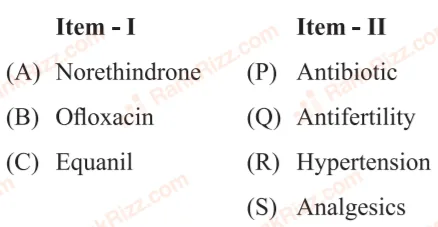
(A) (Q); (B) (R); (C) (S)
(A) (Q); (B) (P); (C) (R)
(A) (R); (B) (P); (C) (S)
(A) (R); (B) (P); (C) (R)
The correct match between Item I and Item II is:
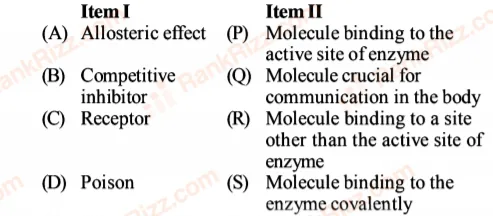
(A) (R); (B) (P); (C) (Q); (D) (S)
(A) (P); (B) (R); (C) (Q); (D) (S)
(A) (R); (B) (P); (C) (S); (D) (Q)
(A) (P); (B) (R); (C) (S); (D) (Q)
The correct match between items of List-I and List-II is:
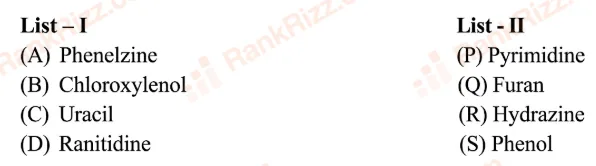
(A)-(S), (B)-(R), (C)-(Q), (D)-(P)
(A)-(R), (B)-(S), (C)-(P), (D)-(Q)
(A)-(R), (B)-(S), (C)-(Q), (D)-(P)
(A)-(S), (B)-(R), (C)-(P), (D)-(Q)
Glucose on prolonged heating with HI gives:
6-iodohexanal
n-Hexane
1-Hexene
Hexanoic acid
The reason for "drug induced poisoning" is:
binding irreversibly to the active site of the enzyme.
binding at the allosteric sites of the enzyme.
binding reversibly at the active site of the enzyme.
bringing conformational change in the binding site of enzyme.
Which of the following is a bactericidal antibiotic?
Ofloxacin
Tetracycline
Chloramphenicol
Erythromycin
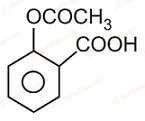
is used as:
Antacid
Insecticide
Antihistamine
Analgesic
Which of the following compounds is not an antacid?
Ranitidine
Aluminium hydroxide
Cimetidine
Phenelzine
Aminoglycosides are usually used as:
antibiotic
analgesic
hypnotic
antifertility
Which one of the following is used as Antihistamine?
Omeprazole
Chloranphenicol
Diphenhydramine
Norethindrone
H - Receptor antagonists is a term associated with :
Antiseptics
Antihistamins
Antacids
Analgesics
Which of the following statements about aspirin is not true?
It is effective in relieving pain.
It is a neurologically active drug.
It has antiblood clotting action.
It belongs to narcotic analgesics.
RELATED CHEMISTRY IN EVERYDAY LIFE TOPICS