JEE Main 2012 Chemistry question — Basicity of amines
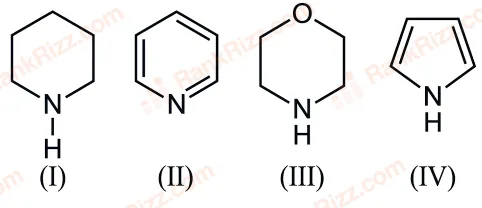
The order of basicity of the compounds is
SOLUTION
The four given bases are assumed to be
Case I: (dimethylamine : a 2° aliphatic amine)
Case II: (trimethylamine : a 3° aliphatic amine)
Case III: (methylamine : a 1° aliphatic amine)
Case IV: (aniline : an aromatic amine)
Basicity of an amine in aqueous medium is governed mainly by two factors.
1. +I (electron-releasing) effect of alkyl groups
More alkyl groups push electron density toward the N-lone pair, increasing its availability for protonation.
2. Stabilisation of the conjugate acid by hydrogen bonding with water (solvation effect)
The conjugate acid must be well solvated. This requires N-H bonds that can form hydrogen bonds with water. Fewer N-H bonds mean poorer solvation and hence lower basicity.
Evaluating each compound
• Case I - dimethylamine,
Has two +I donating CH₃ groups and still possesses one N-H bond for effective solvation. Hence it is the most basic of the set.
• Case III - methylamine,
Only one +I group, but two N-H bonds give excellent solvation. It is slightly less basic than the 2° amine.
• Case II - trimethylamine,
Although it has three +I groups, it has no N-H bond, so its conjugate acid is poorly solvated. Consequently its basicity falls below that of the 1° amine.
• Case IV - aniline,
The lone pair on N participates in resonance with the benzene ring:
Delocalisation reduces electron density on N, making it the least basic.
Collecting the results:
That matches
Option B which is: I > III > II > IV.
Topic: Basicity of amines