JEE MAIN 2012
JEE Main 2012 Chemistry question — Basicity of amines
In the following compounds:
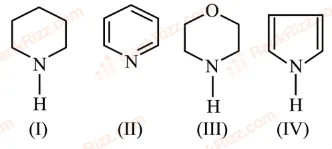
the order of basicity is as follows
SOLUTION
The basic strength of an amine depends on how readily the lone pair on nitrogen can be donated to a proton. The main factors are:
(i) +I (inductive) effect of alkyl groups, which pushes electron density toward nitrogen and increases basicity.
(ii) Resonance (-M) withdrawal of the lone pair, which decreases basicity.
(iii) Additional electron-withdrawing substituents on the ring, which further lower electron density on nitrogen.
1. Piperidine (Compound I) — Most Basic
- Structure: A fully saturated 6-membered ring containing nitrogen ( hybridized).
- Basicity: It behaves like a typical secondary aliphatic amine. The alkyl groups surrounding the nitrogen push electron density toward it via the inductive effect (+I effect), making the lone pair highly available. It has the highest ().
2. Morpholine (Compound III)
- Structure: Similar to piperidine, but it has an oxygen atom directly opposite the nitrogen atom.
- Basicity: The nitrogen is still hybridized, but oxygen is highly electronegative and pulls electron density away through the bonds via a -I (inductive) effect. This reduces the availability of the nitrogen's lone pair compared to piperidine, making it less basic ().
3. Pyridine (Compound II)
- Structure: An aromatic 6-membered ring where the nitrogen is part of the double-bond system ( hybridized).
- Basicity: The lone pair on the nitrogen is not part of the aromatic -system (it sits perpendicular to it in an orbital), so it is available for bonding. However, because orbitals have more s-character than orbitals, they hold onto electrons more tightly. This makes pyridine significantly less basic than aliphatic amines ().
4. Pyrrole (Compound IV) — Least Basic
- Structure: An aromatic 5-membered ring.
- Basicity: The lone pair on this nitrogen atom is actively involved in the aromatic ring system to satisfy Huckel's rule ( electrons). If this lone pair accepts a proton, the aromatic stability of the molecule is completely destroyed. Therefore, it is an extremely weak base ().
Final Answer: Option D which is: I > III > II > IV
Topic: Basicity of amines