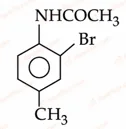
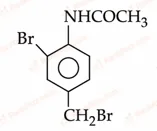
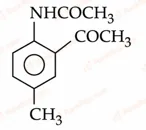
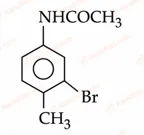
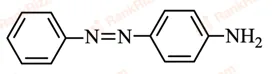
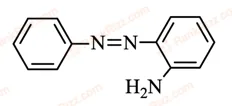
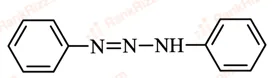
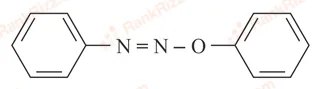
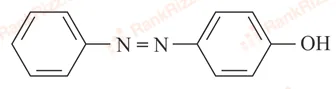
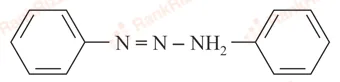
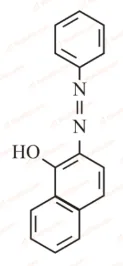
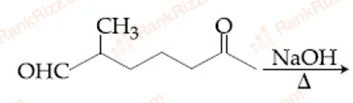
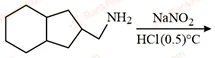
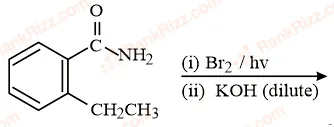
Consider the following reaction:
The product 'X' is used:
- A
in protein estimation as an alternative to ninhydrin
- B
in acid base titration as an indicator
- C
as food grade colourant
- D
in laboratory test for phenols
Diazonium salts has been asked 83 times in JEE Main, in 17 different years between 2008 and 2026, and in all of the last five exam years (2022–2026), 41 questions in all. That is 34% of Amines and Nitrogen-Containing Compounds, its most-asked topic. Last asked in JEE Main 06 Apr 2026, Shift 2. 73 are multiple choice and 10 numerical-value; 11 easy, 65 medium and 4 hard by our difficulty labels. All of them are below, newest first, free to read.
Questions
83
Years asked
17
Since
2008
Of the chapter
34%
61–80 OF 83 · NEWEST FIRST
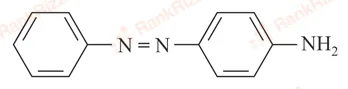
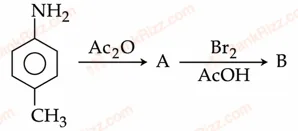
Consider the following reaction:
The product 'X' is used:
in protein estimation as an alternative to ninhydrin
in acid base titration as an indicator
as food grade colourant
in laboratory test for phenols
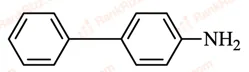
In the following reaction sequence,
the major product B is
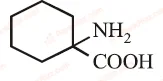


Benzene diazonium chloride on reaction with aniline in the presence of dilute hydrochloric acid gives:


Aniline dissolved in dilute HCl is reacted with sodium nitrite at 0°C. This solution was added dropwise to a solution containing an equimolar mixture of aniline and phenol in dilute HCl. The structure of the major product is:


Hinsberg's reagent is:
CHSOCl
SOCl
(COCl)
CHCOCl
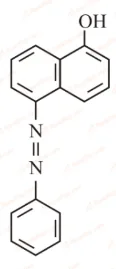
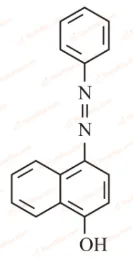
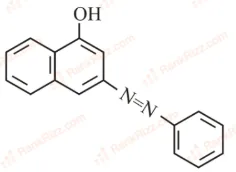
Coupling of benzene diazonium chloride with 1-naphthol in alkaline medium will give:


The major product obtained in the following reaction is:
NaOH,


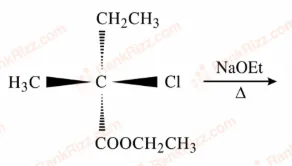
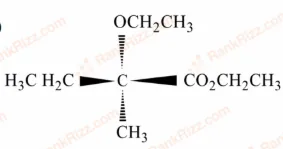
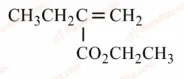
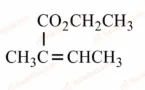
The major product of the following reaction is: (compound with Cl reacting with NaOEt/heat)


The major product formed in the reaction given below will be:


The major product of the following reaction is:


The increasing order of nitration of the following compounds is:
(A) Aniline, (B) Chlorobenzene, (C) Anisole, (D) Toluene
< (B) < (D) < (C)
< (B) < (C) < (D)
< (A) < (C) < (D)
< (A) < (D) < (C)
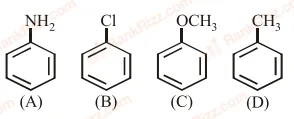
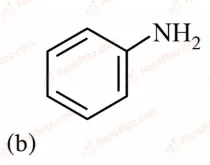
The increasing order of diazotisation of the following compounds is:
(a)


(D) < (C) < (B) < (A)
(A) < (D) < (B) < (C)
(A) < (B) < (C) < (D)
(A) < (D) < (C) < (B)
Among the following compounds, the increasing order of their basic strength is:

(II) < (I) < (III) < (IV)
(II) < (I) < (IV) < (III)
(I) < (II) < (IV) < (III)
(I) < (II) < (III) < (IV)
Fluorination of an aromatic ring is easily accomplished by treating a diazonium salt with . Which of the following conditions is correct about this reaction?
NaF/Cu
Only Heat
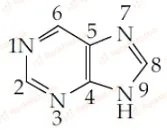
The N which contributes least to the basicity of the compound is:

N-9
N-3
N-1
N-7
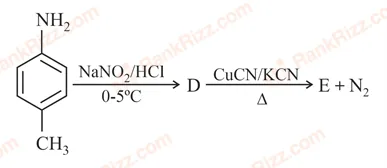
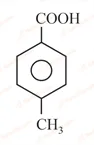
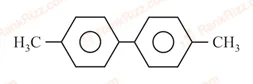
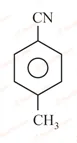
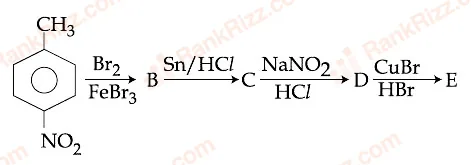
In the reaction,
The product E is


In a set of reactions p-nitrotoluene yielded a product E.
The product E would be:


Conversion of benzene diazonium chloride to chlorobenzene is an example of which of the following reactions?
Claisen
Friedel-craft
Sandmeyer
Wurtz
Complete reduction of benzene-diazonium chloride with Zn/HCl gives:
Aniline
Phenylhydrazine
Azobenzene
Hydrazobenzene
Aryl fluoride may be prepared from arene diazonium chloride using :
, Cu,
CuF/HF
Cu/HF 0
RELATED AMINES AND NITROGEN-CONTAINING COMPOUNDS TOPICS