JEE MAIN 2016 · 03 APR OFFLINE+4 / −1MEDIUM
JEE Main 2016 Chemistry question — Reactions of phenols
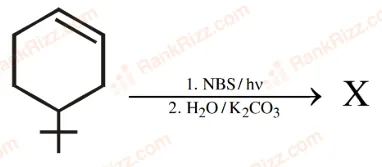
The product of the reaction given below is:
SOLUTION
Key idea: NBS with light brominates at the allylic position through a radical mechanism. Aqueous then replaces Br with OH, giving an allylic alcohol.
- 4-tert-Butylcyclohexene: abstracts an allylic H to give a resonance-stabilised allylic radical, which then takes Br from (supplied in low concentration by NBS). Product: an allylic bromide.
- hydrolyses the allylic bromide (by an / path) to the allylic alcohol.
- X = 5-tert-butylcyclohex-2-en-1-ol. The ring keeps its C=C, with the OH on the carbon next to it and the t-Bu group retained.
(A), the enone, would need an oxidation step. (C), the acid, needs a carbon source. Neither fits.
Answer: (D)
Topic: Reactions of phenols