JEE Main 2021 Chemistry question — Properties and reactions of alcohols
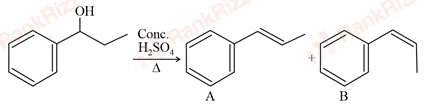
Consider the above reaction, and choose the correct statement:
SOLUTION
Reaction Analysis: Acid-Catalysed Dehydration
The reaction involves a secondary alcohol, , treated with concentrated sulfuric acid and heat.
These conditions favour dehydration through an elimination mechanism.
Step 1: Protonation and Leaving Group Formation
The hydroxyl group gets protonated by the acid, converting it into a better leaving group.
Step 2: Carbocation Formation
The protonated alcohol loses water to form a carbocation intermediate.
The carbocation formed is a benzylic carbocation.
This intermediate is highly stable because the positive charge is delocalised through resonance with the aromatic ring.
Step 3: Elimination (Zaitsev’s Rule)
A weak base such as or removes a beta-hydrogen from the adjacent carbon.
Formation of the double bond gives an alkene conjugated with the benzene ring.
Formation of Products and
The newly formed double bond gives rise to geometrical isomers.
Product (Trans-Isomer):
In this isomer, the phenyl group and methyl group are present on opposite sides of the double bond.
Product (Cis-Isomer):
In this isomer, the phenyl group and methyl group are present on the same side of the double bond.
Conclusion:
The trans-isomer is more stable because bulky groups remain farther apart, reducing steric hindrance.
The cis-isomer experiences greater steric repulsion because the phenyl and methyl groups are on the same side.
Therefore:
while
Correct Statement: