JEE MAIN 2025 · 23 JAN S2+4 / −1MEDIUM
JEE Main 2025 Chemistry question — Reactions of phenols
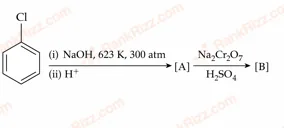
Identify the products [A] and [B], respectively in the following reaction :
SOLUTION
Key idea: The Dow process converts chlorobenzene to phenol. Acidified dichromate then oxidises phenol to p-benzoquinone.
- [A]: NaOH at 623 K and 300 atm replaces Cl by , and acidification then gives phenol:
- [B]: phenol is oxidised by to the conjugated diketone:
- So [A] = phenol and [B] = benzo-1,4-quinone.
Benzene (A, D) would need reduction, not substitution. (C) shows sodium phenoxide as [B], but phenoxide forms in base, not in acidic dichromate.
Answer: (B)
Topic: Reactions of phenols