All 75 questions of JEE Main 05 Apr 2026, Shift 2, in the order they were asked, one subject to a page. Pick an answer on any question to check it against the key. Free to read, nothing to download.
Questions
75
Physics · Chemistry · Maths
Answer key
75
questions with a checked key
Price
Free
no sign-up
Physics
Q1Dimensional analysis: deriving and checking relations
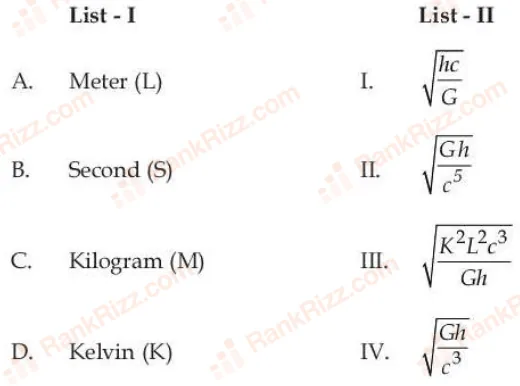
Match the List I With List II:
Where (Plank's constant), G(gravitational constant) and c (speed of light in vacuum) as fundamental units. Choose the correct answer from the options given below:
In an experiment to determine the resistance of a given wire using Ohm’s law, the voltmeter and ammeter readings are noted as 10V and 5A, respectively. The least counts of voltmeter and ammeter are 500mV and 200mA, respectively. The estimated error in the resistance measurement is_______Ω.
A mass of 1 kg is kept on a inclined plane with 30° inclination with respect to horizontal plane and it is at rest initially. Then the whole assembly is moved up with constant velocity of 4 m/s. The work done by the frictional force in time 2 s is ________ J. (Take g = 10 m/s²)
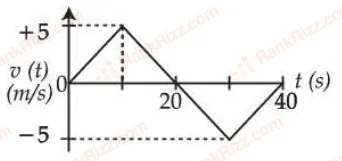
The velocity (v) versus time (t) plot of a particle is shown in the figure, for a time interval of 40 s. The total distance travelled by the particle and the and the average velocity during this period are, respectively___________,
Q5Fixed-axis rotation: kinematics, rotational energy and pulleys
A wheel initially at rest is subjected to a uniform angular acceleration about its axis. In the first 2 s, it rotates through an angle θ1. In the next 2 s, it rotates through an angle θ2. Then the ratio θ1θ2 is :
Q6Rolling with friction, slipping and impulsive forces
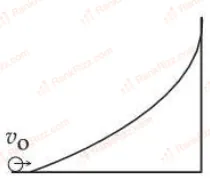
An object of uniform density rolls up a curved path with the initial velocity v∘ as shown in the figure. If the maximum height attained by an object is 10g7v02. (g = acceleration due to gravity), The object is a :
A body of mass m is taken from the surface of the earth to a height equal to twice the radius of earth(Re). The increase in potential energy will be : (g is acceleration due to gravity at the surface of earth)
Eight mercury drops, each of radius r coalesce to form a bigger drop. The surface energy released in this process is_________ . ( S is the surface tension of mercury).
A metal rod of length L rotates about one end at origin with a uniform angular velocity ω. The magnetic field radially falls off as B(r)=B0e−λr. λ being a positive constant. The EMF induced (neglecting the centripetal force on electrons in the rod) is :
Q13Charged particles in combined electric and magnetic fields
A particle of charge q and mass m is projected from origin with an initial velocity has v=2v0x^+2v0y^. There exists a uniform magnetic field B=B0z^ and a space varying electric field E=E0e−λxx^ within the region 0≤x≤L. After travelling a distance such that x-coordinate has changed from x=0 to x=L, the change in the kinetic energy is_________.
Q14Properties of EM waves: fields, energy, intensity and momentum
Given below are two statements: One is labelled as Assertion (A) and the other is labelled as Reason (R).
Assertion (A): The Electromagnetic waves exert pressure on the surface on which they ar allowed to fall.
Reason (R): There is no mass associated with the electromagnetic waves.
In the light of the above statements, Choose the correct answer from the options given below :
A
Both A and R are true and R is the correct explanation of A
B
Both A and R are true but R is not the correct explanation of A
Q15Thin lenses: lens formula, lens maker's formula and power
A thin convex lens and a thin concave lens are kept in contact and are co-axial. Which of the following statements is correct for this combination of two lenses ?
A
behaves as concave lens if ∣fconvex∣>∣fconcave∣
B
behaves as concave if ∣fconvex∣<∣fconcave∣
C
behaves as convex if ∣fconvex∣>∣fconcave∣
D
The focal length of the lens system will changes if the positions of two lenses are interchanged
Q16Thin lenses: lens formula, lens maker's formula and power
An object AB is placed 15 cm to the left of a convex lens P of focal length 10cm. Another convex lens Q is now placed 15cm right of lens P . If the focal length of lens Q is 15 cm, final image is______.
A
virtual, formed at 7.5 cm right of lens Q, with a size bigger than that of AB
B
real, formed at 7.5 cm right of lens Q, with a size same as that of AB
C
formed at infinity
D
real, formed at 7 cm right of lens Q, with a size smaller than that of AB
Q17Young's double slit experiment: fringe width and intensity
The maximum intensity in a Young's double slit experiment is I0, distance between the slits (d) is 5λ, where λ is the wavelength of light used. The intensity of the fringe, exactly opposite to one of the slits on the screen, placed at D=10d is_________.
An electron is travelling with a velocity v in free space and when it enters a medium, its velocity is reduced by 20%. The de Broglie wavelength of electron in the medium is αλ0.where λ0 is its de Broglie wavelength in free space. The value of α is :
Assuming the experimental mass of 612C as 12 u, The mass defect of 12C atom is (in MeV/c2) :
(Mass of proton = 1.00727 u, mass of neutron = 1.00866 u, 1 u = 931.5MeV/c2 and c is the speed of the light in vacuum).
In a semiconductor p-n diode, the doping concentrations on p-side has 1015 atoms/cm³ and the n-side has 1018 atoms/cm³respectively. Which one of the following statements is true?
A
Widths of depletion region on either side of the interface are equal
B
The depletion region widths is more on p-side compared to that in n-side
C
The depletion region width is more on n-side compared to that the p-side
D
No depletion region forms because of unequal doping concentrations on p and n-sides
A copper wire of length 3 m is stretched by 3 mm by applying an external force. The volume of the wire is 600×10−6 m³. The elastic potential energy stored in the wire in stretched condition would be _______ J : (Given Young's modulus of copper =1.1×10¹¹ N/m²)
The heat extracted out of x gram of water initialy at 50°C to cool it down to 0°C is sufficient to evaporate (1000−x) gram of water also initialy at 50°C. The value of x (closest integer) is_______. (Take Latent heat of water L=2256 kJ/kg K, specific heat capacity of water c=4200 J/kg·K)
In a series LCR circuit with , R=20Ω, L=1.6 H, C=40μF is connected to a variable frequency a.c. source. The inductive reactance at resonant frequency is ____________ Ω.
Q24Cells: emf, internal resistance and combinations
When an external resistance of 5Ω is connected across terminals of a cell, a current of 0.25 A flow through it. When the 5Ω resistor is replaced by a 2Ω resistor, a current of 0.5 A flow through it. The internal resistance of the cell is________ Ω.
A circular loop of radius r=20 cm and resistance R=2Ω is placed in a time varying magnetic field B=(2t2+2t+3) T. At t=0, for the plane of the loop being perpendicular to the magnetic field and, The induced current in the loop at t=3 s is 50α A. The value of α is__________. (Take π=22/7)