RankRizz

JEE Main 21 Jan 2026, Shift 1 Question Paper

All 75 questions of JEE Main 21 Jan 2026, Shift 1, in the order they were asked, one subject to a page. Pick an answer on any question to check it against the key. Free to read, nothing to download.

Questions

75

Physics · Chemistry · Maths

Answer key

74

questions with a checked key

Price

Free

no sign-up

Physics

Q1Progressive waves: wave equation, phase and intensity

Two strings (A, B) having linear densities μA=2×10⁻⁴kg/m and ,μB=4×10⁻⁴kg/m\mu_{A}=2\times10^{-4}kg/m\text{ and },\mu_{B}=4\times10^{-4}kg/m and lengths LA=2.5mL_{A}=2.5m and LB=1.5mL_{B}=1.5m respectively are joined. Free ends of A and B are tied to two rigid supports C and D, respectively creating a tension of 500 N in the wire. Two identical pulses, sent from C and D ends, take time t1 and t2t_{1}\text{ and } t_{2}, respectively, to reach the joint. The ratio t1/t2t_{1}/ t_{2} is :

  1. A

    1.08

  2. B

    1.90

  3. C

    1.67

  4. D

    1.18

Q2Calorimetry and specific heat capacity

A gas based geyser heats water flowing at the rate of 5.0 litres per minute from 27°C to 87°C. The rate of consumption of the gas is ___ g/s. (take heat of combustion of gas=5.0×10⁴J/ggas=5.0\times10^{4}J/g) specific heat capacity of water =4200 J/ kg.°C

  1. A

    0.42

  2. B

    0.21

  3. C

    2.1

  4. D

    4.2

Q3Motional emf in moving rods and loops

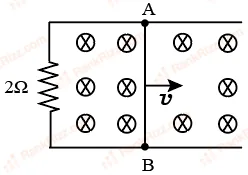
A 1 m long metal rod AB completes the circuit as shown in figure. The area of circuit is perpendicular to the magnetic field of 0.10 T. lf the resistance of the total circuit is 2Ω then the force needed to move the rod towards right with constant speed (v) of 1.5 m/s is ___ N

Screenshot_1
  1. A

    5.7×10−35.7\times10^{-3}

  2. B

    7.5×10−37.5\times10^{-3}

  3. C

    7.5×10−27.5\times10^{-2}

  4. D

    5.7×10−25.7\times10^{-2}

Q4Dimensional analysis: deriving and checking relations

Consider a modified Bernoulli equation.
(P+ABt2)+ρg(h+Bt)+12 ρV2=constant\left( P + \frac{A}{B t^2} \right) + \rho g (h + B t) + \frac{1}{2}\,\rho V^2 = \text{constant}
If t has tile dimension of time then the dimensions of A and B are ___.___ respectively.

  1. A

    [ML0T−1] and [M0LT][ML^{0}T^{-1}]\text{ and }[M^{0}LT]

  2. B

    [ML0T−2] and [M0LT−2][ML^{0}T^{-2}]\text{ and }[M^{0}LT^{-2}]

  3. C

    [ML0T−2] and [M0LT−1][ML^{0}T^{-2}]\text{ and }[M^{0}LT^{-1}]

  4. D

    [ML0T−1] and [M0LT−1][ML^{0}T^{-1}]\text{ and }[M^{0}LT^{-1}]

Q5Young's double slit experiment: fringe width and intensity

In a double slit experiment the distance between the slits is 0.1 cm and the screen is placed at 50 cm from the slits plane. When one slit is covered with a transparent sheet having thickness t and refractive index n(=1.5), the central fringe shifts by 0.2 cm. The value of t is____ cm

  1. A

    5.6×10−45.6\times10^{-4}

  2. B

    6.0×10−36.0\times10^{-3}

  3. C

    8×10−48\times10^{-4}

  4. D

    5.0×10−35.0\times10^{-3}

Q6Motion of charged particles in a magnetic field

A current carrying solenoid is placed vertically and a particle of mass m with charge Q is released from rest. The particle moves along the axis of solenoid. lf g is acceleration due to gravity then the acceleration (n) of the charged particle will satisfy :

  1. A

    a>ga > g

  2. B

    0<n<g0 < n < g

  3. C

    a=0

  4. D

    a=g

Q7Fixed-axis rotation: kinematics, rotational energy and pulleys

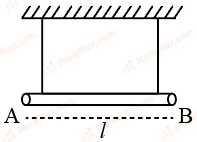
A uniform rod of mass mm and length ll is suspended by means of two identical inextensible light strings as shown in the figure. Tension in one of the strings, immediately after the other string is cut, is ____ . (g is the acceleration due to gravity)

Screenshot_2
  1. A

    mg3\frac{mg}{3}

  2. B

    mg4\frac{mg}{4}

  3. C

    mg

  4. D

    mg2\frac{mg}{2}

Q8Capacitors with dielectrics

A parallel plate capacitor has capacitance C, when there is vacuum within the parallel plates. A sheet having thickness (13)rd\left(\frac{1}{3}\right)^{rd} of the separation between the plates and relative permittivity K is introduced between the plates. The new capacitance of the system is:

  1. A

    CK2+K\frac{CK}{2+K}

  2. B

    3CK2(2K+1)2\frac{3CK^{2}}{(2K+1)^{2}}

  3. C

    4KC(3K−1)\frac{4KC}{(3K-1)}

  4. D

    3KC(2K+1)\frac{3KC}{(2K+1)}

Q9Logic gates and digital circuits

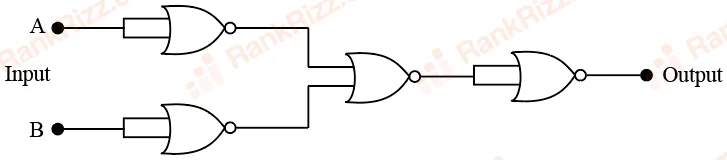
The given circuit works as:

Screenshot_3
  1. A

    OR gate

  2. B

    NOR gate

  3. C

    NAND gate

  4. D

    AND gate

Q10Temperature scales and thermal expansion

An aluminium and steel rods having same lengths and cross-sections are joined to make total length of 120 cm at 30°C. The coefficient of linear expansion of aluminium and steel are 24×10−6/∘C and 1.2×10⁻⁵/∘C24\times10^{-6}/^{\circ}C\text{ and }1.2\times10^{-5}/^{\circ}C, respectively. The length of this composite rod when its temperature is raised to 100∘100^\circ C, is ___ cm.

  1. A

    120.06

  2. B

    120.20

  3. C

    120.15

  4. D

    120.03

Q11Potential energy, conservative forces and energy curves

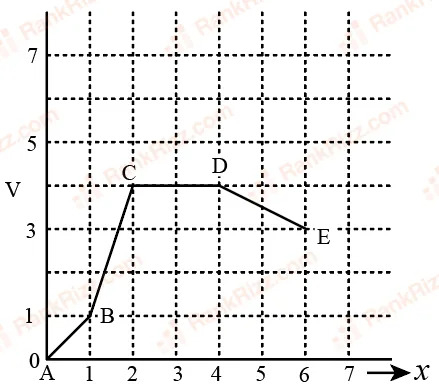
Potential energy (V) versus distance (x) is given by the graph. Rank various regions as per the magnitudes of the force (F) acting on a particle from high lo low.

Screenshot_4
  1. A

    FCD>FDE>FAB>FBCF_{CD} > F_{DE} > F_{AB} > F_{BC}

  2. B

    FCD>FAB>FBC>FDEF_{CD} > F_{AB} > F_{BC} > F_{DE}

  3. C

    FBC>FCD>FDE>FABF_{BC} > F_{CD} > F_{DE} > F_{AB}

  4. D

    FBC>FAB>FDE>FCDF_{BC} > F_{AB} > F_{DE} > F_{CD}

Q12Newton's laws, free-body diagrams and equilibrium of a particle

A 4 kg mass moves under the influence of a force F→=(4t3i^−3tj^)N\overrightarrow{F}=\left(4t^{3}\widehat{i}-3t\widehat{j}\right)N where t is the time in second. If mass starts from origin at t= 0, the velocity and position after t= 2 s will be:

  1. A

    v→=4i^−32j^ r→=85i^−j^\overrightarrow{v}=4\widehat{i}-\frac{3}{2}\widehat{j}\text{ } \overrightarrow{r}=\frac{8}{5}\widehat{i}-\widehat{j}

  2. B

    v→=4i^−52j^ r→=85i^−2j^\overrightarrow{v}=4\widehat{i}-\frac{5}{2}\widehat{j}\text{ } \overrightarrow{r}=\frac{8}{5}\widehat{i}-2\widehat{j}

  3. C

    v→=3i^+32j^ r→=65i^+j^\overrightarrow{v}=3\widehat{i}+\frac{3}{2}\widehat{j}\text{ } \overrightarrow{r}=\frac{6}{5}\widehat{i}+\widehat{j}

  4. D

    v→=4i^−32j^ r→=65i^−j^\overrightarrow{v}=4\widehat{i}-\frac{3}{2}\widehat{j}\text{ } \overrightarrow{r}=\frac{6}{5}\widehat{i}-\widehat{j}

Q13Properties of EM waves: fields, energy, intensity and momentum

The electric field in a plan a electromagnetic wave is given by :
Ey=69sin⁡[0.6×10³x−1.8×10¹¹t]V/mE_{y}=69\sin[0.6\times10^{3}x-1.8\times10^{11}t]V/m
The expression for magneticfield associated with this electromagnetic wave is ___ T.

  1. A

    By=69sin⁡[0.6×10³x+1.8×10¹¹t]B_{y}=69\sin[0.6\times10^{3}x+1.8\times10^{11}t]

  2. B

    By=2.3×10⁻⁷sin⁡[0.6×10³x−1.8×10¹¹t]B_{y}=2.3\times10^{-7}\sin[0.6\times10^{3}x-1.8\times10^{11}t]

  3. C

    Bz=2.3×10⁻⁷sin⁡[0.6×10³x+1.8×10¹¹t]B_{z}=2.3\times10^{-7}\sin[0.6\times10^{3}x+1.8\times10^{11}t]

  4. D

    Bz=2.3×10⁻⁷sin⁡[0.6×10³x−1.8×10¹¹t]B_{z}=2.3\times10^{-7}\sin[0.6\times10^{3}x-1.8\times10^{11}t]

Q14Photoelectric effect and Einstein's equation

A light wave described by E=60[sin⁡(3×10¹⁵)t+sin⁡(12×1015)t]E=60[\sin(3\times10^{15})t+\sin(12\times10^{15})t] (in SI units) falls on a metal surface of work function 2.8 eV. The maximum kinetic energy of ejected photoelectron is (approximately) ___ eV. (h=6.6×10⁻³⁴J.s and e=1.6×10¹⁹C)(h=6.6\times10^{-34}J.s\text{ and }e=1.6\times10^{19}C)

  1. A

    7.8

  2. B

    6.0

  3. C

    3.8

  4. D

    5.1

Q15Speed of efflux and applications of Bernoulli's theorem

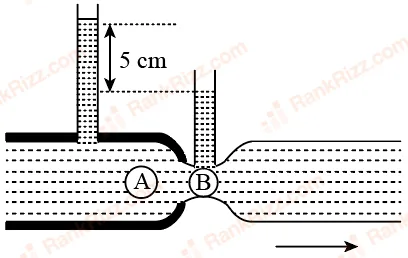
Water flows through a horizontal tube as shown in the figure. The difference in height between the water colunms in vertical tubes is 5 cm and the area of cross-sections at A and B are 6cm26cm^{2} and 3cm23cm^{2} respectively. The rate of flow will be ____ cm3/scm^{3/s}. (takeg=10m/s2)(take g=10m/s^{2})

Screenshot_5
  1. A

    2003200\sqrt{3}

  2. B

    1003100\sqrt{3}

  3. C

    2003\frac{200}{\sqrt{3}}

  4. D

    2006200\sqrt{6}

Q16Relation between field and potential, equipotential surfaces

A point charge of 10−810^{-8} is placed at origin. The work done in moving a point charge 2μC2 \mu C from point A(4, 4, 2) m to B(2, 2, 1) m is _____J (14πϵ0=9×10⁹in SI units)\left(\frac{1}{4\pi\epsilon _{0}}=9\times10^{9} \text{in SI units}\right)

  1. A

    15×10−615\times10^{-6}

  2. B

    30×10−630\times10^{-6}

  3. C

    0

  4. D

    45×10−645\times10^{-6}

Q17Magnetic flux, Faraday's law and Lenz's law

A conducting circular loop of area 1.0m21.0m^{2} is placed perpendicular to a magnetic field which varies as B=sin⁡(100t)B = \sin(100 t) Tesla. If the resistance of the loop is 100Ω100 \Omega, then the average thermal energy dissipated in the loop in one period is _______J.

  1. A

    π2\frac{\pi}{2}

  2. B

    2π\pi

  3. C

    π\pi

  4. D

    π2\pi^{2}

Q18Errors in measurement and significant figures

In an experiment the values of two spring constants were measured as k1=(10±0.2)N/m and k2=(20±0.3)N/mk_{1}=(10\pm0.2)N/m\text{ and }k_{2}=(20\pm0.3)N/m. lf these springs are connected in parallel, then the percentage error in equivalent spring constant is :

  1. A

    1.67%

  2. B

    1.33%

  3. C

    2.33%

  4. D

    2.67%

Q19Alpha-particle scattering and Rutherford model

If an alpha particle with energy 7.7 MeV is bombarded on a thin gold foil, the closest distance from nucleus it can reach is ___ m. (Atomic number of gold = 79 and 14πϵ0=9×10⁹in SI units)\frac{1}{4\pi\epsilon _{0}}=9\times10^{9} \text{in SI units} )

  1. A

    2.95×10−142.95\times10^{-14}

  2. B

    3.85×10−163.85\times10^{-16}

  3. C

    3.85×10−143.85\times10^{-14}

  4. D

    2.95×10−162.95\times10^{-16}

Q20Escape speed

Initially a satellite of 100 kg is in a circular orbit of radius 1.5RE1.5R_{E} This satellite can be moved to a circular orbit of radius 3RE3R_{E} by supplying α×106J\alpha\times10^{6}J of energy The value of α\alpha is ____. (Take Radius of Earth RE=6×10⁶m and g=10m/s2R_{E}=6\times10^{6}m\text{ and }g=10m/s^{2})

  1. A

    150

  2. B

    1000

  3. C

    100

  4. D

    500

Q21Moment of inertia of standard bodies and composite systems

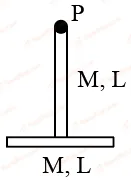
Two identical thin rods of mass M kg and length L m are connected as shown in the figure below. Moment of inertia of the combined rod system about an axis passing through point P and perpendicular to the plane of the rods is x12ML2kg m2\frac{x}{12}ML^{2}\text{kg m}^{2}. The value of x is ____ .

Screenshot_6
Q22Molar specific heats of gases, Mayer's relation and gas mixtures

10 mole of oxygen is heated at constant volume from 30∘C to 40∘C30^{\circ}C  \text{to}  40^{\circ}C. The change in the internal energy of the gas is ____ cal (the molecular specific heat of oxygen at constant pressure, Cp=7cal/mol.∘CandR=2cal./mol.∘C).C_{p}= 7 \text{cal}/\text{mol}.^{\circ}C \text{and} R = 2 \text{cal}./\text{mol}.^{\circ}C).

Q23Thin lenses: lens formula, lens maker's formula and power

A collimated beam of light of diameter 2 mm is propagating along x-axis. The beam is required to be expanded in a collimated beam of diameter 14 mm using a system of two convex lenses. lf first lens has focal length 40 mm, then the focal length of second lens is ____ mm.

Q24Electric power and heating effect of current

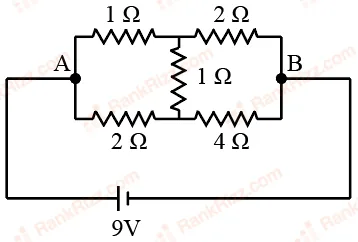
The heat generated in 1 minute between points A and B in the given circuit, when a battery of 9 V with internal resistance of 1Ω is connected across these points is ____ J

Screenshot_7
Q25Optical instruments: microscopes and telescopes

In a microscope the objective is having focal length f0=2cmf_{0}=2 \text{cm} and eye-piece is having focal length fe=4cmf_{e} = 4 \text{cm} The tube length is 32 cm. the magnification produced by this microscope for normal adjustment is _______.

NEXT IN THIS PAPER →Chemistry, Q26 onwards