RankRizz

JEE Main 28 Jan 2025, Shift 2 Question Paper

All 75 questions of JEE Main 28 Jan 2025, Shift 2, in the order they were asked, one subject to a page. Pick an answer on any question to check it against the key. Free to read, nothing to download.

Questions

75

Physics · Chemistry · Maths

Answer key

73

questions with a checked key

Price

Free

no sign-up

Physics

Q1Bar magnet as a magnetic dipole
page3_img1


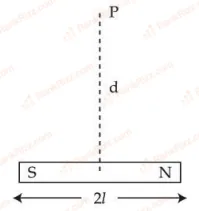
A bar magnet has total length 2l=202l = 20 units and the field point PP is at a distance d = 10 units from the centre of the magnet. If the relative uncertainty of length measurement is 1%, then uncertainty of the magnetic field at point P is :

  1. A

    4%

  2. B

    15%

  3. C

    5%

  4. D

    10%

Q2Spherical mirrors: mirror formula and magnification

A concave mirror produces an image of an object such that the distance between the object and image is 20 cm . If the magnification of the image is ' -3 ', then the magnitude of the radius of curvature of the mirror is :

  1. A

    30 cm

  2. B

    3.75 cm

  3. C

    15 cm

  4. D

    7.5 cm

Q3Motion graphs: x-t, v-t and a-t

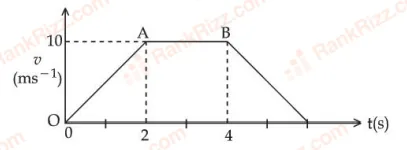
The velocity-time graph of an object moving along a straight line is shown in the figure. What is the distance covered by the object between t = 0 to t = 4 s ?

page4_img1
  1. A

    30 m

  2. B

    11 m

  3. C

    10 m

  4. D

    13 m

Q4Power

A body of mass 4 kg is placed on a plane at a point P having coordinate (3,4)m. Under the action of force F→=(2i^+3j^)N\overrightarrow{F} = (2\hat{i}+3\hat{j})N, it moves to a new point Q having coordinates (6,10)m in 4 sec . The average power and instanteous power at the end of 4 sec are in the ratio of :

  1. A

    13 : 6

  2. B

    4 : 3

  3. C

    1 : 2

  4. D

    6 : 13

Q5Dimensional formulae of physical quantities

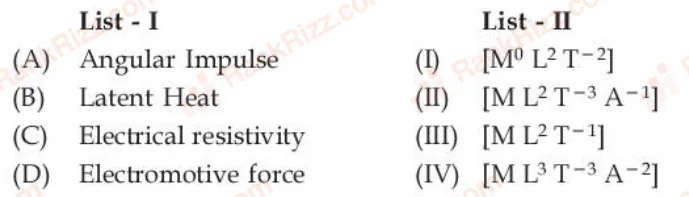
Match List - I with List - II.

page4_img2
  1. A

    (A)-(II), (B)-(I), (C)-(IV), (D)-(III)

  2. B

    (A)-(I), (B)-(III), (C)-(IV), (D)-(II)

  3. C

    (A)-(III), (B)-(I), (C)-(II), (D)-(IV)

  4. D

    (A)-(III), (B)-(I), (C)-(IV), (D)-(II)

Q6Motional emf in moving rods and loops

A uniform magnetic field of 0.4 T acts perpendicular to a circular copper disc 20 cm in radius. The disc is having a uniform angular velocity of 10πrads−110\pi rads^{-1} about an axis through its centre and perpendicular to the disc. What is the potential difference developed between the axis of the disc and the rim ? (π=3.14)(\pi = 3.14)

  1. A

    0.5024 V

  2. B

    V

  3. C

    0.2512V V

  4. D

    0.1256V V

Q7Biot-Savart law: straight wires and moving charges
page4_img3


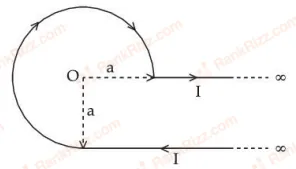
An infinite wire has a circular bend of radius a, and carrying a current I as shown in figure. The magnitude of magnetic field at the origin O of the arc is given by :

  1. A

    μ0I4πa[π2+1]\dfrac{\mu_0 I}{4\pi a}\left[\dfrac{\pi}{2}+1\right]

  2. B

    μ0I4πa[3π2+2]\dfrac{\mu_0 I}{4\pi a}\left[\dfrac{3\pi}{2}+2\right]

  3. C

    μ0I2πa[π2+2]\dfrac{\mu_0 I}{2\pi a}\left[\dfrac{\pi}{2}+2\right]

  4. D

    μ0I4πa[3π2+1]\dfrac{\mu_0 I}{4\pi a}\left[\dfrac{3\pi}{2}+1\right]

Q8Refraction at plane surfaces, Snell's law and apparent depth

In a long glass tube, mixture of two liquids A and B with refractive indices 1.3 and 1.4 respectively, forms a convex refractive meniscus towards . If an object placed at 13 cm from the vertex of the meniscus in A forms an image with a magnification of '-2' then the radius of curvature of meniscus is :

  1. A

    13\frac{1}{3}cm

  2. B

    43\frac{4}{3}cm

  3. C

    1 cm

  4. D

    23\frac{2}{3}cm

Q9Archimedes' principle and floatation

A 400 g solid cube having an edge of length 10 cm floats in water. How much volume of the cube is outside the water ? (Given : density of water =1000kgm−3= 1000 kg m^{-3})

  1. A

    1400 cm3cm^{3}

  2. B

    600 cm3cm^{3}

  3. C

    4000 cm3cm^{3}

  4. D

    400 cm3cm^{3}

Q10Energy in simple harmonic motion

Given below are two statements. One is labelled as Assertion (A) and the other is labelled as Reason (R). Assertion (A) : Knowing initial position x∘x_{\circ} and initial momentum p∘p_{\circ} is enough to determine the position and momentum at any time tt for a simple harmonic motion with a given angular frequency ω\omega. Reason (R): The amplitude and phase can be expressed in terms of x∘x_{\circ} and p∘p_{\circ}. In the light of the above statements, choose the correct answer from the options given below :

  1. A

    (A) is false but (R) is true

  2. B

    (A) is true but (R) is false

  3. C

    Both (A) and (R) are true but (R) is NOT the correct explanation of (A)

  4. D

    Both (A) and (R) are true and (R) is the correct explanation of (A)

Q11Equilibrium of rigid bodies and toppling

A uniform rod of mass 250 g having length 100 cm is balanced on a sharp edge at 40 cm mark. A mass of 400 g is suspended at 10 cm mark. To maintain the balance of the rod, the mass to be suspended at 90 cm mark, is

  1. A

    190 g

  2. B

    200 g

  3. C

    300 g

  4. D

    290 g

Q12Escape speed

Earth has mass 8 times and radius 2 times that of a planet. If the escape velocity from the earth is 11.2 km/s. the escape velocity in km/s from the planet will be :

  1. A

    2.8

  2. B

    11.2

  3. C

    5.6

  4. D

    8.4

Q13Properties of EM waves: fields, energy, intensity and momentum

The magnetic field of an E.M. wave is given by B⃗=(32 i^+12 j^)30sin⁡[ω(t−zc)]  (S.I. Units).\vec{B} = \left(\frac{\sqrt{3}}{2}\,\hat{i} + \frac{1}{2}\,\hat{j}\right) 30 \sin\left[\omega \left(t - \frac{z}{c}\right)\right] \; \text{(S.I. Units)}. corresponding electric field in S.I. units is :

  1. A

    E⃗=(12i^−32j^)30csin⁡ ⁣[ω(t−zc)]\vec{E} = \left(\frac{1}{2}\hat{i} - \frac{\sqrt{3}}{2}\hat{j}\right) 30c \sin\!\left[\omega\left(t - \frac{z}{c}\right)\right]

  2. B

    E⃗=(34i^+14j^)30ccos⁡ ⁣[ω(t−zc)]\vec{E} = \left(\frac{3}{4}\hat{i} + \frac{1}{4}\hat{j}\right) 30c \cos\!\left[\omega\left(t - \frac{z}{c}\right)\right]

  3. C

    E⃗=(12i^+32j^)30csin⁡ ⁣[ω(t+zc)]\vec{E} = \left(\frac{1}{2}\hat{i} + \frac{\sqrt{3}}{2}\hat{j}\right) 30c \sin\!\left[\omega\left(t + \frac{z}{c}\right)\right]

  4. D

    E⃗=(32i^−12j^)30csin⁡ ⁣[ω(t+zc)]\vec{E} = \left(\frac{\sqrt{3}}{2}\hat{i} - \frac{1}{2}\hat{j}\right) 30c \sin\!\left[\omega\left(t + \frac{z}{c}\right)\right]

Q14Kinetic interpretation of pressure and temperature

The kinetic energy of translation of the molecules in 50 g of CO2CO_{2} gas at 17∘C17^{\circ}C is

  1. A

    4205.5 J

  2. B

    4102.8 J

  3. C

    3582.7 J

  4. D

    3986.3 J

Q15Photons: energy, momentum and radiation pressure

Which of the following phenomena can not be explained by wave theory of light?

  1. A

    Compton effect

  2. B

    Refraction of light

  3. C

    Reflection of light

  4. D

    Diffraction of light

Q16Newton's laws, free-body diagrams and equilibrium of a particle

A balloon and its content having mass MM is moving up with an acceleration 'a'. The mass that must be released from the content so that the balloon starts moving up with an acceleration '3a' will be (Take ' g ' as acceleration due to gravity)

  1. A

    2Ma3a+g\frac{2Ma}{3a + g}

  2. B

    3Ma2a−g\frac{3Ma}{2a - g}

  3. C

    3Ma2a+g\frac{3Ma}{2a + g}

  4. D

    2Ma3a−g\frac{2Ma}{3a - g}

Q17RMS, average and most probable speeds of gas molecules

The ratio of vapour densities of two gases at the same temperature is 425\frac{4}{25}, then the ratio of r.m.s. velocities will be :

  1. A

    254\frac{25}{4}

  2. B

    25\frac{2}{5}

  3. C

    52\frac{5}{2}

  4. D

    425\frac{4}{25}

Q18Energy stored, force between plates and charge sharing

A parallel plate capacitor of capacitance 1μF1\mu F is charged to a potential difference of 20V. The distance between plates is 1μm1\mu m. The energy density between plates of capacitor is.

  1. A

    2×10⁻⁴ J/m32 \times 10^{-4}\ \text{J/m}^3

  2. B

    1.8×10⁵ J/m31.8 \times 10^{5}\ \text{J/m}^3

  3. C

    1.8×10³ J/m31.8 \times 10^{3}\ \text{J/m}^3

  4. D

    2×10² J/m32 \times 10^{2}\ \text{J/m}^3

Q19Hydrogen spectrum and spectral series

The frequency of revolution of the electron in Bohr's orbit varies with , the principal quantum number as

  1. A

    1n4\frac{1}{n^4}

  2. B

    1n2\frac{1}{n^2}

  3. C

    1n\frac{1}{n}

  4. D

    1n3\frac{1}{n^3}

Q20p-n junction diode and its characteristics
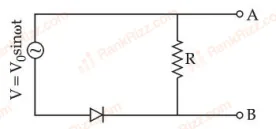
page6_img1


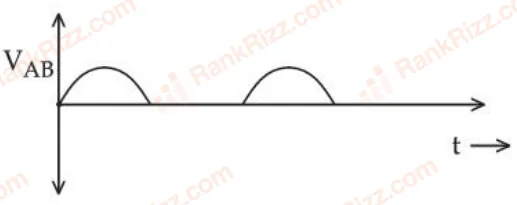
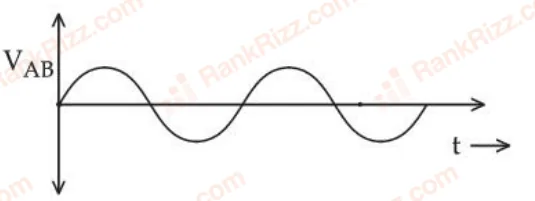
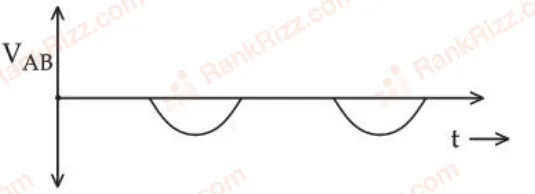
In the circuit shown here, assuming threshold voltage of diode is negligibly small, then voltage VABV_{AB} is correctly represented by :

  1. A

    VABV_{AB} would be zero at all times

  2. B
    page6_img2
  3. C
    page6_img3
  4. D
    page6_img4
Q21Young's double slit experiment: fringe width and intensity

A thin transparent film with refractive index 1.4 , is held on circular ring of radius 1.8 cm . The fluid in the film evaporates such that transmission through the film at wavelength 560 nm goes to a minimum every 12 seconds. Assuming that the film is flat on its two sides, the rate of evaporation is ____π×10−13m3/s\pi \times 10^{-13}m^{3}/s.

Q22Wheatstone bridge

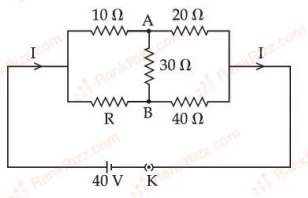
The value of current I in the electrical circuit as given below, when potential at A is equal to the potential at B, will be ____ A.

page7_img1
Q23Electric dipole and dipole in external field

An electric dipole of dipole moment 6×10⁻⁶Cm6 \times 10^{-6}Cm is placed in uniform electric field of magnitude 106V/m10^{6}V/m. Initially, the dipole moment is parallel to electric field. The work that needs to be done on the dipole to make its dipole moment opposite to the field, will be ____ J.

Q24Motional emf in moving rods and loops
page7_img2


A conducting bar moves on two conducting rails as shown in the figure. A constant magnetic field B exists into the page. The bar starts to move from the vertex at time t=0t = 0 with a constant velocity. If the induced EMF is E∝tnE \propto t^n. then value of n is _.

Q25Bulk modulus and compressibility

The volume contraction of a solid copper cube of edge length 10 cm , when subjected to a hydraulic pressure of 7×10⁶Pa7 \times 10^{6}Pa, would be ____ mm3mm^{3}. (Given bulk modulus of copper =1.4×10¹¹Nm−2= 1.4 \times 10^{11} Nm^{-2})

NEXT IN THIS PAPER →Chemistry, Q26 onwards