Q1Temperature scales and thermal expansion
Which of the following figure represents the relation between Celsius and Fahrenheit temperatures?
- A
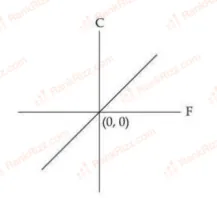
- B
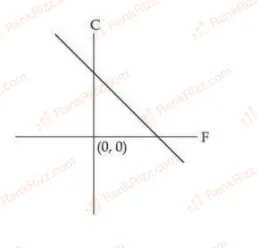
- C
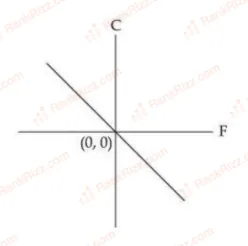
- D
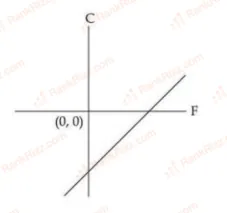
All 75 questions of JEE Main 24 Jan 2025, Shift 2, in the order they were asked, one subject to a page. Pick an answer on any question to check it against the key. Free to read, nothing to download.
Questions
75
Physics · Chemistry · Maths
Answer key
75
questions with a checked key
Price
Free
no sign-up
Which of the following figure represents the relation between Celsius and Fahrenheit temperatures?
The position vector of a moving body at any instant of time is given as The magnitude and direction of velocity at is:
, m/s, making an angle of with -ve -axis
, m/s, making an angle of with +ve -axis
, m/s, making an angle of with +ve -axis
, m/s, making an angle of with -ve -axis
The output of the circuit is low (zero) for:

Choose the correct answer from the options given below:
(B), (C) and (D) only
(A), (B) and (C) only
(A), (C) and (D) only
(A), (B) and (D) only
Young's double slit inteference apparatus is immersed in a liquid of refractive index 1.44. It has slit separation of 1.5 mm . The slits are illuminated by a parallel beam of light whose wavelength in air is 690 nm . The fringe-width on a screen placed behind the plane of slits at a distance of 0.72 m , will be :
0.23 mm
0.33 mm
0.63 mm
0.46 mm
The magnitude of heat exchanged by a system for the given cyclic process ABCA (as shown in figure) is (in SI unit) :
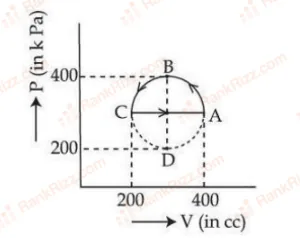
zero
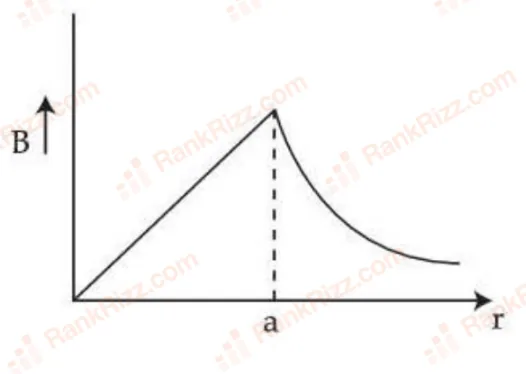
A long straight wire of a circular cross-section with radius '' carries a steady current . The current is uniformly distributed across this cross-section. The plot of magnitude of magnetic field B with distance from the centre of the wire is given by
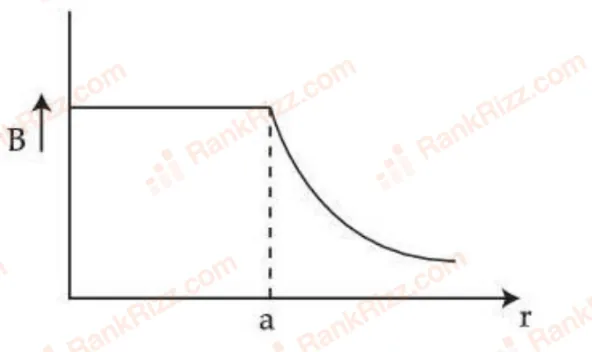
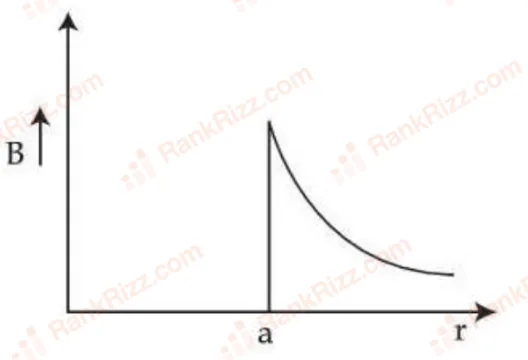
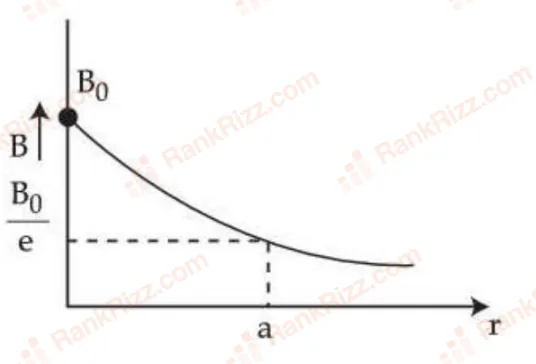
In photoelectric effect, the stopping potential frequency curve is plotted. ( is Planck's constant and is work function of the metal) is linear. } The slope of } v/s line.(D) The value of electric charge of electron is not required to determine using the v/s curve. The work function can be estimated without knowing the value of h.Choose the correct answer from the options given below:
(C) and (D) only
(A), (C) and (E) only
(A), (B) and (C) only
(D) and (E) only
A solid sphere and a hollow sphere of the same mass and of same radius are rolled on an inclined plane. Let the time taken to reach the bottom by the solid sphere and the hollow sphere be , respectively, then
,
,
,
,
A small uncharged conducting sphere is placed in contact with an identical sphere but having charge and then removed to a distance such that the force of repulsion between them is . The distance between them is
3 cm
2 cm
4 cm
1 cm
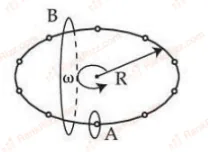
N equally spaced charges each of value q , are placed on a circle of radius R . The circle rotates about its axis with an angular velocity as shown in the figure. A bigger Amperian loop B encloses the whole circle where as a smaller Amperian loop A encloses a small segment. The difference between enclosed currents, , for the given Amperian loops is
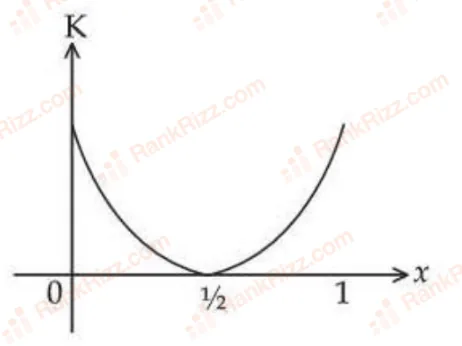
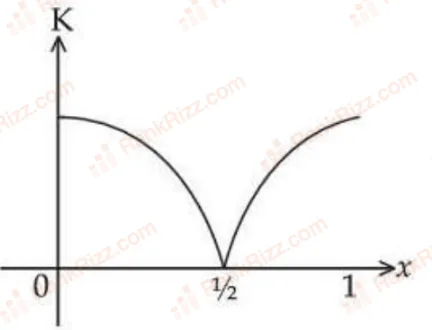
A particle oscillates along the -axis according to the law, where . The kinetic energy of the particle as a function of is correctly represented by the graph
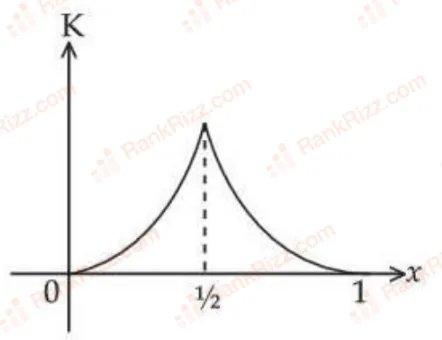
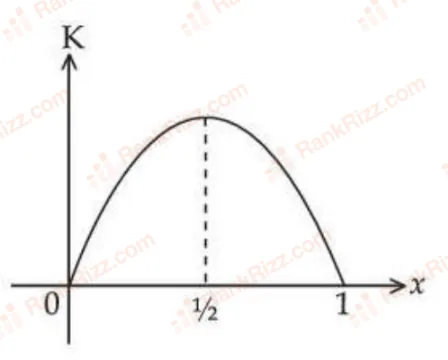
A photograph of a landscape is captured by a drone camera at a height of 18 km . The size of the camera film is and the area of the landscape photographed is . The focal length of the lens in the drone camera is :
1.8 cm
0.9 cm
2.8 cm
2.5 cm
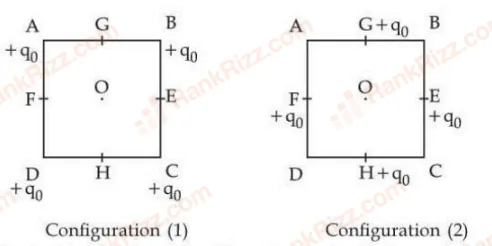
Work done in rearranging the four charges from configuration (1) to configuration (2) is
Arrange the following in the ascending order of wavelength : (A) Microwaves (B) Ultraviolet rays (C) Infrared rays (D) X-rays Choose the most appropriate answer from the options given below
The energy and momentum of a moving body of mass are related by some equation. Given that c represents the speed of light, identify the correct equation
The temperature of a body in air falls from to in 4 minutes. The temperature of the air is . The temperature of the body in the next 4 minutes will be:
A solid sphere is rolling without slipping on a horizontal plane. The ratio of the linear kinetic energy of the centre of mass of the sphere and rotational kinetic energy is :
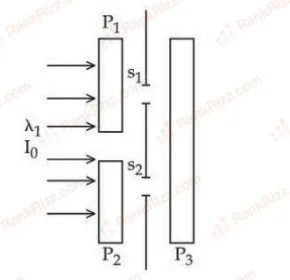
In a Young's double slit experiment, three polarizers are kept as shown in the figure. The transmission axes of and are orthogonal to each other. The polarizer covers both the slits with its transmission axis at to those of and . An unpolarized light of wavelength and intensity is incident on and .The intensity at a point after where the path difference between the light waves from and is
Given below are two statements. One is labelled as Assertion (A) and the other is labelled as Reason (R). Assertion (A) : In an insulated container, a gas is adiabatically shrunk to half of its initial volume. The temperature of the gas decreases. Reason (R): Free expansion of an ideal gas is an irreversible and an adiabatic process. In the light of the above statements, choose the correct answer from the options given below :
Both (A) and (R) are true but (R) is NOT the correct explanation of (A)
(A) is false but (R) is true
(A) is true but (R) is false
Both (A) and (R) are true and (R) is the correct explanation of (A)
Given below are two statements. One is labelled as Assertion (A) and the other is labelled as Reason (R). Assertion (A) : A electron in a certain region of uniform magnetic field is moving with constant velocity in a straight line path. Reason (R): The magnetic field in that region is along the direction of velocity of the electron. In the light of the above statements, choose the correct answer from the options given below :
(A) is true but (R) is false
Both (A) and (R) are true but (R) is NOT the correct explanation of (A)
Both (A) and (R) are true and (R) is the correct explanation of (A)
(A) is false but (R) is true
The ratio of the power of a light source to that of the light source is 2. is emitting photons per second at 600,nm. If the wavelength of the source is 300, nm,then the number of photons per second emitted by is
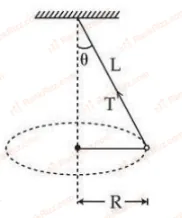
A string of length is fixed at one end and carries a mass of at the other end. The mass makes rotations per second about the vertical axis passing through end of the string as shown. The tension in the string is
The increase in pressure required to decrease the volume of a water sample by is Bulk modulus of water is The value of is
A tightly wound long solenoid carries a current of An electron is executing uniform circular motion inside the solenoid with a time period of The number of turns per metre in the solenoid is [Take mass of electron change of electron
Acceleration due to gravity on the surface of earth is . If the diameter of earth is reduced to one third of its original value and mass remains unchanged, then the acceleration due to gravity on the surface of the earth is