RankRizz

JEE Main 23 Jan 2025, Shift 2 Question Paper

All 75 questions of JEE Main 23 Jan 2025, Shift 2, in the order they were asked, one subject to a page. Pick an answer on any question to check it against the key. Free to read, nothing to download.

Questions

75

Physics · Chemistry · Maths

Answer key

74

questions with a checked key

Price

Free

no sign-up

Physics

Q1Galvanometer conversion to ammeter and voltmeter

A galvanometer having a coil of resistance 30Ω need 20 mA of current for full-scale deflection. If a maximum current of 3 A is to be measured using this galvanometer, the resistance of the shunt to be added to the galvanometer should be 30X\frac{30}{X}Ω.where X is Options

  1. A

    596

  2. B

    149

  3. C

    298

  4. D

    447

Q2Projectile motion from level ground

A ball having kinetic energy KE, is projected at an angle of 60∘60^{\circ} from the horizontal. What will be the kinetic energy of ball at the highest point of its flight ?

  1. A

    (KE)8\frac{(KE)}{8}

  2. B

    (KE)2\frac{(KE)}{2}

  3. C

    (KE)16\frac{(KE)}{16}

  4. D

    (KE)4\frac{(KE)}{4}

Q3Electric potential and potential energy

Two charges 7μc7\mu c and −4μc-4\mu c are placed at (−7 cm, 0, 0) and (7 cm, 0, 0) respectively. Given, ϵ∘=8.85×10⁻¹²C2m−2\epsilon_{\circ}=8.85\times 10^{-12}C^{2}m^{-2}, the electrostatic potential energy of the charge configuration is :

  1. A

    -1.8 J

  2. B

    -2.0 J

  3. C

    -1.5 J

  4. D

    -1.2 J

Q4Electric dipole and dipole in external field

Two point charges −4μc-4\mu c and 4μc4\mu c, constituting an electric dipole, are placed at (−9, 0, 0)cm and (9, 0, 0)cm in a uniform electric field of strength 104NC−110^{4}NC^{-1}. The work done on the dipole in rotating it from the equilibrium through 180∘180^{\circ} is :

  1. A

    18.4 mJ

  2. B

    14.4 mJ

  3. C

    12.4 mJ

  4. D

    16.4 mJ

Q5Spring force and spring combinations in dynamics

A massless spring gets elongated by amount x1x_{1} under a tension of 5 N . Its elongation is x2x_{2} under the tension of 7 N . For the elongation of (5x1−2x2)(5x_{1}-2x_{2}),the tension in the spring will be,

  1. A

    39 N

  2. B

    15 N

  3. C

    11 N

  4. D

    20 N

Q6Second law, heat engines, refrigerators and reversibility

Water of mass m gram is slowly heated to increase the temperature from T1T_{1} to T2T_{2} The change in entropy of the water, given specific heat of water is 1Jkg−1K−11Jkg^{-1}K^{-1}, is :

  1. A

    mln(T2T1)mln(\frac{T_{2}}{T_{1}})

  2. B

    zero

  3. C

    mln(T1T2)mln(\frac{T_{1}}{T_{2}})

  4. D

    m(T2−T1)m(T_{2}-T_{1})

Q7Equation of continuity and Bernoulli's theorem

Water flows in a horizontal pipe whose one end is closed with a valve. The reading of the pressure gauge attached to the pipe is P1P_{1}. The reading of the pressure gauge falls to P2P_{2} when the valve is opened. The speed of water flowing in the pipe is proportional to

  1. A

    P1−P2P_{1}-P_{2}

  2. B

    (P1−P2)4(P_{1}-P_{2})^{4}

  3. C

    (P1−P2)2(P_{1}-P_{2})^{2}

  4. D

    P1−P2\sqrt{P_{1}-P_{2}}

Q8Spherical mirrors: mirror formula and magnification

A concave mirror of focal length ff in air is dipped in a liquid of refractive index μ\mu. Its focal length in the liquid will be:

  1. A

    μf\mu f

  2. B

    f

  3. C

    f(μ−1)\frac{f}{(\mu -1)}

  4. D

    fμ\frac{f}{\mu}

Q9Diode circuits and rectifiers

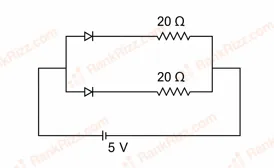
What is the current through the battery in the circuit shown below

Figure for JEE Main 2025 Physics question on Diode circuits and rectifiers
  1. A

    1.5 A

  2. B

    0.5 A

  3. C

    0.25 A

  4. D

    1.0 A

Q10Refraction at plane surfaces, Snell's law and apparent depth

The refractive index of the material of a glass prism is 3\sqrt{3}. The angle of minimum deviation is equal to the angle of the prism. What is the angle of the prism?

  1. A

    60∘60^{\circ}

  2. B

    58∘58^{\circ}

  3. C

    48∘48^{\circ}

  4. D

    50∘50^{\circ}

Q11Wavefronts and Huygens' principle

The width of one of the two slits in Young's double slit experiment is d while that of the other slit is xx d. If the ratio of the maximum to the minimum intensity in the interference pattern on the screen is 9:4 then what is the value of xx ? (Assume that the field strength varies according to the slit width.)

  1. A

    4

  2. B

    5

  3. C

    3

  4. D

    2

Q12Work done in thermodynamic processes and P-V diagrams
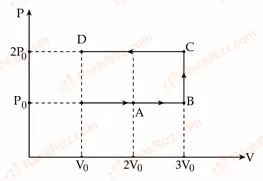
Figure for JEE Main 2025 Physics question on Work done in thermodynamic processes and P-V diagrams


Using the given P - V diagram, the work done by an ideal gas along the path ABCD is :

  1. A

    3P∘V∘3P_{\circ}V_{\circ}

  2. B

    −4P∘V∘-4P_{\circ}V_{\circ}

  3. C

    −3P∘V∘-3P_{\circ}V_{\circ}

  4. D

    4P∘V∘4P_{\circ}V_{\circ}

Q13Properties of EM waves: fields, energy, intensity and momentum

A plane electromagnetic wave of frequency 20 MHz travels in free space along the +x direction. At a particular point in space and time, the electric field vector of the wave is Ey=9.3Vm−1E_{y}=9.3Vm^{-1}. Then, the magnetic field vector of the wave at that point is

  1. A

    Bz=6.2×10−8TB_{z}=6.2\times 10^{-8}T

  2. B

    Bz=3.1×10−8TB_{z}=3.1\times 10^{-8}T

  3. C

    Bz=1.55×10−8TB_{z}=1.55\times 10^{-8}T

  4. D

    Bz=9.3×10−8TB_{z}=9.3\times 10^{-8}T

Q14Progressive waves: wave equation, phase and intensity

The equation of a transverse wave travelling along a string is y(x,t)=4.0sin⁡[20×10−3x+600t]mmy(x,t)=4.0\sin[20\times 10^{-3}x+600t]mm where x is in mm and t is in second. The velocity of the wave is :

  1. A

    −60 m/s

  2. B

    −30 m/s

  3. C

    +30 m/s

  4. D

    +60 m/s

Q15Nuclear size, mass defect and binding energy

Given below are two statements. One is labelled as Assertion (A) and the other is labelled as Reason (R). Assertion (A) : The binding energy per nucleon is found to be practically independent of the atomic number A, for nuclei with mass numbers between 30 and 170. Reason (R): Nuclear force is long range. In the light of the above statements, choose the correct answer from the options given below :

  1. A

    (A) is true but (R) is false

  2. B

    (A) is false but (R) is true

  3. C

    Both (A) and (R) are true and (R) is the correct explanation of (A)

  4. D

    Both (A) and (R) are true but (R) is NOT the correct explanation of (A)

Q16Kepler's laws and planetary motion

If a satellite orbiting the Earth is 9 times closer to the Earth than the Moon, what is the time period of rotation of the satellite? Given rotational time period of Moon =27 days and gravitational attraction between the satellite and the moon is neglected.

  1. A

    27 days

  2. B

    1 days

  3. C

    81 days

  4. D

    3 days

Q17Torque and the rotational form of Newton's second law

A circular disk of radius R meter and mass M kg is rotating around the axis perpendicular to the disk. An external torque is applied to the disk such that θ(t)=5t2−8t\theta (t)=5t^{2}-8t, where θ(t)\theta (t) is the angular position of the rotating disc as a function of time t. How much power is delivered by the applied torque, when t = 2 s ?

  1. A

    72MR2MR^{2}

  2. B

    8MR2MR^{2}

  3. C

    108MR2MR^{2}

  4. D

    60MR2MR^{2}

Q18Errors in measurement and significant figures

The energy of a system is given as E(t)=α3e−βtE(t)=\alpha^{3}e^{-\beta t}, where t is the time and β=0.3s−1\beta= 0.3s^{-1}. The errors in the measurement of α\alpha and t are 1.2% and 1.6%, respectively. At t=5s,maximum percentage error in the energy is:

  1. A

    6%

  2. B

    8.4%

  3. C

    11.6%

  4. D

    4$

Q19Dimensional analysis: deriving and checking relations

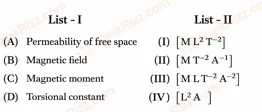
Match List - I with List - II.

Figure for JEE Main 2025 Physics question on Dimensional analysis: deriving and checking relations


Choose the correct answer from the options given below :

  1. A

    (A)-(IV), (B)-(III), (C)-(I), (D)-(II)

  2. B

    (A)-(III), (B)-(II), (C)-(IV), (D)-(I)

  3. C

    (A)-(I), (B)-(IV), (C)-(II), (D)-(III)

  4. D

    (A)-(II), (B)-(I), (C)-(III), (D)-(IV)

Q20Photoelectric effect and Einstein's equation

In photoelectric effect an em-wave is incident on a metal surface and electrons are ejected from the surface. If the work function of the metal is 2.14 eV and stopping potential is 2 V , what is the wavelength of the emwave ? (Given hc = 1242eVnm where h is the Planck's constant and c is the speed of light in vaccum.)

  1. A

    300 nm

  2. B

    400 nm

  3. C

    600 nm

  4. D

    200 nm

Q21Displacement current and Maxwell's equations

A time varying potential difference is applied between the plates of a parallel plate capacitor of capacitance 2.5μF2.5\mu F. The dielectric constant of the medium between the capacitor plates is 1 . It produces an instantaneous displacement current of 0.25 mA in the intervening space between the capacitor plates, the magnitude of the rate of change of the potential difference will be _____Vs−1Vs^{-1}.

Q22Series LCR circuits: impedance and phase

In a series LCR circuit, a resistor of 300Ω, a capacitor of 25 nF and an inductor of 100 mH are used. For maximum current in the circuit, the angular frequency of the ac source is _____×104 radians s−1\times 10^{4}\text{ radians }s^{-1}

Q23Excess pressure in drops and bubbles

An air bubble of radius 1.0 mm is observed at a depth of 20 cm below the free surface of a liquid having surface tension 0.095J/m20.095 J/m^{2} and density 103kg/m310^{3}kg/m^{3}. The difference between pressure inside the bubble and atmospheric pressure is _____N/m2.( take g=10m/s2)N/m^{2}.(\text{ take }g=10m/s^{2})

Q24Satellites: orbital speed, period, energy and geostationary orbits

A satellite of mass M2\frac{M}{2} is revolving around earth in a circular orbit at a height of R3\frac{R}{3} from earth surface. The angular momentum of the satellite is MGMRxM\sqrt{\frac{GMR}{x}}.The value of xx is ______ , where M and R are the mass and radius of earth, respectively. ( G is the gravitational constant)

Q25Capacitors in DC circuits (steady state)

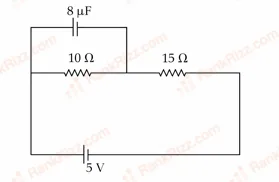
At steady state the charge on the capacitor, as shown in the circuit below, is μC\mu C.

Figure for JEE Main 2025 Physics question on Capacitors in DC circuits (steady state)
NEXT IN THIS PAPER →Chemistry, Q26 onwards