Q1Superposition, interference and beats
Two harmonic waves moving in the same direction superimpose to form a wave where t is in seconds. Find the period with which they beat (close to nearest integer)
- A
6 s
- B
4 s
- C
1 s
- D
2 s
All 75 questions of JEE Main 07 Apr 2025, Shift 1, in the order they were asked, one subject to a page. Pick an answer on any question to check it against the key. Free to read, nothing to download.
Questions
75
Physics · Chemistry · Maths
Answer key
75
questions with a checked key
Price
Free
no sign-up
Two harmonic waves moving in the same direction superimpose to form a wave where t is in seconds. Find the period with which they beat (close to nearest integer)
6 s
4 s
1 s
2 s
Two plane polarized light waves combine at a certain point whose electric field components are and . Find the amplitude of the resultant wave.
0.9 E
1.7
3.4
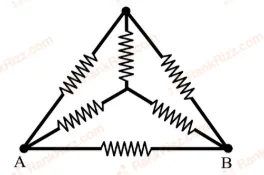
A wire of resistance R is bent into a triangular pyramid as shown in figure with each segment having same length. The resistance between points A and B is R/n. The value of n is :
16
14
10
12
Uniform magnetic fields of different strengths ( and ), both normal to the plane of the paper exist as shown in the figure. A charged particle of mass m and charge q, at the interface at an instant, moves into the region 2 with velocity v and returns to the interface. It continues to move into region 1 and finally reaches the interface. What is the displacement of the particle during this movement along the interface?
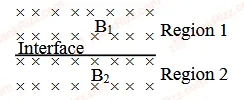
(Consider the velocity of the particle to be normal to the magnetic field and )
If denotes the permittivity of free space and is the flux of the electric field through the area bounded by the closed surface, then dimension of are that of :
Electric field
Electric potential
Electric charge
Electric current
A rod of length 5L is bent right angle keeping one side length as 2L.
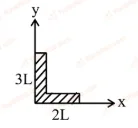
The position of the centre of mass of the system: (Consider L = 10 cm)
The percentage increase in magnetic field (B) when space within a current carrying solenoid is filled with magnesium (magnetic susceptibility ) is :
A lens having refractive index 1.6 has focal length of 12 cm, when it is in air. Find the focal length of the lens when it is placed in water. (Take refractive index of water as 1.28)
355 mm
288 mm
555 mm
655 mm
An ac current is represented as Amp. The r.m.s value of the current is :
50 Amp
100 Amp
10 Amp
Amp
Two thin convex lenses of focal lengths 30 cm and 10 cm are placed coaxially, 10 cm apart. The power of this combination is :
5 D
1 D
20 D
10 D
In the following circuit, the reading of the ammeter will be (Take Zener breakdown voltage = 4 V)
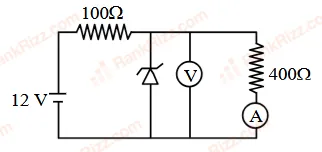
24 mA
80 mA
10 mA
60 mA
Two projectiles are fired from ground with same initial speeds from same point at angles and with horizontal direction. The ratio of their times of flights is
1
Match the List-I with List-II.
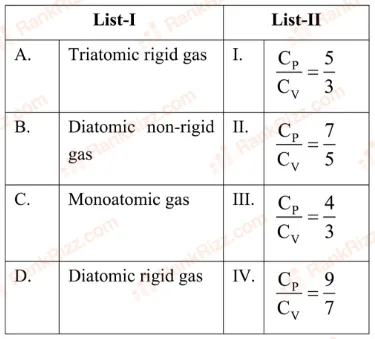
Choose the correct answer from the options given below :
A-III, B-IV, C-I, D-II
A-III, B-II, C-IV, D-I
A-II, B-IV, C-I, D-II
A-IV, B-II, C-III, D-I
A cubic block of mass m is sliding down on an inclined plane at with an acceleration of , the value of coefficient of kinetic friction is
In a hydrogen like ion, the energy difference between the 2nd excitation energy state and ground state is 108.8 eV. The atomic number of the ion is
4
2
1
3
For a hydrogen atom, the ratio of the largest wavelength of Lyman series to that of the Balmer series is
5 : 36
5 : 27
3 : 4
27 : 5
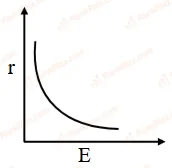
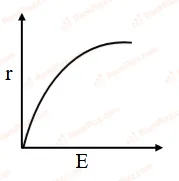
A particle of charge q, mass m and kinetic energy E enters in magnetic field perpendicular to its velocity and undergoes a circular arc of radius(r). Which of the following curves represents the variation of r with E?
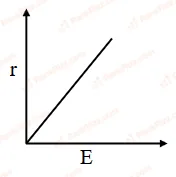
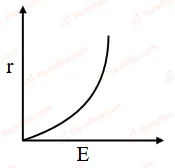
An object of mass 1000 g experiences a time dependent force N. The power generated by the force at time t is :
W
W
W
W
Two wires A and B are made of same material having ratio of lengths and their diameters ratio . If both the wires are stretched using same force, what would be the ratio of their respective elongations?
1 : 6
1 : 12
3 : 4
1 : 3
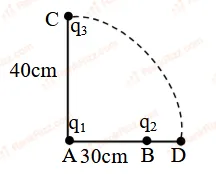
Two charges and are separated by a distance of 30 cm. A third charge initially at 'C' as shown in the figure, is moved along the circular path of radius 40 cm from C to D. If the difference in potential energy due to movement of from C to D is given by , the value of K is :
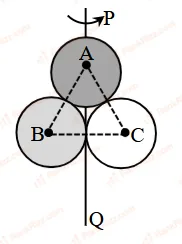
A, B and C are disc, solid sphere, and spherical shell respectively with same radii and masses. These masses are placed as shown in the figure. The moment of inertia of the given system about PQ is , where I is the moment of inertia of the disc about its diameter. The value of x is ______.
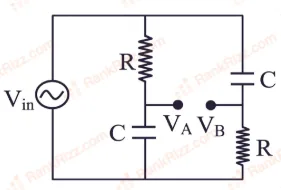
For ac circuit shown in figure, R = 100 k and C = 100 pF and the phase difference between and is . The input signal frequency is rad/sec, where 'x' is ______.
A container contains a liquid with refractive index of 1.2 up to a height of 60 cm and another liquid having refractive index 1.6 is added to height H above first liquid. If viewed from above, the apparent shift in the position of bottom of container is 40 cm. The value of H is ___ cm.
(Consider liquids are immisible)
A wire of length 10 cm and diameter 0.5 mm is used in a bulb. The temperature of the wire is 1727 degrees C and power radiated by the wire is 94.2 W. Its emissivity is where x = ______.
(Given W m K, and assume that the emissivity of wire material is same at all wavelength. )
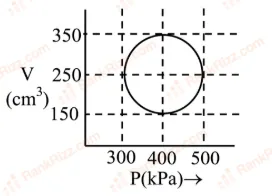
An ideal gas has undergone through the cyclic process as shown in the figure. Work done by the gas in the entire cycle is ______ J. (Take )