Q1Mean free path
The mean free path and the average speed of oxygen molecules at 300 K and 1 atm are m and 600 m/s, respectively. Find the frequency of its collisions.
- A
/s
- B
/s
- C
/s
- D
/s
All 75 questions of JEE Main 04 Apr 2025, Shift 1, in the order they were asked, one subject to a page. Pick an answer on any question to check it against the key. Free to read, nothing to download.
Questions
75
Physics · Chemistry · Maths
Answer key
74
questions with a checked key
Price
Free
no sign-up
The mean free path and the average speed of oxygen molecules at 300 K and 1 atm are m and 600 m/s, respectively. Find the frequency of its collisions.
/s
/s
/s
/s
A small mirror of mass m is suspended by a massless thread of length . Then the small angle through which the thread will be deflected when a short pulse of laser of energy E falls normal on the mirror (c = speed of light in vacuum and g = acceleration due to gravity)
Two liquids A and B have and as contact angles in a capillary tube. If , then identify the correct statement:
K is negative, then liquid A and liquid B have convex meniscus
K is negative, then liquid A and liquid B have concave meniscus
K is negative, then liquid A has concave meniscus and liquid B has convex meniscus
K is zero, then liquid A has convex meniscus and liquid B has concave meniscus
Which of the following are correct expressions for torque acting on a body?
A.
B.
C.
D.
E.
( )
Choose the correct answer from the options given below :
B, D and E Only
C and D Only
B, C, D and E Only
A, B, D and E Only
In a Young's double slit experiment, the slits are separated by 0.2 mm. If the slits separation is increased to 0.4 mm, the percentage change of the fringe width is:
0%
100%
50%
25%
An alternating current is represented by the equation ampere. The RMS value of current and the frequency of the given alternating current are
A, 100 Hz
A, 100 Hz
100 A, 50 Hz
A, 50 Hz
Consider the sound wave travelling in ideal gases of He, , and . All the gases have the same ratio , where P is the pressure and is the density. The ratio of the speed of sound through the gases is given by
In an electromagnetic system, the quantity representing the ratio of electric flux and magnetic flux has dimension of , where value of 'Q' and 'R' are
When an object is placed 40 cm away from a spherical mirror an image of magnification is produced. To obtain an image with magnification of , the object is to be moved:
40 cm away from the mirror.
80 cm away from the mirror.
20 cm towards the mirror.
20 cm away from the mirror.
Given below are two statements:
Assertion A: In photoelectric effect, on increasing the intensity of incident light the stopping potential increases.
Reason R: Increase in intensity of light increases the rate of photoelectrons emitted, provided the frequency of incident light is greater than threshold frequency.
Choose the correct answer:
Both A and R are true but R is NOT the correct explanation of A
A is false but R is true
A is true but R is false
Both A and R are true and R is the correct explanation of A
If and represent the angular momentum and linear momentum respectively of a particle of mass 'm' having position vector . The direction of force is
Opposite to the direction of
Opposite to the direction of
Opposite to the direction of
Opposite to the direction of
A body of mass m is suspended by two strings making angles and with the horizontal ceiling with tensions and simultaneously. and are related by . The angles and are
, with
, with
, with
, with
Current passing through a wire as function of time is given as A. The charge that will flow through the wire from s to s is:
0.06 C
0.02 C
0.07 C
0.04 C
Given below are two statements:
Assertion A: The kinetic energy needed to project a body of mass m from earth surface to infinity is , where R is the radius of earth.
Reason R: The maximum potential energy of a body is zero when it is projected to infinity from earth surface.
In the light of the above statements, choose the correct answer from the option given below
A False but R is true
Both A and R are true and R is the correct explanation of A
A is true but R is false
Both A and R are true but R is NOT the correct explanation of A
The Boolean expression can be realised with which of the following gate configurations.
A. One 3-input AND gate, 3 NOT gates and one 2-input OR gate, One 2-input AND gate,
B. One 3-input AND gate, 1 NOT gate, One 2-input NOR gate and one 2-input OR gate
C. 3-input OR gate, 3 NOT gates and one 2-input AND gate
Choose the correct answer:
B, C Only
A, B Only
A, B, C Only
A, C Only
In an experiment with a closed organ pipe, it is filled with water by th of its volume. The frequency of the fundamental note will change by
25%
20%
%
%
Two simple pendulums having lengths and with negligible string mass undergo angular displacements and , from their mean positions, respectively. If the angular accelerations of both pendulums are same, then which expression is correct?
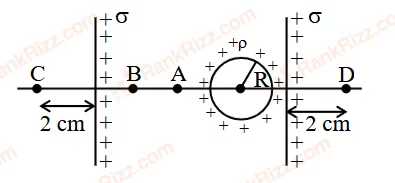
Two infinite identical charged sheets and a charged spherical body of charge density '' are arranged as shown in figure. Then the correct relation between the electrical fields at A, B, C and D points is:
Two small spherical balls of mass 10g each with charges and , are attached to two ends of very light rigid rod of length 20 cm. The arrangement is now placed near an infinite non-conducting charge sheet with uniform charge density such that length of rod makes an angle of 30° with electric field generated by charge sheet. Net torque acting on the rod is: (Take )
112 Nm
1.12 Nm
2.24 Nm
11.2 Nm
Considering the Bohr model of hydrogen like atoms, the ratio of the radius orbit of the electron in and is
A circular ring and a solid sphere having same radius roll down on an inclined plane from rest without slipping. The ratio of their velocities when reached at the bottom of the plane is where x = ________.
Two slabs with square cross section of different materials (1, 2) with equal sides () and thickness and such that and . Considering lower edges of these slabs are fixed to the floor, we apply equal shearing force on the narrow faces. The angle of deformation is . If the shear moduli of material 1 is N/m, then shear moduli of material 2 is , where value of x is ________.
Distance between object and its image (magnified by ) is 30 cm. The focal length of the mirror used is cm, where magnitude of value of x is ________.
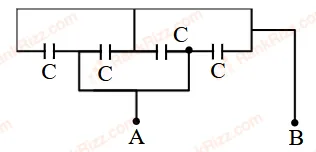
Four capacitors each of capacitance are connected as shown in the figure. The capacitance between points A and B is ________ .
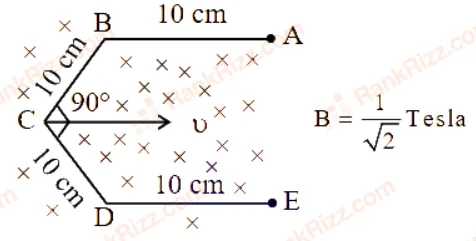
Conductor wire ABCDE with each arm 10 cm in length is placed in magnetic field of Tesla, perpendicular to its plane. When conductor is pulled towards right with constant velocity of 10 cm/s, induced emf between points A and E is ________ mV.