Q1Dimensional analysis: deriving and checking relations
If mass is written as , then the value of will be : (Constants have their usual meaning with a dimensionless constant)
- A
- B
- C
- D
All 90 questions of JEE Main 30 Jan 2024, Shift 2, in the order they were asked, one subject to a page. Pick an answer on any question to check it against the key. Free to read, nothing to download.
Questions
90
Physics · Chemistry · Maths
Answer key
89
questions with a checked key
Price
Free
no sign-up
If mass is written as , then the value of will be : (Constants have their usual meaning with a dimensionless constant)
Projectiles and are thrown at angles of and with vertical respectively from top of a 400 m high tower. If their times of flight are same, the ratio of their speeds of projection is:
Three blocks , and are pulled on a horizontal smooth surface by a force of 80 N as shown in figure. The tensions and in the string are respectively:

40N, 64N
60N, 80N
88N, 96N
80N, 100N
A block of mass is placed on a surface having vertical cross section given by . If coefficient of friction is 0.5, the maximum height above the ground at which block can be placed without slipping is:
m
m
m
m
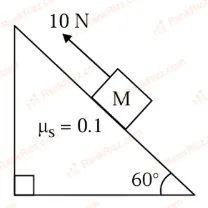
A block of mass 1 kg is pushed up a surface inclined to horizontal at an angle of by a force of 10 N parallel to the inclined surface as shown in figure. When the block is pushed up by 10 m along inclined surface, the work done against frictional force is : m s
J
5 J
J
10 J
Escape velocity of a body from earth is 11.2 km s. If the radius of a planet be one-third the radius of earth and mass be one-sixth that of earth, the escape velocity from the planet is:
11.2 km s
8.4 km s
4.2 km s
7.9 km s
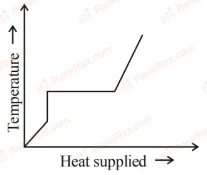
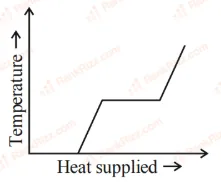
A block of ice at is slowly heated and converted to steam at . Which of the following curves represent the phenomenon qualitatively:
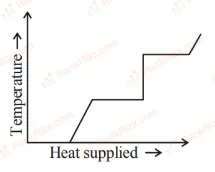
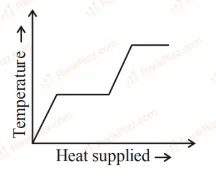
Choose the correct statement for processes & shown in figure.
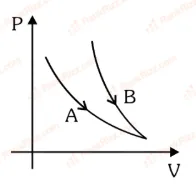
for process and for process
for process and
for process and for process
for process and for process
If three moles of monoatomic gas is mixed with two moles of a diatomic gas , the value of adiabatic exponent for the mixture is:
1.75
1.40
1.52
1.35
A particle of charge and mass moves in a circle of radius around an infinitely long line charge of linear density . Then time period will be given as: (Consider as Coulomb's constant)
When a potential difference is applied across a wire of resistance , it dissipates energy at a rate . If the wire is cut into two halves and these halves are connected mutually parallel across the same supply, the energy dissipation rate will become:
An alternating voltage volt is applied to a purely resistive load of . The time taken for the current to rise from half of the peak value to the peak value is:
5 ms
3.3 ms
7.2 ms
2.2 ms
Match List I with List II
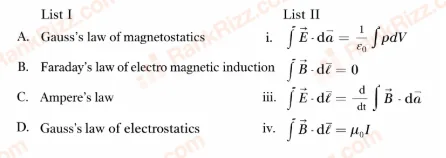
Choose the correct answer from the options given below:
A-I, B-III, C-IV, D-II
A-III, B-IV, C-I, D-II
A-IV, B-II, C-III, D-I
A-II, B-III, C-IV, D-I
A beam of unpolarised light of intensity is passed through a polaroid and then through another polaroid which is oriented so that its principal plane makes an angle of relative to that of . The intensity of emergent light is:
If the total energy transferred to a surface in time is J, then the magnitude of the total momentum delivered to this surface for complete absorption will be:
kg m s
kg m s
kg m s
kg m s
For the photoelectric effect, the maximum kinetic energy of the photoelectrons is plotted against the frequency of the incident photons as shown in figure. The slope of the graph give
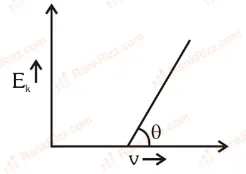
Ratio of Planck's constant to electric charge
Work function of the metal
Charge of electron
Planck's constant
An electron revolving in Bohr orbit has magnetic moment . If , the value of is:
2
1
3
0
In a nuclear fission reaction of an isotope of mass , three similar daughter nuclei of same mass are formed. The speed of a daughter nuclei in terms of mass defect will be:
In the given circuit, the voltage across load resistance is:
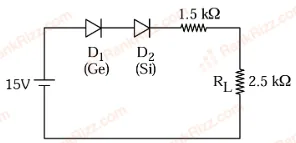
8.75 V
9.00 V
8.50 V
14.00 V
If 50 Vernier divisions are equal to 49 main scale divisions of a travelling microscope and one smallest reading of main scale is 0.5 mm, the Vernier constant of travelling microscope is:
0.1 mm
0.1 cm
0.01 cm
0.01 mm
A vector has magnitude same as that of and is parallel to . The and components of this vector in first quadrant are and 3 respectively where = ____.
Two discs of moment of inertia kg m and kg m about their central axes & normal to their planes, rotating with angular speeds 10 rad s & 4 rad s respectively are brought into contact face to face with their axes of rotation coincident. The loss in kinetic energy of the system in the process is _________ J.
A big drop is formed by coalescing 1000 small identical drops of water. If be the total surface energy of 1000 small drops of water and be the surface energy of single big drop of water, the is , where = ________.
A simple pendulum is placed at a place where its distance from the earth's surface is equal to the radius of the earth. If the length of the string is 4 m, then the time period of small oscillations will be _________ s. [take m s]
A point source is emitting sound waves of intensity W m at the origin. The difference in intensity (magnitude only) at two points located at distances of 2 m and 4 m from the origin respectively will be ________ W m.
Two identical charged spheres are suspended by strings of equal lengths. The string make an angle of with each other. When suspended in a liquid of density g cm, the angle remains same. If density of material of the sphere is g cm, the dielectric constant of the liquid is _____ ()
Two resistance of and are connected in series with a battery of 4 V and negligible internal resistance. A voltmeter is used to measure voltage across resistance, which gives reading as 1 V. The resistance of voltmeter must be _______ .
The current of 5 A flows in a square loop of sides 1 m is placed in air. The magnetic field at the centre of the loop is T. The value of X is _________.
A power transmission line feeds input power at 2.3 kV to a step down transformer with its primary winding having 3000 turns. The output power is delivered at 230 V by the transformer. The current in the primary of the transformer is 5 A and its efficiency is 90%. The winding of transformer is made of copper. The output current of transformer is ____ A.
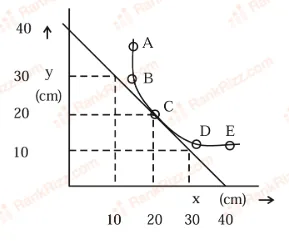
In an experiment to measure the focal length of a convex lens, the magnitude of object distance and the image distance are measured with reference to the focal point of the lens. The plot is shown in figure. The focal length of the lens is ____ cm.