RankRizz

JEE Main 27 Jan 2024, Shift 1 Question Paper

All 90 questions of JEE Main 27 Jan 2024, Shift 1, in the order they were asked, one subject to a page. Pick an answer on any question to check it against the key. Free to read, nothing to download.

Questions

90

Physics · Chemistry · Maths

Answer key

90

questions with a checked key

Price

Free

no sign-up

Physics

Q1Dimensional analysis: deriving and checking relations

Given below are two statements: 

Statement (I) : Planck's constant and angular momentum have the same dimensions.

Statement (II) : Linear momentum and moment of force have the same dimensions. In light of the above statements, choose the correct answer from the options given below :

  1. A

    Statement I is true but Statement II is false

  2. B

    Both Statement I and Statement II are false

  3. C

    Both Statement I and Statement II are true

  4. D

    Statement I is false but Statement II is true
Q2Kinematics in two dimensions using position vectors

Position of an ant (S in metres) moving in Y−ZY - Z plane is given by S=2t2j^+5k^S = 2t^2 \hat{j} + 5\hat{k} (where tt is in second). The magnitude and direction of velocity of the ant at t=1t = 1 s will be :

  1. A

    16 m s−116 \text{ m s}^{-1} in y-direction

  2. B

    4 m s−14 \text{ m s}^{-1} in x-direction

  3. C

    9 m s−19 \text{ m s}^{-1} in z-direction

  4. D

    4 m s−14 \text{ m s}^{-1} in y-direction

Q3Vehicles on curves: banking, friction and centrifugal force

A train is moving with a speed of 12 m s−112 \text{ m s}^{-1} on rails which are 1.51.5 m apart. To negotiate a curve radius 400400 m, the height by which the outer rail should be raised with respect to the inner rail is (Given, g=10 m s−2g = 10 \text{ m s}^{-2}):

  1. A

    6.06.0 cm

  2. B

    5.45.4 cm

  3. C

    4.84.8 cm

  4. D

    4.24.2 cm

Q4Motion of centre of mass, momentum conservation and explosions

Two bodies of mass 44 g and 2525 g are moving with equal kinetic energies. The ratio of magnitude of their linear momentum is :

  1. A

    3:53 : 5

  2. B

    5:45 : 4

  3. C

    2:52 : 5

  4. D

    4:54 : 5

Q5Impulse and impulse-momentum theorem

A body of mass 10001000 kg is moving horizontally with a velocity 6 m s−16 \text{ m s}^{-1}. If 200200 kg extra mass is added, the final velocity (in m s−1\text{m s}^{-1}) is:

  1. A

    6

  2. B

    2

  3. C

    3

  4. D

    5

Q6Acceleration due to gravity and its variation

The acceleration due to gravity on the surface of earth is gg. If the diameter of earth reduces to half of its original value and mass remains constant, then acceleration due to gravity on the surface of earth would be :

  1. A

    g4\frac{g}{4}

  2. B

    2g2g

  3. C

    g2\frac{g}{2}

  4. D

    4g4g

Q7Surface tension and surface energy

Given below are two statements : 

Statement (I) : Viscosity of gases is greater than that of liquids. 

Statement (II) : Surface tension of a liquid decreases due to the presence of insoluble impurities. In the light of the above statements, choose the most appropriate answer from the options given below :

  1. A

    Statement I is correct but Statement II is incorrect

  2. B

    Statement I is incorrect but Statement II is correct

  3. C

    Both Statement I and Statement II are incorrect

  4. D

    Both Statement I and Statement II are correct

Q8Molar specific heats of gases, Mayer's relation and gas mixtures

0.080.08 kg air is heated at constant volume through 5°C5°C. The specific heat of air at constant volume is 0.17 kcal kg−1 °C−10.17 \text{ kcal kg}^{-1} \text{ °C}^{-1} and 1 J=4.18 joule cal−11 \text{ J} = 4.18 \text{ joule cal}^{-1}. The change in its internal energy is approximately.

  1. A

    318318 J

  2. B

    298298 J

  3. C

    284284 J

  4. D

    142142 J

Q9Kinetic interpretation of pressure and temperature

The average kinetic energy of a monatomic molecule is 0.4140.414 eV at temperature: (Use KB=1.38×10⁻²³ J mol−1 K−1K_B = 1.38 \times 10^{-23} \text{ J mol}^{-1} \text{ K}^{-1})

  1. A

    30003000 K

  2. B

    32003200 K

  3. C

    16001600 K

  4. D

    15001500 K

Q10Electric potential and potential energy

An electric charge 10−610^{-6} μ\muC is placed at origin (0,0)(0, 0) m of X−YX - Y co-ordinate system. Two points PP and QQ are situated at (3,3)(\sqrt{3}, \sqrt{3}) m and (6,0)(\sqrt{6}, 0) m respectively. The potential difference between the points PP and QQ will be :

  1. A

    3\sqrt{3} V

  2. B

    6\sqrt{6} V

  3. C

    00 V

  4. D

    33 V

Q11Combination of resistors and equivalent resistance

A wire of resistance RR and length LL is cut into 55 equal parts. If these parts are joined parallely, then resultant resistance will be :

  1. A

    R25\frac{R}{25}

  2. B

    R5\frac{R}{5}

  3. C

    25R25R

  4. D

    5R5R

Q12Meter bridge

A wire of length 1010 cm and radius 7×10⁻⁴\sqrt{7} \times 10^{-4} m connected across the right gap of a meter bridge. When a resistance of 4.5  Ω4.5 \; \Omega is connected on the left gap by using a resistance box, the balance length is found to be at 6060 cm from the left end. If the resistivity of the wire is R×10−7  ΩR \times 10^{-7} \; \Omega m, then value of RR is :

  1. A

    63

  2. B

    70

  3. C

    66

  4. D

    35

Q13Motion of charged particles in a magnetic field

A proton moving with a constant velocity passes through a region of space without any change in its velocity. If E⃗\vec{E} and B⃗\vec{B} represent the electric and magnetic fields respectively, then the region of space may have : 

(A) E=0,B=0E = 0, B = 0; (B) E=0,B≠0E = 0, B \neq 0; (C) E≠0,B=0E \neq 0, B = 0; (D) E≠0,B≠0E \neq 0, B \neq 0. Choose the most appropriate answer from the options given below :

  1. A

    (A), (B) and (C) only

  2. B

    (A), (C) and (D) only

  3. C

    (A), (B) and (D) only

  4. D

    (B), (C) and (D) only

Q14Magnetic flux, Faraday's law and Lenz's law

A rectangular loop of length 2.52.5 m and width 22 m is placed at 30°30° to a magnetic field of 44 T. The loop is removed from the field in 1010 sec. The average emf induced in the loop during this time is

  1. A

    −2-2 V

  2. B

    +2+2 V

  3. C

    +1+1 V

  4. D

    −1-1 V

Q15Properties of EM waves: fields, energy, intensity and momentum

A plane electromagnetic wave propagating in xx-direction is described by Ey=(200 V m−1)sin⁡[1.5×10⁷t−0.05x]E_y = (200 \text{ V m}^{-1}) \sin[1.5 \times 10^7 t - 0.05x]. The intensity of the wave is : (Use ϵ0=8.85×10⁻¹² C2 N−1 m−2\epsilon_0 = 8.85 \times 10^{-12} \text{ C}^2 \text{ N}^{-1} \text{ m}^{-2})

  1. A

    35.4 W m−235.4 \text{ W m}^{-2}

  2. B

    53.1 W m−253.1 \text{ W m}^{-2}

  3. C

    26.6 W m−226.6 \text{ W m}^{-2}

  4. D

    106.2 W m−2106.2 \text{ W m}^{-2}

Q16Refraction at plane surfaces, Snell's law and apparent depth

If the refractive index of the material of a prism is cot⁡(A2)\cot\left(\frac{A}{2}\right), where AA is the angle of prism then the angle of minimum deviation will be

  1. A

    π−2A\pi - 2A

  2. B

    π2−2A\frac{\pi}{2} - 2A

  3. C

    π−A\pi - A

  4. D

    π2−A\frac{\pi}{2} - A

Q17Thin lenses: lens formula, lens maker's formula and power

A convex lens of focal length 4040 cm forms an image of an extended source of light on a photoelectric cell. A current II is produced. The lens is replaced by another convex lens having the same diameter but focal length 2020 cm. The photoelectric current now is

  1. A

    I2\frac{I}{2}

  2. B

    4I4I

  3. C

    2I2I

  4. D

    II

Q18Bohr model of hydrogen-like atoms

The radius of third stationary orbit of electron for Bohr's atom is RR. The radius of fourth stationary orbit will be:

  1. A

    43R\frac{4}{3}R

  2. B

    169R\frac{16}{9}R

  3. C

    34R\frac{3}{4}R

  4. D

    916R\frac{9}{16}R

Q19p-n junction diode and its characteristics

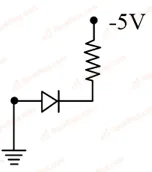
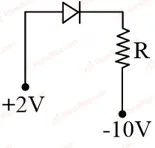
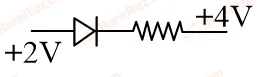
Which of the following circuits is reverse-biased?

  1. A
    Figure for JEE Main 2024 Physics question on p-n junction diode and its characteristics
  2. B
    Figure for JEE Main 2024 Physics question on p-n junction diode and its characteristics
  3. C
    Figure for JEE Main 2024 Physics question on p-n junction diode and its characteristics
  4. D
    Figure for JEE Main 2024 Physics question on p-n junction diode and its characteristics
Q20Screw gauge: pitch, least count and zero error

Identify the physical quantity that cannot be measured using spherometer :

  1. A

    Radius of curvature of concave surface

  2. B

    Specific rotation of liquids

  3. C

    Thickness of thin plates

  4. D

    Radius of curvature of convex surface

Q21Projectile motion from level ground

A particle starts from origin at t=0t = 0 with a velocity 5i^ m s−15\hat{i} \text{ m s}^{-1} and moves in x−yx - y plane under action of a force which produces a constant acceleration of (3i^+2j^) m s−2(3\hat{i} + 2\hat{j}) \text{ m s}^{-2}. If the xx-coordinate of the particle at that instant is 8484 m, then the speed of the particle at this time is α m s−1\sqrt{\alpha} \text{ m s}^{-1}. The value of α\alpha is _______.

Q22Parallel and perpendicular axis theorems

Four particles, each of mass 11 kg are placed at four corners of a square of side 22 m. The moment of inertia of the system about an axis perpendicular to its plane and passing through one of its vertex is ______ kg m2^2.

Q23Bulk modulus and compressibility

If average depth of an ocean is 40004000 m and the bulk modulus of water is 2×10⁹ N m−22 \times 10^9 \text{ N m}^{-2}, then fractional compression ΔVV\frac{\Delta V}{V} of water at the bottom of ocean is α×10−2\alpha \times 10^{-2}. The value of α\alpha is _______, (Given, g=10 m s−2,ρ=1000 kg m−3g = 10 \text{ m s}^{-2}, \rho = 1000 \text{ kg m}^{-3})

Q24SHM: equation, phase, velocity and acceleration

A particle executes simple harmonic motion with an amplitude of 44 cm. At the mean position, velocity of the particle is 10 cm s−110 \text{ cm s}^{-1}. The distance of the particle from the mean position when its speed becomes 5 cm s−15 \text{ cm s}^{-1} is α\sqrt{\alpha} cm, where α=\alpha = ______.

Q25Electric charge and Coulomb's law

A thin metallic wire having cross sectional area of 10−4 m210^{-4} \text{ m}^2 is used to make a ring of radius 3030 cm. A positive charge of 2π2\pi C is uniformly distributed over the ring, while another positive charge of 3030 pC is kept at the centre of the ring. The tension in the ring is _______ N; provided that the ring does not get deformed (neglect the influence of gravity). (Given, 14πϵ0=9×10⁹\frac{1}{4\pi\epsilon_0} = 9 \times 10^9 SI units)

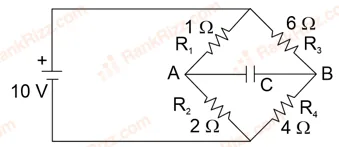
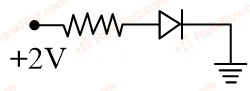
Q26Capacitors in DC circuits (steady state)

The charge accumulated on the capacitor connected in the following circuit is ______ μ\muC. (Given C=150  μC = 150 \; \muF)

Figure for JEE Main 2024 Physics question on Capacitors in DC circuits (steady state)
Q27Biot-Savart law: straight wires and moving charges

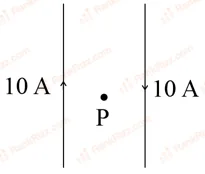
Two long, straight wires carry equal currents in opposite directions as shown in figure. The separation between the wires is 5.05.0 cm. The magnitude of the magnetic field at a point P midway between the wires is ______ μ\muT. (Given: μ0=4π×10−7 T m A−1\mu_0 = 4\pi \times 10^{-7} \text{ T m A}^{-1})

Figure for JEE Main 2024 Physics question on Biot-Savart law: straight wires and moving charges
Q28Self inductance and energy stored in inductors

Two coils have mutual inductance 0.0020.002 H. The current changes in the first coil according to the relation i=i0sin⁡ωti = i_0 \sin \omega t, where i0=5i_0 = 5 A and ω=50π rad s−1\omega = 50\pi \text{ rad s}^{-1}. The maximum value of emf in the second coil is πα\frac{\pi}{\alpha} V. The value of α\alpha is

Q29Refraction at plane surfaces, Snell's law and apparent depth

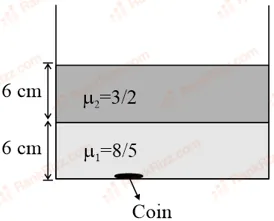
Two immiscible liquids of refractive indices 85\frac{8}{5} and 32\frac{3}{2} respectively are put in a beaker as shown in the figure. The height of each column is 66 cm. A coin is placed at the bottom of the beaker. For near normal vision, the apparent depth of the coin is α4\frac{\alpha}{4} cm. The value of α\alpha is _______.

Figure for JEE Main 2024 Physics question on Refraction at plane surfaces, Snell's law and apparent depth
Q30Nuclear size, mass defect and binding energy

In a nuclear fission process, a high mass nuclide (A≈236)(A \approx 236) with binding energy 7.67.6 MeV/Nucleon dissociated into two middle mass nuclides (A≈118)(A \approx 118), having binding energy of 8.68.6 MeV/Nucleon. The energy released in the process would be _______ MeV.

NEXT IN THIS PAPER →Chemistry, Q31 onwards