RankRizz

JEE Main 29 Jan 2023, Shift 2: Chemistry

The 30 Chemistry questions of JEE Main 29 Jan 2023, Shift 2, numbered across the whole paper. Pick an answer on any question to check it against the key. Free to read, nothing to download.

Chemistry

Q31Ionisation enthalpy

Given below are two statements:
Statement I: The decrease in first ionization enthalpy from B to Al is much larger than that from Al to Ga.
Statement II: The d orbitals in Ga are completely filled.
In the light of the above statements, choose the most appropriate answer from the options given below

  1. A

    Statement I is incorrect but statement II is correct.

  2. B

    Both the statements I and II are correct

  3. C

    Statement I is correct but statement II is incorrect

  4. D

    Both the statements I and II are incorrect
Q32Molecular orbital theory of diatomic species

According to MO theory the bond orders for O22−_2^{2-}, CO and NO+^+ respectively, are

  1. A

    1,31, 3 and 33

  2. B

    1,31, 3 and 22

  3. C

    1,21, 2 and 33

  4. D

    2,32, 3 and 33

Q33Heat capacity and calorimetry

Which of the following relations are correct?
(A) ΔU=q+pΔV\Delta U = q + p\Delta V
(B) ΔG=ΔH−TΔS\Delta G = \Delta H - T\Delta S
(C) ΔS=qrevT\Delta S = \frac{q_{rev}}{T}
(D) ΔH=ΔU−ΔnRT\Delta H = \Delta U - \Delta nRT
Choose the most appropriate answer from the options given below:

  1. A

    C and D only

  2. B

    B and C only

  3. C

    A and B only

  4. D

    B and D only

Q34Physical chemistry experiments

An indicator 'X' is used for studying the effect of variation in concentration of iodide on the rate of reaction of iodide ion with H2_2O2_2 at room temp. The indicator 'X' forms blue colored complex with compound 'A' present in the solution. The indicator 'X' and compound 'A' respectively are

  1. A

    Starch and iodine

  2. B

    Methyl orange and H2_2O2_2

  3. C

    Starch and H2_2O2_2

  4. D

    Methyl orange and iodine

Q35Magnetic moment, colour and catalytic properties of transition metals

Given below are two statements:
Statement I: Nickel is being used as the catalyst for producing syn gas and edible fats.
Statement II: Silicon forms both electron rich and electron deficient hydrides.
In the light of the above statements, choose the most appropriate answer from the options given below:

  1. A

    Both the statements I and II are correct

  2. B

    Statement I is incorrect but statement II is correct

  3. C

    Both the statements I and II are incorrect
  4. D

    Statement I is correct but statement II is incorrect

Q36Stoichiometry, limiting reagent and percentage yield

When a hydrocarbon A undergoes combustion in the presence of air, it requires 9.59.5 equivalents of oxygen and produces 33 equivalents of water. What is the molecular formula of A?

  1. A

    C8_8H6_6

  2. B

    C9_9H9_9

  3. C

    C6_6H6_6

  4. D

    C9_9H6_6

Q37Water pollution

The concentration of dissolved Oxygen in water for growth of fish should be more than X ppm and Biochemical Oxygen Demand in clean water should be less than Y ppm. X and Y in ppm are, respectively.

  1. A

    X=6, Y=5

  2. B

    X=4, Y=8

  3. C

    X=4, Y=15

  4. D

    X=6, Y=12

Q38Abnormal molar mass and van't Hoff factor

Match List I with List II.

List IList II
A. van't Hoff factor, iI. Cryoscopic constant
B. kf_fII. Isotonic solutions
C. Solutions with same osmotic pressureIII. Normal molar massAbnormal molar mass\frac{\text{Normal molar mass}}{\text{Abnormal molar mass}}
D. AzeotropesIV. Solutions with same composition of vapour above it

Choose the correct answer from the options given below:
  1. A

    A-III, B-I, C-II, D-IV

  2. B

    A-III, B-II, C-I, D-IV

  3. C

    A-III, B-I, C-IV, D-II

  4. D

    A-I, B-III, C-II, D-IV

Q39Properties of colloids and coagulation

Match List-I and List-II

List-IList-II
A. OsmosisI. Solvent molecules pass through semi permeable membrane towards solvent side.
B. Reverse osmosisII. Movement of charged colloidal particles under the influence of applied electric potential towards oppositely charged electrodes
C. Electro osmosisIII. Solvent molecules pass through semi permeable membrane towards solution side
D. ElectrophoresisIV. Dispersion medium moves in an electric field.

Choose the correct answer from the options given below:
  1. A

    A-I, B-III, C-IV, D-II

  2. B

    A-III, B-I, C-IV, D-II

  3. C

    A-III, B-I, C-II, D-IV

  4. D

    A-I, B-III, C-II, D-IV

Q40Occurrence of metals: minerals and ores

The major component of which of the following ore is sulphide based mineral?

  1. A

    Calamine

  2. B

    Siderite

  3. C

    Sphalerite

  4. D

    Malachite

Q41Other important compounds of transition metals

A solution of CrO5_5 in amyl alcohol has a ____colour

  1. A

    Green

  2. B

    Orange-Red

  3. C

    Yellow

  4. D

    Blue

Q42General properties of transition elements

The set of correct statements is:
(i) Manganese exhibits +7+7 oxidation state in its oxide.
(ii) Ruthenium and Osmium exhibit +8+8 oxidation in their oxides.
(iii) Sc shows +4+4 oxidation state which is oxidizing in nature.
(iv) Cr shows oxidising nature in +6+6 oxidation state.

  1. A

    (ii) and (iii)

  2. B

    (i), (ii) and (iv)

  3. C

    (i) and (iii)

  4. D

    (ii), (iii) and (iv)

Q43Colour and magnetic behaviour of complexes from CFT

Correct order of spin only magnetic moment of the following complex ions is:
(Given At. No. Fe : 26, Co : 27)

  1. A

    [FeF6]3−>[CoF6]3−>[Co(C2O4)3]3−[\text{FeF}_6]^{3-} > [\text{CoF}_6]^{3-} > [\text{Co}(\text{C}_2\text{O}_4)_3]^{3-}

  2. B

    [Co(C2O4)3]3−>[CoF6]3−>[FeF6]3−[\text{Co}(\text{C}_2\text{O}_4)_3]^{3-} > [\text{CoF}_6]^{3-} > [\text{FeF}_6]^{3-}

  3. C

    [FeF6]3−>[Co(C2O4)3]3−>[CoF6]3−[\text{FeF}_6]^{3-} > [\text{Co}(\text{C}_2\text{O}_4)_3]^{3-} > [\text{CoF}_6]^{3-}

  4. D

    [CoF6]3−>[FeF6]3−>[Co(C2O4)3]3−[\text{CoF}_6]^{3-} > [\text{FeF}_6]^{3-} > [\text{Co}(\text{C}_2\text{O}_4)_3]^{3-}

Q44Alkenes: preparation and stability

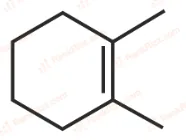
The one giving maximum number of isomeric alkenes on dehydrohalogenation reaction is (excluding rearrangement)

  1. A

    1-Bromo-2-methylbutane

  2. B

    2-Bromopropane

  3. C

    2-Bromopentane

  4. D

    2-Bromo-3,3-dimethylpentane

Q45Properties and reactions of alcohols

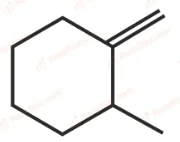
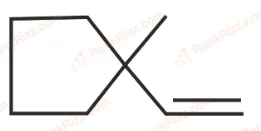
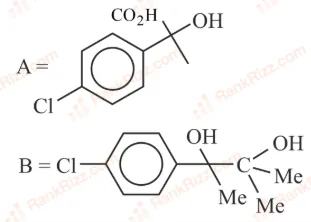
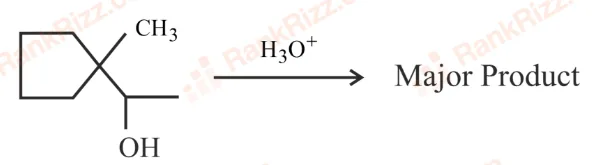
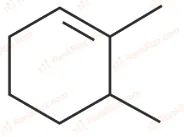
Find out the major product for the following reaction

Figure for JEE Main 2023 Chemistry question on Properties and reactions of alcohols
  1. A
    Figure for JEE Main 2023 Chemistry question on Properties and reactions of alcohols
  2. B
    Figure for JEE Main 2023 Chemistry question on Properties and reactions of alcohols
  3. C
    Figure for JEE Main 2023 Chemistry question on Properties and reactions of alcohols
  4. D
    Figure for JEE Main 2023 Chemistry question on Properties and reactions of alcohols
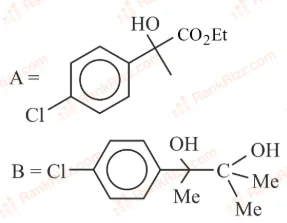
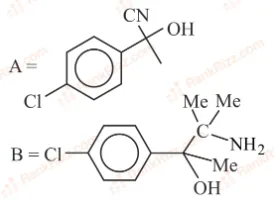
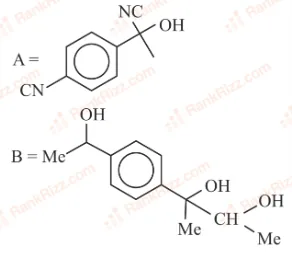
Q46Nucleophilic addition reactions of carbonyl compounds

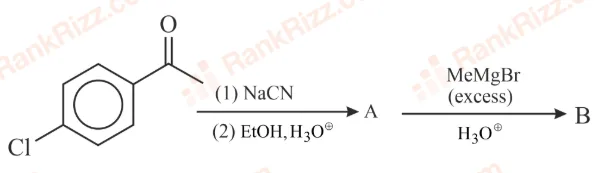
Find out the major products from the following reaction sequence.

Figure for JEE Main 2023 Chemistry question on Nucleophilic addition reactions of carbonyl compounds
  1. A
    Figure for JEE Main 2023 Chemistry question on Nucleophilic addition reactions of carbonyl compounds
  2. B
    Figure for JEE Main 2023 Chemistry question on Nucleophilic addition reactions of carbonyl compounds
  3. C
    Figure for JEE Main 2023 Chemistry question on Nucleophilic addition reactions of carbonyl compounds
  4. D
    Figure for JEE Main 2023 Chemistry question on Nucleophilic addition reactions of carbonyl compounds
Q47Reactions and tests of amines

Reaction of propanamide with Br2_2 / KOH (aq) produces:

  1. A

    Ethylnitrile

  2. B

    Propylamine

  3. C

    Propanenitrile

  4. D

    Ethylamine

Q48Important polymers and their monomers

Match List-I and List-II.

List-IList-II
A. Elastomeric polymerI. Urea formaldehyde resin
B. Fibre polymerII. Polystyrene
C. Thermosetting polymerIII. Polyester
D. Thermoplastic polymerIV. Neoprene

Choose the correct answer from the options given below:
  1. A

    A-II, B-III, C-I, D-IV

  2. B

    A-II, B-I, C-IV, D-III

  3. C

    A-IV, B-III, C-I, D-II

  4. D

    A-IV, B-I, C-III, D-II

Q49Drugs and medicines

A doctor prescribed the drug Equanil to a patient. The patient was likely to have symptoms of which disease?

  1. A

    Stomach ulcers

  2. B

    Hyperacidity

  3. C

    Anxiety and stress

  4. D

    Depression and hypertension

Q50Proteins and enzymes

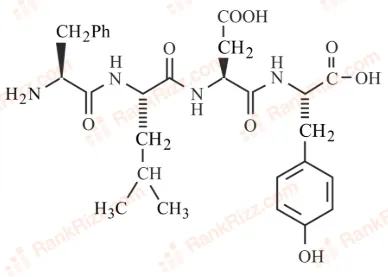
Following tetrapeptide can be represented as

Figure for JEE Main 2023 Chemistry question on Proteins and enzymes


(F, L, D, Y, I, Q, P are one letter codes for amino acids)

  1. A

    FIQY

  2. B

    FLDY

  3. C

    YQLF

  4. D

    PLDY

Q51Bohr model of hydrogen-like species

Assume that the radius of the first Bohr orbit of hydrogen atom is 0.60.6 A˚\text{\AA}. The radius of the third Bohr orbit of He+^+ is ______ picometer. (Nearest Integer)

Q52Law of mass action and equilibrium constants Kc and Kp

At 298 K
N2(g)+3H2(g)⇌2NH3(g),K1=4×10⁵\text{N}_2(g) + 3\text{H}_2(g) \rightleftharpoons 2\text{NH}_3(g), K_1 = 4 \times 10^5
N2(g)+O2(g)⇌2NO(g),K2=1.6×10¹²\text{N}_2(g) + \text{O}_2(g) \rightleftharpoons 2\text{NO}(g), K_2 = 1.6 \times 10^{12}
H2(g)+12O2(g)⇌H2O(g),K3=1.0×10⁻¹³\text{H}_2(g) + \frac{1}{2}\text{O}_2(g) \rightleftharpoons \text{H}_2\text{O}(g), K_3 = 1.0 \times 10^{-13}
Based on above equilibria, the equilibrium constant of the reaction,
2NH3(g)+52O2(g)⇌2NO(g)+3H2O(g)2\text{NH}_3(g) + \frac{5}{2}\text{O}_2(g) \rightleftharpoons 2\text{NO}(g) + 3\text{H}_2\text{O}(g)
is ______ ×10−33\times 10^{-33} (Nearest integer)

Q53Mole concept, atomic and molar mass

The volume of HCl, containing 7373 g L−1^{-1}, required to completely neutralise NaOH obtained by reacting 0.690.69 g of metallic sodium with water, is ______ mL. (Nearest Integer)
(Given: molar Masses of Na, Cl, O, H are 23, 35.5, 16 and 1 g mol−1^{-1} respectively)

Q54Compounds of alkali metals

On heating, LiNO3_3 gives how many compounds among the following?
Li2_2O, N2_2, O2_2, LiNO2_2, NO2_2

Q55Mole concept, atomic and molar mass

When 0.010.01 mol of an organic compound containing 60%60\% carbon was burnt completely, 4.44.4 g of CO2_2 was produced. The molar mass of compound is ______ g mol−1^{-1} (Nearest integer)

Q56Voids, radius ratio and structures of ionic solids

A metal M forms hexagonal close-packed structure. The total number of voids in 0.020.02 mol of it is ______ ×1021\times 10^{21} (Nearest integer)
(Given NA=6.02×10²³_A = 6.02 \times 10^{23})

Q57Electrode potentials, electrochemical series and cell EMF

The equilibrium constant for the reaction Zn(s) + Sn2+^{2+}(aq) ⇌\rightleftharpoons Zn2+^{2+}(aq) + Sn(s) is 1×10201 \times 10^{20} at 298 K. The magnitude of standard electrode potential of Sn/Sn2+^{2+} if EZn2+/Zn0=−0.76^0_{\text{Zn}^{2+}/\text{Zn}} = -0.76 V is ______ ×10−2\times 10^{-2} V. (Nearest integer)
Given: 2.303RTF=0.059\frac{2.303 RT}{F} = 0.059 V

Q58Methods to determine order of reaction

For conversion of compound A →\to B, the rate constant of the reaction was found to be 4.6×10−54.6 \times 10^{-5} L mol−1^{-1} s−1^{-1}. The order of the reaction is ______.

Q59Valency, oxidation states and nature of oxides

Total number of acidic oxides among N2_2O3_3, NO2_2, N2_2O, Cl2_2O7_7, SO2_2, CO, CaO, Na2_2O and NO is ______.

Q60Ligands, denticity and chelation

The denticity of the ligand present in the Fehling's reagent is ______.

NEXT IN THIS PAPER →Maths, Q61 onwards