All 90 questions of JEE Main 08 Apr 2023, Shift 2, in the order they were asked, one subject to a page. Pick an answer on any question to check it against the key. Free to read, nothing to download.
Questions
90
Physics · Chemistry · Maths
Answer key
89
questions with a checked key
Price
Free
no sign-up
Physics
Q1Units: SI system, unit conversion and new systems of units
Match List I with List II
List I
List II
A.
Torque
I.
ML−2T−2
B.
Stress
II.
ML2T−2
C.
Pressure gradient
III.
ML−1T−1
D.
Coefficient of viscosity
IV.
ML−1T−2
Choose the correct answer from the options given below:
Given below are two statements: Statement I: Area under velocity-time graph gives the distance travelled by the body in a given time. Statement II: Area under acceleration-time graph is equal to the change in velocity in the given time. In the light of given statements, choose the correct answer from the options given below.
The trajectory of projectile, projected from the ground is given by y=x−20x2. Where x and y are measured in meter. The maximum height attained by the projectile will be.
A bullet of mass 0.1 kg moving horizontally with speed 400 m s−1 hits a wooden block of mass 3.9 kg kept on a horizontal rough surface. The bullet gets embedded into the block and moves 20 m before coming to rest. The coefficient of friction between the block and the surface is
The orbital angular momentum of a satellite is L, when it is revolving in a circular orbit at height h from earth surface. If the distance of satellite from the earth centre is increased by eight times to its initial value, then the new angular momentum will be
Q7Fluid pressure, Pascal's law and accelerated/rotating liquids
A hydraulic automobile lift is designed to lift vehicles of mass 5000 kg. The area of cross section of the cylinder carrying load is 250 cm2. The maximum pressure the smaller piston would have to bear is [Assume g=10 m s−2]
Q10SHM: equation, phase, velocity and acceleration
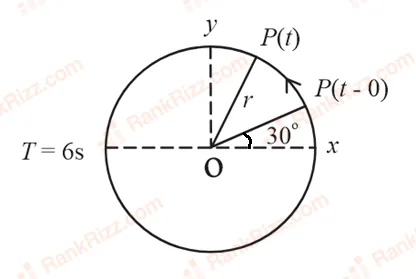
For particle P revolving round the centre O with radius of circular path r and angular velocity ω, as shown in below figure, the projection of OP on the x-axis at time t is
Electric potential at a point P due to a point charge of 5×10⁻⁹ C is 50 V. The distance of P from the point charge is: (Assume, 4πε01=9×10⁹ N m2 C−2)
Q13Magnetisation, magnetic intensity, susceptibility and permeability
Given below are two statements: one is labelled as Assertion A and the other is labelled as Reason R. Assertion A: Electromagnets are made of soft iron. Reason R: Soft iron has high permeability and low retentivity. In the light of above statements, choose the most appropriate answer from the options given below.
A
A is not correct but R is correct
B
A is correct but R is not correct
C
Both A and R are correct and R is the correct explanation of A
D
Both A and R are correct but R is NOT the correct explanation of A
Q16Young's double slit experiment: fringe width and intensity
The width of fringe is 2 mm on the screen in a double slit experiment for the light of wavelength of 400 nm. The width of the fringe for the light of wavelength 600 nm will be:
In photoelectric effect A. The photocurrent is proportional to the intensity of the incident radiation. B. Maximum kinetic energy with which photoelectrons are emitted depends on the intensity of incident light. C. Max K.E. with which photoelectrons are emitted depends on the frequency of incident light. D. The emission of photoelectrons require a minimum threshold intensity of incident radiation. E. Max K.E. of the photoelectrons is independent of the frequency of the incident light. Choose the correct option from the options given below:
Q18Radioactivity: decay law, half-life and decay modes
A radio active material is reduced to 81 of its original amount in 3 days. If 8×10⁻³ kg of the material is left after 5 days the initial amount of the material is
A body of mass 5 kg is moving with a momentum of 10 kg m s−1. Now a force of 2 N acts on the body in the direction of its motion for 5 s. The increase in the Kinetic energy of the body is _______ J.
Q22Rolling with friction, slipping and impulsive forces
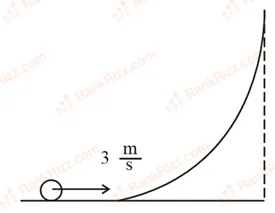
A hollow spherical ball of uniform density rolls up a curved surface with an initial velocity 3 m s−1 (as shown in figure). Maximum height with respect to the initial position covered by it will be _______ cm. (take, g=10 m s−2)
A steel rod of length 1 m and cross-sectional area 10−4 m2 is heated from 0∘C to 200∘C without being allowed to extend or bend. The compressive tension produced in the rod is _______ ×104 N. (Given Young's modulus of steel =2×10¹¹ N m−2, coefficient of linear expansion =10−5 K−1)
A guitar string of length 90 cm vibrates with a fundamental frequency of 120 Hz. The length of the string producing a fundamental of 180 Hz will be _______ cm.
Q25Energy stored, force between plates and charge sharing
A 600 pF capacitor is charged by 200 V supply. It is then disconnected from the supply and is connected to another uncharged 600 pF capacitor. Electrostatic energy lost in the process is _______ μJ.
Q26Electric current, current density and drift velocity
The number density of free electrons in copper is nearly 8×1028 m−3. A copper wire has its area of cross-section =2×10⁻⁶ m2 and is carrying a current of 3.2 A. The drift speed of the electrons is _______ ×10−6 m s−1.
Q27Biot-Savart law: straight wires and moving charges
The ratio of magnetic field at the centre of a current carrying coil of radius r to the magnetic field at distance r from the centre of coil on its axis is x : 1. The value of x is _____.
A series combination of resistor of resistance 100 Ω, inductor of inductance 1 H and capacitor of capacitance 6.25 μF is connected to an ac source. The quality factor of the circuit will be _____.
Q29Refraction at plane surfaces, Snell's law and apparent depth
Two transparent media having refractive indices 1.0 and 1.5 are separated by a spherical refracting surface of radius of curvature 30 cm. The centre of curvature of surface is towards denser medium and a point object is placed on the principal axis in rarer medium at a distance of 15 cm from the pole of the surface. The distance of image from the pole of the surface is _______ cm.