RankRizz

JEE Main 29 Jun 2022, Shift 2 Question Paper

All 90 questions of JEE Main 29 Jun 2022, Shift 2, in the order they were asked, one subject to a page. Pick an answer on any question to check it against the key. Free to read, nothing to download.

Questions

90

Physics · Chemistry · Maths

Answer key

88

questions with a checked key

Price

Free

no sign-up

Physics

Q1Equations of motion for uniform acceleration

A small toy starts moving from the position of rest under a constant acceleration. If it travels a distance of 10 m in tt s, the distance travelled by the toy in the next tt s will be:

  1. A

    10 m

  2. B

    20 m

  3. C

    30 m

  4. D

    40 m

Q2Projectile motion from level ground

A person can throw a ball upto a maximum range of 100 m. How high above the ground he can throw the same ball?

  1. A

    25 m

  2. B

    50 m

  3. C

    100 m

  4. D

    200 m

Q3Static and kinetic friction

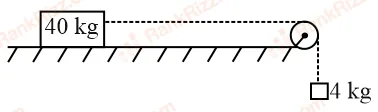
A block of mass 40 kg slides over a surface, when a mass of 4 kg is suspended through an inextensible massless string passing over frictionless pulley as shown below. The coefficient of kinetic friction between the surface and block is 0.02. The acceleration of block is: (Given g=10g = 10 m s−2^{-2}.)

Figure for JEE Main 2022 Physics question on Static and kinetic friction
  1. A

    811\frac{8}{11} m s−2^{-2}

  2. B

    1 m s−2^{-2}

  3. C

    15\frac{1}{5} m s−2^{-2}

  4. D

    45\frac{4}{5} m s−2^{-2}

Q4Pseudo force: lifts and accelerating frames

A block of mass MM placed inside a box descends vertically with acceleration aa. The block exerts a force equal to one-fourth of its weight on the floor of the box. The value of 'aa' will be

  1. A

    gg

  2. B

    3g4\frac{3g}{4}

  3. C

    g2\frac{g}{2}

  4. D

    g4\frac{g}{4}

Q5Conservation of mechanical energy

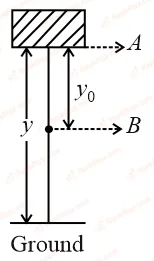
In the given figure, the block of mass mm is dropped from the point 'A'. The expression for kinetic energy of block when it reaches point 'B' is

Figure for JEE Main 2022 Physics question on Conservation of mechanical energy
  1. A

    mgy0mgy_0

  2. B

    12mgy02\frac{1}{2}mgy_0^2

  3. C

    12mgy2\frac{1}{2}mgy^2

  4. D

    mg(y−y0)mg(y - y_0)

Q6Kepler's laws and planetary motion

The time period of a satellite revolving around earth in a given orbit is 7 hours. If the radius of orbit is increased to three times its previous value, then approximate new time period of the satellite will be

  1. A

    36 hours

  2. B

    40 hours

  3. C

    30 hours

  4. D

    25 hours

Q7Temperature scales and thermal expansion

At what temperature a gold ring of diameter 6.230 cm be heated so that it can be fitted on a wooden bangle of diameter 6.241 cm? Both the diameters have been measured at room temperature (27°C).
(Given: coefficient of linear thermal expansion of gold αL=1.4×10⁻⁵\alpha_L = 1.4 \times 10^{-5} K−1^{-1})

  1. A

    125.7°C

  2. B

    91.7°C

  3. C

    425.7°C

  4. D

    152.7°C

Q8Isothermal and adiabatic processes

Starting with the same initial conditions, an ideal gas expands from volume V1V_1 to V2V_2 in three different ways. The work done by the gas is W1W_1 if the process is purely isothermal, W2W_2, if the process is purely adiabatic and W3W_3 if the process is purely isobaric. Then, choose the correct option

  1. A

    W2<W1<W3W_2 < W_1 < W_3

  2. B

    W1<W2<W3W_1 < W_2 < W_3

  3. C

    W2<W3<W1W_2 < W_3 < W_1

  4. D

    W3<W1<W2W_3 < W_1 < W_2

Q9Ideal gas equation and gas laws

A vessel contains 16 g of hydrogen and 128 g of oxygen at standard temperature and pressure. The volume of the vessel in cm3^3 is:

  1. A

    72×10572 \times 10^5

  2. B

    32×10532 \times 10^5

  3. C

    27×10427 \times 10^4

  4. D

    54×10454 \times 10^4

Q10SHM: equation, phase, velocity and acceleration

The motion of a simple pendulum executing S.H.M. is represented by the following equation y=Asin⁡(πt+ϕ)y = A \sin(\pi t + \phi), where time is measured in second. The length of pendulum is

  1. A

    97.23 cm

  2. B

    25.3 cm

  3. C

    99.4 cm

  4. D

    406.1 cm

Q11Electric charge and Coulomb's law

Two point charges QQ each are placed at a distance dd apart. A third point charge qq is placed at a distance xx from mid-point on the perpendicular bisector. The value of xx at which charge qq will experience the maximum Coulomb's force is:

  1. A

    dd

  2. B

    d2\frac{d}{2}

  3. C

    d2\frac{d}{\sqrt{2}}

  4. D

    d22\frac{d}{2\sqrt{2}}

Q12Electric potential and potential energy

If the electric potential at any point (x,y,z)(x, y, z) m in space is given by V=3x2V = 3x^2 volt. The electric field at the point (1,0,3)(1, 0, 3) m will be:

  1. A

    3 Vm−1^{-1}, directed along positive xx-axis.

  2. B

    3 Vm−1^{-1}, directed along negative xx-axis.

  3. C

    6 Vm−1^{-1}, directed along negative xx-axis.

  4. D

    6 Vm−1^{-1}, directed along positive xx-axis.

Q13RC circuits: charging and discharging

A capacitor is discharging through a resistor RR. Consider in time t1t_1, the energy stored in the capacitor reduces to half of its initial value and in time t2t_2, the charge stored reduces to one eighth of its initial value. The ratio t1t2\frac{t_1}{t_2} will be

  1. A

    12\frac{1}{2}

  2. B

    13\frac{1}{3}

  3. C

    14\frac{1}{4}

  4. D

    16\frac{1}{6}

Q14Cells: emf, internal resistance and combinations

The combination of two identical cells, whether connected in series or parallel combination provides the same current through an external resistance of 2 Ω\Omega. The value of internal resistance of each cell is

  1. A

    2 Ω\Omega

  2. B

    4 Ω\Omega

  3. C

    6 Ω\Omega

  4. D

    8 Ω\Omega

Q15Biot-Savart law: straight wires and moving charges

Two long current carrying conductors are placed parallel to each other at a distance of 8 cm between them. The magnitude of magnetic field produced at mid-point between the two conductors due to current flowing in them is 300 μ\muT. The equal current flowing in the two conductors is:

  1. A

    30 A in the same direction.

  2. B

    60 A in the opposite direction.

  3. C

    30 A in the opposite direction.

  4. D

    300 A in the opposite direction.

Q16Motion of charged particles in a magnetic field

Given below are two statements:
Statement I: The electric force changes the speed of the charged particle and hence changes its kinetic energy; whereas the magnetic force does not change the kinetic energy of the charged particle.
Statement II: The electric force accelerates the positively charged particle perpendicular to the direction of electric field. The magnetic force accelerates the moving charged particle along the direction of magnetic field.
In the light of the above statements, choose the most appropriate answer from the options below:

  1. A

    Both Statement I and Statement II are correct.

  2. B

    Both Statement I and Statement II are incorrect.

  3. C

    Statement I is correct but Statement II is incorrect.

  4. D

    Statement I is incorrect but Statement II is correct.

Q17Total internal reflection and critical angle

The speed of light in media 'A' and 'B' are 2.0×10102.0 \times 10^{10} cm s−1^{-1} and 1.5×10101.5 \times 10^{10} cm s−1^{-1} respectively. A ray of light enters from the medium BB to AA at an incident angle θ\theta. If the ray suffers total internal reflection, then

  1. A

    θ=sin⁡−1(43)\theta = \sin^{-1}\left(\frac{4}{3}\right)

  2. B

    θ>sin⁡−1(23)\theta > \sin^{-1}\left(\frac{2}{3}\right)

  3. C

    θ>sin⁡−1(34)\theta > \sin^{-1}\left(\frac{3}{4}\right)

  4. D

    θ<sin⁡−1(34)\theta < \sin^{-1}\left(\frac{3}{4}\right)

Q18Photoelectric effect and Einstein's equation

The electric field at a point associated with a light wave is given by
E=200[sin⁡(6×10¹⁵)t+sin⁡(9×10¹⁵)t]E = 200\left[\sin(6 \times 10^{15})t + \sin(9 \times 10^{15})t\right] Vm−1^{-1}
Given: h=4.14×10⁻¹⁵h = 4.14 \times 10^{-15} eVs
If this light falls on a metal surface having a work function of 2.50 eV, the maximum kinetic energy of the photoelectrons will be

  1. A

    1.90 eV

  2. B

    3.27 eV

  3. C

    3.60 eV

  4. D

    3.42 eV

Q19Radioactivity: decay law, half-life and decay modes

In the following nuclear reaction,
D→αD1→βD2→αD3→γD4D \xrightarrow{\alpha} D_1 \xrightarrow{\beta} D_2 \xrightarrow{\alpha} D_3 \xrightarrow{\gamma} D_4
Mass number of DD is 182 and atomic number is 74. Mass number and atomic number of D4D_4 respectively will be

  1. A

    174 and 71

  2. B

    174 and 69

  3. C

    172 and 69

  4. D

    172 and 71

Q20Elements of communication and propagation of EM waves

The TV transmission tower at a particular station has a height of 125 m. For doubling the coverage of its range, the height of the tower should be increased by

  1. A

    500 m

  2. B

    375 m

  3. C

    250 m

  4. D

    125 m

Q21Moment of inertia of standard bodies and composite systems

The moment of inertia of a uniform thin rod about a perpendicular axis passing through one end is I1I_1. The same rod is bent into a ring and its moment of inertia about a diameter is I2I_2. If I1I2\frac{I_1}{I_2} is xπ23\frac{x\pi^2}{3}, then the value of xx will be ______.

Q22Stokes' law and terminal velocity

A small spherical ball of radius 0.1 mm and density 10410^4 kg m−3^{-3} falls freely under gravity through a distance hh before entering a tank of water. If, after entering the water the velocity of ball does not change and it continue to fall with same constant velocity inside water, then the value of hh will be ______ m. (Given g=10g = 10 m s−2^{-2}, viscosity of water =1.0×10−5= 1.0 \times 10^{-5} N-s m−2^{-2}).

Q23Superposition, interference and beats

In an experiment to determine the velocity of sound in air at room temperature using a resonance tube, the first resonance is observed when the air column has a length of 20.0 cm for a tuning fork of frequency 400 Hz is used. The velocity of the sound at room temperature is 336 m s−1^{-1}. The third resonance is observed when the air column has a length of ______ cm.

Q24Properties of EM waves: fields, energy, intensity and momentum

The displacement current of 4.425 μ\muA is developed in the space between the plates of parallel plate capacitor when voltage is changing at a rate of 10610^6 V s−1^{-1}. The area of each plate of the capacitor is 40 cm2^2. The distance between each plate of the capacitor is x×10−3x \times 10^{-3} m. The value of xx is,
(Permittivity of free space, ε0=8.85×10⁻¹²\varepsilon_0 = 8.85 \times 10^{-12} C2^2 N−1^{-1} m−2^{-2})

Q25Galvanometer conversion to ammeter and voltmeter

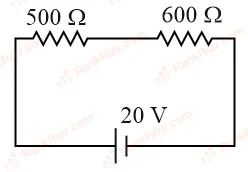
Two resistors are connected in series across a battery as shown in figure. If a voltmeter of resistance 2000 Ω\Omega is used to measure the potential difference across 500 Ω\Omega resister, the reading of the voltmeter will be ______ V.

Figure for JEE Main 2022 Physics question on Galvanometer conversion to ammeter and voltmeter
Q26Series LCR circuits: impedance and phase

An inductor of 0.5 mH, a capacitor of 200 μ\muF and a resistor of 2 Ω\Omega are connected in series with a 220 V ac source. If the current is in phase with the emf, the frequency of ac source will be ______ ×102\times 10^2 Hz.

Q27Wavefronts and Huygens' principle

In a double slit experiment with monochromatic light, fringes are obtained on a screen placed at some distance from the plane of slits. If the screen is moved by 5×10⁻²⁵ \times 10^{-2} m towards the slits, the change in fringe width is 3×10⁻³³ \times 10^{-3} cm. If the distance between the slits is 1 mm, then the wavelength of the light will be ______ nm.

Q28Radioactivity: decay law, half-life and decay modes

The half life of a radioactive substance is 5 years. After xx years a given sample of the radioactive substance gets reduced to 6.25% of its initial value. The value of xx is ______.

Q29p-n junction diode and its characteristics

A potential barrier of 0.4 V exists across a p-n junction. An electron enters the junction from the nn-side with a speed of 6.0×1056.0 \times 10^5 m s−1^{-1}. The speed with which electron enters the pp side will be x3×105\frac{x}{3} \times 10^5 m s−1^{-1}, then the value of xx is ______.: (Given mass of electron =9×10−31= 9 \times 10^{-31} kg, charge on electron =1.6×10−19= 1.6 \times 10^{-19} C.)

Q30Vernier calipers: least count and zero error

The Vernier constant of Vernier callipers is 0.1 mm and it has zero error of (−-0.05 cm). While measuring diameter of a sphere, the main scale reading is 1.7 cm and coinciding vernier division is 5. The corrected diameter will be ______ ×10−2\times 10^{-2} cm.

NEXT IN THIS PAPER →Chemistry, Q31 onwards