RankRizz

JEE Main 27 Jul 2022, Shift 2: Maths

The 30 Maths questions of JEE Main 27 Jul 2022, Shift 2, numbered across the whole paper. Pick an answer on any question to check it against the key. Free to read, nothing to download.

Maths

Q61Relation between roots and coefficients

If α,β\alpha, \beta are the roots of the equation x2−(5+3log⁡35−5log⁡53)x+3(3(log⁡35)1/3−5(log⁡53)2/3−1)=0x^2 - (5 + 3^{\sqrt{\log_3 5}} - 5^{\sqrt{\log_5 3}})x + 3(3^{(\log_3 5)^{1/3}} - 5^{(\log_5 3)^{2/3}} - 1) = 0 then the equation, whose roots are α+1β\alpha + \dfrac{1}{\beta} and β+1α\beta + \dfrac{1}{\alpha}, is

  1. A

    3x2−20x−12=03x^2 - 20x - 12 = 0

  2. B

    3x2−10x−4=03x^2 - 10x - 4 = 0

  3. C

    3x2−10x+2=03x^2 - 10x + 2 = 0

  4. D

    3x2−20x+16=03x^2 - 20x + 16 = 0

Q62Algebra of complex numbers and square roots

Let S be the set of all (α,β)(\alpha, \beta), π<α,β<2π\pi < \alpha, \beta < 2\pi, for which the complex number 1−isin⁡α1+2isin⁡α\frac{1-i\sin\alpha}{1+2i\sin\alpha} is purely imaginary and 1+icos⁡β1−2icos⁡β\frac{1+i\cos\beta}{1-2i\cos\beta} is purely real. Let Zαβ=sin⁡2α+icos⁡2β,(α,β)∈SZ_{\alpha\beta} = \sin 2\alpha + i\cos 2\beta, (\alpha,\beta) \in S. Then ∑(α,β)∈S(iZαβ+1iZˉαβ)\sum_{(\alpha,\beta)\in S}(iZ_{\alpha\beta} + \frac{1}{i\bar{Z}_{\alpha\beta}}) is equal to

  1. A

    3

  2. B

    3i

  3. C

    1

  4. D

    2−i2 - i

Q63Geometric progression and infinite GP

Let the sum of an infinite G.P., whose first term is aa and the common ratio is rr, be 5. Let the sum of its first five terms be 9825\frac{98}{25}. Then the sum of the first 21 terms of an A.P., whose first term is 10ar10ar, nthn^{th} term is ana_n and the common difference is 10ar210ar^2, is equal to

  1. A

    21a1121a_{11}

  2. B

    22a1122a_{11}

  3. C

    15a1615a_{16}

  4. D

    14a1614a_{16}

Q64Number of solutions in an interval

Let S={θ∈(0,π2):∑m=19sec⁡(θ+(m−1)π6)sec⁡(θ+mπ6)=−83}S = \left\{\theta \in \left(0, \frac{\pi}{2}\right) : \sum_{m=1}^{9} \sec\left(\theta + (m-1)\frac{\pi}{6}\right) \sec\left(\theta + \frac{m\pi}{6}\right) = -\frac{8}{\sqrt{3}}\right\}. Then

  1. A

    S={π12}S = \left\{\frac{\pi}{12}\right\}

  2. B

    S={2π3}S = \left\{\frac{2\pi}{3}\right\}

  3. C

    ∑θ∈Sθ=π2\sum_{\theta \in S} \theta = \frac{\pi}{2}

  4. D

    ∑θ∈Sθ=3π4\sum_{\theta \in S} \theta = \frac{3\pi}{4}

Q65Centroid, incentre, circumcentre and orthocentre

The equations of the sides AB, BC and CA of a triangle ABC are 2x+y=02x + y = 0, x+py=39x + py = 39 and x−y=3x - y = 3 respectively and P(2,3) is its circumcentre. Then which of the following is NOT true?

  1. A

    (AC)2=9p(AC)^2 = 9p

  2. B

    (AC)2+p2=136(AC)^2 + p^2 = 136

  3. C

    32<area(ΔABC)<3632 < \text{area}(\Delta ABC) < 36

  4. D

    34<area(ΔABC)<3834 < \text{area}(\Delta ABC) < 38

Q66Tangents and normals to a circle

A circle C1C_1 passes through the origin O and has diameter 4 on the positive x-axis. The line y=2xy = 2x gives a chord OA of circle C1C_1. Let C2C_2 be the circle with OA as a diameter. If the tangent to C2C_2 at the point A meets the x-axis at P and y-axis at Q, then QA:APQA : AP is equal to

  1. A

    1 : 4

  2. B

    1 : 5

  3. C

    2 : 5

  4. D

    1 : 3

Q67Tangents, pair of tangents and chord of contact

If the length of the latus rectum of a parabola, whose focus is (a,a)(a, a) and the tangent at its vertex is x+y=ax + y = a, is 16, then ∣a∣|a| is equal to

  1. A

    222\sqrt{2}

  2. B

    232\sqrt{3}

  3. C

    424\sqrt{2}

  4. D

    4

Q68Logical connectives, truth tables and tautologies

If the truth value of the statement (P∧(∼R))→((∼R)∧Q)(P \wedge (\sim R)) \to ((\sim R) \wedge Q) is F, then the truth value of which of the following is F?

  1. A

    P∨Q→∼RP \vee Q \to \sim R

  2. B

    R∨Q→∼PR \vee Q \to \sim P

  3. C

    ∼(P∨Q)→∼R\sim(P \vee Q) \to \sim R

  4. D

    ∼(R∨Q)→∼P\sim(R \vee Q) \to \sim P

Q69Heights and distances

The angle of elevation of the top P of a vertical tower PQ of height 10 from a point A on the horizontal ground is 45∘45^\circ. Let R be a point on AQ and from a point B, vertically above R, the angle of elevation of P is 60∘60^\circ. If ∠BAQ=30∘\angle BAQ = 30^\circ, AB=dAB = d and the area of the trapezium PQRB is α\alpha, then the ordered pair (d,α)(d, \alpha) is

  1. A

    (10(3−1),25)(10(\sqrt{3}-1), 25)

  2. B

    (10(3−1),252)(10(\sqrt{3}-1), \frac{25}{2})

  3. C

    (10(3+1),25)(10(\sqrt{3}+1), 25)

  4. D

    (10(3+1),252)(10(\sqrt{3}+1), \frac{25}{2})

Q70Properties of determinants

Let A=(4−2αβ)A = \begin{pmatrix} 4 & -2 \\ \alpha & \beta \end{pmatrix}. If A2+γA+18I=OA^2 + \gamma A + 18I = O, then det⁡(A)\det(A) is equal to

  1. A

    -18

  2. B

    18

  3. C

    -50

  4. D

    50

Q71Domain, range and principal values

The domain of the function f(x)=sin⁡−1[2x2−3]+log⁡2(log⁡12(x2−5x+5))f(x) = \sin^{-1}[2x^2 - 3] + \log_2\left(\log_{\frac{1}{2}}(x^2 - 5x + 5)\right), where [t][t] is the greatest integer function, is

  1. A

    (−52,5−52)\left(-\sqrt{\frac{5}{2}}, \frac{5-\sqrt{5}}{2}\right)

  2. B

    (5−52,5+52)\left(\frac{5-\sqrt{5}}{2}, \frac{5+\sqrt{5}}{2}\right)

  3. C

    (1,5−52)\left(1, \frac{5-\sqrt{5}}{2}\right)

  4. D

    [1,5+52)\left[1, \frac{5+\sqrt{5}}{2}\right)

Q72Continuity at a point

If for p≠q≠0p \neq q \neq 0, the function f(x)=7729+xp−3729+qx3−9f(x) = \frac{7\sqrt[p]{729+x} - 3}{\sqrt[3]{729+qx} - 9} is continuous at x=0x = 0, then

  1. A

    7pqf(0)−1=07pqf(0) - 1 = 0

  2. B

    63qf(0)−p2=063qf(0) - p^2 = 0

  3. C

    21qf(0)−p2=021qf(0) - p^2 = 0

  4. D

    7pqf(0)−9=07pqf(0) - 9 = 0

Q73Integrals with modulus, greatest integer and piecewise functions

Let f(x)=2+∣x∣−∣x−1∣+∣x+1∣f(x) = 2 + |x| - |x-1| + |x+1|, x∈Rx \in \mathbb{R}. Consider
(S1):f′(−3/2)+f′(−1/2)+f′(1/2)+f′(3/2)=2(S_1): f'(-3/2) + f'(-1/2) + f'(1/2) + f'(3/2) = 2
(S2):∫−22f(x)dx=12(S_2): \int_{-2}^{2} f(x) dx = 12
Then,

  1. A

    both (S1)(S_1) and (S2)(S_2) are correct

  2. B

    both (S1)(S_1) and (S2)(S_2) are wrong

  3. C

    only (S1)(S_1) is correct

  4. D

    only (S2)(S_2) is correct

Q74Definite integrals: properties and King's rule

∫02∣2x2−3x+[x−12]∣dx\int_0^2 \left|2x^2 - 3x + \left[x - \frac{1}{2}\right]\right| dx, where [t][t] is the greatest integer function, is equal to

  1. A

    76\frac{7}{6}

  2. B

    1912\frac{19}{12}

  3. C

    3112\frac{31}{12}

  4. D

    32\frac{3}{2}

Q75Areas of regions defined by inequalities

The area of the region enclosed by y≤4x2y \leq 4x^2, x2≤9yx^2 \leq 9y and y≤4y \leq 4, is equal to

  1. A

    403\frac{40}{3}

  2. B

    563\frac{56}{3}

  3. C

    1123\frac{112}{3}

  4. D

    803\frac{80}{3}

Q76Area between curves

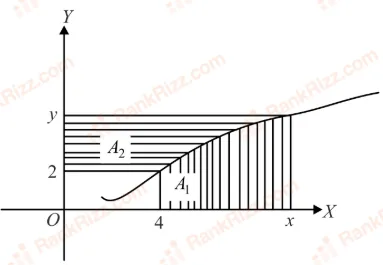
Consider a curve y=y(x)y = y(x) in the first quadrant as shown in the figure. Let the area A1A_1 is twice the area A2A_2. Then the normal to the curve perpendicular to the line 2x−12y=152x - 12y = 15 does NOT pass through the point

Figure for JEE Main 2022 Mathematics question on Area between curves
  1. A

    (6, 21)

  2. B

    (8, 9)

  3. C

    (10, -4)

  4. D

    (12, -15)

Q77Foot of perpendicular, image and distance from a line

If the length of the perpendicular drawn from the point P(a,4,2)P(a, 4, 2), a>0a > 0 on the line x+12=y−33=z−1−1\frac{x+1}{2} = \frac{y-3}{3} = \frac{z-1}{-1} is 262\sqrt{6} units and Q(α1,α2,α3)(\alpha_1, \alpha_2, \alpha_3) is the image of the point P in this line, then a+∑i=13αia + \sum_{i=1}^{3} \alpha_i is equal to

  1. A

    7

  2. B

    8

  3. C

    12

  4. D

    14

Q78Line and plane: intersection, coplanarity and projection

If the line of intersection of the planes ax+by=3ax + by = 3 and ax+by+cz=0ax + by + cz = 0, a>0a > 0 makes an angle 30∘30^\circ with the plane y−z+2=0y - z + 2 = 0, then the direction cosines of the line are

  1. A

    12,12,0\frac{1}{\sqrt{2}}, \frac{1}{\sqrt{2}}, 0

  2. B

    12,−12,0\frac{1}{\sqrt{2}}, -\frac{1}{\sqrt{2}}, 0

  3. C

    15,−25,0\frac{1}{\sqrt{5}}, -\frac{2}{\sqrt{5}}, 0

  4. D

    12,−32,0\frac{1}{2}, -\frac{\sqrt{3}}{2}, 0

Q79Binomial distribution

Let X have a binomial distribution B(n,p)B(n, p) such that the sum and the product of the mean and variance of X are 24 and 128 respectively. If P(X>n−3)=k2nP(X > n-3) = \frac{k}{2^n}, then kk is equal to

  1. A

    528

  2. B

    529

  3. C

    629

  4. D

    630

Q80Random variables, mean and variance

A six faced die is biased such that 3×P(a prime number)=6×P(a composite number)=2×P(1)3 \times P(\text{a prime number}) = 6 \times P(\text{a composite number}) = 2 \times P(1). Let X be a random variable that counts the number of times one gets a perfect square on some throws of this die. If the die is thrown twice, then the mean of X is

  1. A

    311\frac{3}{11}

  2. B

    511\frac{5}{11}

  3. C

    711\frac{7}{11}

  4. D

    811\frac{8}{11}

Q81Arithmetico-geometric progression

23−131×7+43−33+23−132×11+63−53+43−33+23−133×15+…+303−293+283−273+…+23−1315×63\frac{2^3 - 1^3}{1 \times 7} + \frac{4^3 - 3^3 + 2^3 - 1^3}{2 \times 11} + \frac{6^3 - 5^3 + 4^3 - 3^3 + 2^3 - 1^3}{3 \times 15} + \ldots + \frac{30^3 - 29^3 + 28^3 - 27^3 + \ldots + 2^3 - 1^3}{15 \times 63} is equal to ______.

Q82General term and specific coefficients

Let for the 9th9^{th} term in the binomial expansion of (3+6x)n(3 + 6x)^n, in the increasing powers of 6x6x, to be the greatest for x=32x = \frac{3}{2}, the least value of nn is n0n_0. If kk is the ratio of the coefficient of x6x^6 to the coefficient of x3x^3, then k+n0k + n_0 is equal to

Q83Common tangents involving an ellipse

A common tangent T to the curves C1:x24+y29=1C_1: \frac{x^2}{4} + \frac{y^2}{9} = 1 and C2:x242−y2143=1C_2: \frac{x^2}{42} - \frac{y^2}{143} = 1 does not pass through the fourth quadrant. If T touches C1C_1 at (x1,y1)(x_1, y_1) and C2C_2 at (x2,y2)(x_2, y_2), then ∣2x1+x2∣|2x_1 + x_2| is equal to _______.

Q84Properties of determinants

Consider a matrix A=(αβγα2β2γ2β+γγ+αα+β)A = \begin{pmatrix} \alpha & \beta & \gamma \\ \alpha^2 & \beta^2 & \gamma^2 \\ \beta+\gamma & \gamma+\alpha & \alpha+\beta \end{pmatrix}, where α,β,γ\alpha, \beta, \gamma are three distinct natural numbers. If det⁡(adj(adj(adj(adjA))))(α−β)16(β−γ)16(γ−α)16=232×316\frac{\det(\text{adj}(\text{adj}(\text{adj}(\text{adj} A))))}{(\alpha-\beta)^{16}(\beta-\gamma)^{16}(\gamma-\alpha)^{16}} = 2^{32} \times 3^{16}, then the number of such 3-tuples (α,β,γ)(\alpha, \beta, \gamma) is ______.

Q85One-one, onto functions and counting functions

The number of functions ff, from the set A={x∈N:x2−10x+9≤0}A = \{x \in \mathbb{N}: x^2 - 10x + 9 \leq 0\} to the set B={n2:n∈N}B = \{n^2 : n \in \mathbb{N}\} such that f(x)≤(x−3)2+1f(x) \leq (x-3)^2 + 1, for every x∈Ax \in A, is _______.

Q86Higher order derivatives

For the curve C:(x2+y2−3)+(x2−y2−1)5=0C: (x^2 + y^2 - 3) + (x^2 - y^2 - 1)^{5} = 0, the value of 3y′−y3y′′3y' - y^3 y'', at the point (α,α)(\alpha, \alpha), α>0\alpha > 0 on C, is equal to ________.

Q87Rate of change of quantities

A water tank has the shape of a right circular cone with axis vertical and vertex downwards. Its semivertical angle is tan⁡−134\tan^{-1}\frac{3}{4}. Water is poured in it at a constant rate of 6 cubic meter per hour. The rate (in square meter per hour), at which the wet curved surface area of the tank is increasing, when the depth of water in the tank is 4 meters, is _______.

Q88Definite integrals: properties and King's rule

Let f(x)=min⁡{[x−1],[x−2],…,[x−10]}f(x) = \min\{[x-1], [x-2], \ldots, [x-10]\} where [t][t] denotes the greatest integer ≤t\leq t. Then ∫010f(x)dx+∫010(f(x))2dx+∫010∣f(x)∣dx\int_0^{10} f(x)dx + \int_0^{10} (f(x))^2 dx + \int_0^{10} |f(x)| dx is equal to _______.

Q89Leibniz rule for differentiating integrals

Let ff be a differentiable function satisfying f(x)=23∫03f(λ2x3)dλf(x) = \frac{2}{\sqrt{3}} \int_0^{\sqrt{3}} f\left(\frac{\lambda^2 x}{3}\right) d\lambda, x>0x > 0 and f(1)=3f(1) = \sqrt{3}. If y=f(x)y = f(x) passes through the point (α,6)(\alpha, 6), then α\alpha is equal to _______.

Q90Vector (cross) product and area

Let a⃗,b⃗,c⃗\vec{a}, \vec{b}, \vec{c} be three non-coplanar vectors such that a⃗×b⃗=4c⃗\vec{a} \times \vec{b} = 4\vec{c}, b⃗×c⃗=9a⃗\vec{b} \times \vec{c} = 9\vec{a} and c⃗×a⃗=αb⃗\vec{c} \times \vec{a} = \alpha\vec{b}, α>0\alpha > 0. If ∣a⃗∣+∣b⃗∣+∣c⃗∣=36|\vec{a}| + |\vec{b}| + |\vec{c}| = {36}, then α\alpha is equal to _______.