Q1Errors in measurement and significant figures
If , then the relative error in will be
- A
- B
- C
- D
All 90 questions of JEE Main 25 Jun 2022, Shift 1, in the order they were asked, one subject to a page. Pick an answer on any question to check it against the key. Free to read, nothing to download.
Questions
90
Physics · Chemistry · Maths
Answer key
89
questions with a checked key
Price
Free
no sign-up
If , then the relative error in will be
is a vector quantity such that = non-zero constant. Which of the following expression is true for ?
Which of the following relations is true for two unit vectors and making an angle to each other?
If force acts on a particle having position vector then, the torque about the origin will be:
The height of any point above the surface of earth is equal to diameter of earth. The value of acceleration due to gravity at point will be : (Given = acceleration due to gravity at the surface of earth).
The terminal velocity of the spherical rain drop depends on the radius of the spherical rain drop as
The relation between root mean square speed and most probable speed for the molar mass of oxygen gas molecule at the temperature of K will be
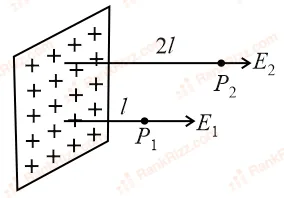
In the figure, a very large plane sheet of positive charge is shown. and are two points at distance and from the charge distribution. If is the surface charge density, then the magnitude of electric fields and at and respectively are
A teacher in his physics laboratory allotted an experiment to determine the resistance a galvanometer. Students took the observations for deflection in the galvanometer. Which of the below is true for measuring value of ?
deflection method cannot be used for determining the resistance of the galvanometer.
deflection method can be used and in this case the equals to twice the value of shunt resistance(s).
deflection method can be used and in this case, the equals to three times the value of shunt resistance(s).
deflection method can be used and in this case the value equals to the shunt resistance(s).
A long straight wire with a circular cross-section having radius , is carrying a steady current . The current is uniformly distributed across this cross-section. Then the variation of magnetic field due to current with distance () from its centre will be
Match List - I with List - II.
| List-I | List-II |
|---|---|
| (A) AC generator | (I) Detects the presence of current in the circuit |
| (B) Galvanometer | (II) Converts mechanical energy into electrical energy |
| (C) Transformer | (III) Works on the principle of resonance in AC circuit |
| (D) Metal detector | (IV) Changes an alternating voltage for smaller or greater value |
A - II, B - I, C - IV, D - III
A - II, B - I, C - III, D - IV
A - III, B - IV, C - II, D - I
A - III, B - I, C - II, D - IV
If wattless current flows in the AC circuit, then the circuit is :
Purely Resistive circuit
Purely Inductive circuit
LCR series circuit
RC series circuit only
The electric field in an electromagnetic wave is given by NC. Find the intensity of the wave if it is propagating along -axis in the free space. (Given C N m)
Wm
Wm
Wm
Wm
A light wave travelling linearly in a medium of dielectric constant , incidents on the horizontal interface separating medium with air. The angle of incidence for which the total intensity of incident wave will be reflected back into the same medium will be :
(Given : relative permeability of medium )
The difference of speed of light in the two media and () is m s. If the refractive index of medium is , then the ratio of refractive index of medium to medium is: (Given : speed of light in vacuum m s)
1.303
1.318
1.13
0.12
The two light beams having intensities and interfere to produce a fringe pattern on a screen. The phase difference between the beams is at point and at point . Then the difference between the resultant intensities at and will be :
Given below are two statements :
Statement I : Davisson-Germer experiment establishes the wave nature of electrons.
Statement II : If electrons have wave nature, they can interfere and show diffraction.
In the light of the above statements choose the correct answer from the option given below :
Both Statement I and Statement II are true.
Both Statement I and Statement II are false.
Statement I is true but Statement II is false.
Statement I is false but Statement II is true.
The ratio for the speed of the electron in the orbit of to the speed of the electron in the orbit of hydrogen atom will be :
The photodiode is used to detect the optical signals. These diodes are preferably operated in reverse biased mode because
fractional change in majority carriers produce higher forward bias current
fractional change in majority carriers produce higher reverse bias current
fractional change in minority carriers produce higher forward bias current
fractional change in minority carriers produce higher reverse bias current
A signal of THz frequency can be transmitted with maximum efficiency by
Coaxial cable
Optical fibre
Twisted pair of copper wires
Water
A uniform chain of m length is placed on a table such that a part of its length is hanging over the edge of the table. The system is at rest. The co-efficient of static friction between the chain and the surface of the table is , the maximum length of the chain hanging from the table is ______ m.
A force on an object of mass g is N. The position of that object at s is m after starting from rest. The value of will be ______.
A kg block moving at a speed of ms compresses a spring through a distance cm when its speed is halved. The spring constant of the spring will be ______ Nm
The velocity of upper layer of water in a river is km h. Shearing stress between horizontal layers of water is N m. Depth of the river is ______ m. (Co-efficient of viscosity of water is Pa s)
A steam engine intakes g of steam at C per minute and cools it down to C. If latent heat of vaporization of steam is cal g, then the heat rejected by the steam engine per minute is ______ cal
(Given : specific heat capacity of water : cal g °C)
The first overtone frequency of an open organ pipe is equal to the fundamental frequency of a closed organ pipe. If the length of the closed organ pipe is cm. The length of the open organ pipe is ______ cm
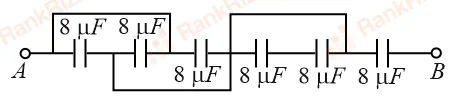
The equivalent capacitance between points and in below shown figure will be ______ F.
A resistor develops J of thermal energy in s, when a current of A is passed through it. If the current increases to A, the energy developed in s is ______ J.
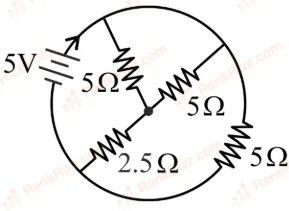
The total current supplied to the circuit as shown in the figure by the V battery is ______ A.
The current in a coil of self inductance H is increasing according to the law . Find the amount of energy spent (in J) during the period when the current changes from to A.