Q31VSEPR theory and shapes of molecules and ions
Amongst the following, the linear species is:
- A
NO
- B
ClO
- C
O
- D
N
The 30 Chemistry questions of JEE Main 17 Mar 2021, Shift 2, numbered across the whole paper. Pick an answer on any question to check it against the key. Free to read, nothing to download.
Amongst the following, the linear species is:
NO
ClO
O
N
During which of the following processes, does entropy decrease?
(A) Freezing of water to ice at 0°C
(B) Freezing of water to ice at -10°C
(C) N(g) + 3H(g) 2NH(g)
(D) Adsorption of CO(g) and lead surface
(E) Dissolution of NaCl in water
(A), (B), (C) and (D) only
(B) and (C) only
(A) and (E) only
(A), (C) and (E) only
The functional groups that are responsible for the ion-exchange property of cation and anion exchange resins, respectively, are:
and
and
and
and
The set of elements that differ in mutual relationship from those of the other sets is:
Li - Mg
B - Si
Be - Al
Li - Na
One of the by-products formed during the recovery of NH from Solvay process is:
Ca(OH)
NaHCO
CaCl
NHCl
The correct pair(s) of the ambident nucleophiles is (are):
(A) AgCN / KCN
(B) RCOOAg / RCOOK
(C) AgNO / KNO
(D) AgI / KI
(B) and (C) only
(A) only
(A) and (C) only
(B) only
Nitrogen can be estimated by Kjeldahl's method for which of the following compound?
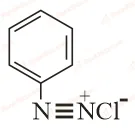
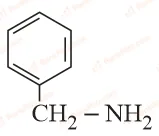

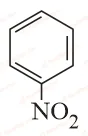
Given below are two statements:
Statement-I: 2-methylbutane on oxidation with KMnO gives 2-methylbutan-2-ol.
Statement-II: n-alkanes can be easily oxidised to corresponding alcohol with KMnO.
Choose the correct option:
Both statement I and statement II are correct
Both statement I and statement II are incorrect
Statement I is correct but Statement II is incorrect
Statement I is incorrect but Statement II is correct
Choose the correct statement regarding the formation of carbocations A and B given:
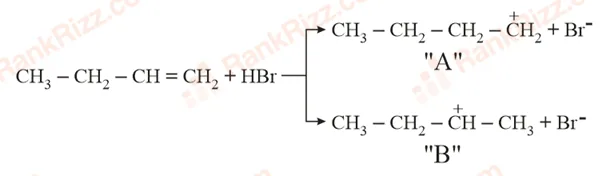
Carbocation B is more stable and formed relatively at faster rate
Carbocation A is more stable and formed relatively at slow rate
Carbocation B is more stable and formed relatively at slow rate
Carbocation A is more stable and formed relatively at faster rate
Which of the following statement(s) is (are) incorrect reason for eutrophication?
(A) excess usage of fertilisers
(B) excess usage of detergents
(C) dense plant population in water bodies
(D) lack of nutrients in water bodies that prevent plant growth
Choose the most appropriate answer from the options given below:
(A) only
(C) only
(B) and (D) only
(D) only
For the coagulation of a negative sol, the species below, that has the highest flocculating power is:
Match List-I and List-II:
List-I List-II
a. Haematite i. AlO . xHO
b. Bauxite ii. FeO
c. Magnetite iii. CuCO . Cu(OH)
d. Malachite iv. FeO
Choose the correct answer from the options given below:
(a)-(ii), (b)-(iii), (c)-(i), (d)-(iv)
(a)-(iv), (b)-(i), (c)-(ii), (d)-(iii)
(a)-(i), (b)-(iii), (c)-(ii), (d)-(iv)
(a)-(ii), (b)-(i), (c)-(iv), (d)-(iii)
The set that represents the pair of neutral oxides of nitrogen is:
NO and NO
NO and NO
NO and NO
NO and NO
The common positive oxidation states for an element with atomic number 24, are:
to
and to
and
to
Match List-I with List-II:
List-I List-II
a. [Co(NH)][Cr(CN)] i. Linkage isomerism
b. [Co(NH)(NO)] ii. Solvate isomerism
c. [Cr(HO)]Cl iii. Co-ordination isomerism
d. -[CrCl(ox)] iv. Optical isomerism
Choose the correct answer from the options given below:
(a)-(iii), (b)-(i), (c)-(ii), (d)-(iv)
(a)-(iv), (b)-(ii), (c)-(iii), (d)-(i)
(a)-(ii), (b)-(i), (c)-(iii), (d)-(iv)
(a)-(ii), (b)-(i), (c)-(iv), (d)-(iii)
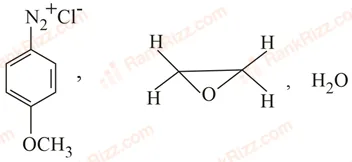
In the above reaction, the structural formula of (A), "X" and "Y" respectively are:
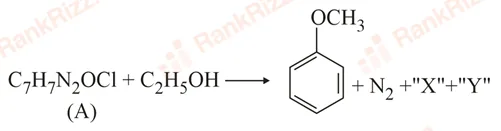
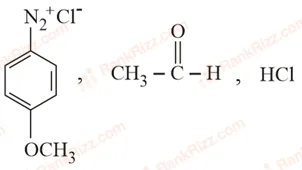
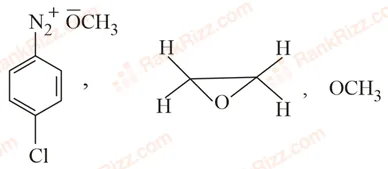
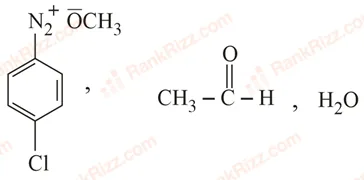
Primary, secondary and tertiary amines can be separated using:
Para-Toluene sulphonyl chloride
Chloroform and KOH
Benzene sulphonic acid
Acetyl amide
Match List-I with List-II:
List-I (Chemical Compound) List-II (Used as)
a. Sucralose i. Synthetic detergent
b. Glyceryl ester of stearic acid ii. Artificial sweetener
c. Sodium benzoate iii. Antiseptic
d. Bithional iv. Food preservative
Choose the correct match:
(a)-(iv), (b)-(iii), (c)-(ii), (d)-(i)
(a)-(ii), (b)-(i), (c)-(iv), (d)-(iii)
(a)-(iii), (b)-(ii), (c)-(iv), (d)-(i)
(a)-(i), (b)-(ii), (c)-(iv), (d)-(iii)
Fructose is an example of:
Pyranose
Ketohexose
Aldohexose
Heptose
In the above reactions, the enzyme A and enzyme B respectively are:
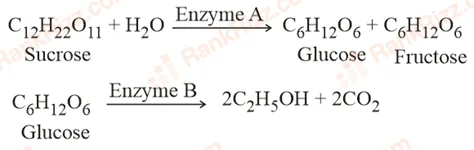
Amylase and Invertase
Invertase and Amylase
Invertase and Zymase
Zymase and Invertase
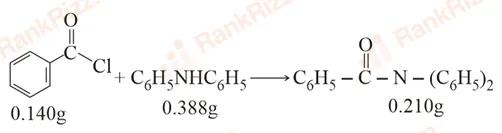
Consider the above reaction. The percentage yield of amide product is ________ (Round off to the Nearest Integer).
(Given: Atomic mass: C: 12.0u, H: 1.0u, N: 14.0u, O: 16.0u, Cl: 35.5u)
The number of chlorine atoms in 20 mL of chlorine gas at STP is ________ . (Round off to the Nearest Integer).
[Assume chlorine is an ideal gas at STP. R = 0.083 L bar mol K, ]
Consider the reaction . The temperature at which and , is ________ K. (Round off to the Nearest Integer). [Assume all gases are ideal and R = 0.0831 L bar K mol]
The total number of C-C sigma bond/s in mesityl oxide () is ________ (Round off to the Nearest Integer).
KBr is doped with mole percent of SrBr. The number of cationic vacancies in 1 g of KBr crystal is ________. (Round off to the Nearest Integer). [Atomic Mass: K: 39.1u, Br: 79.9u, ]
A 1 molal solution has a degree of dissociation of 0.4. Its boiling point is equal to that of another solution which contains 18.1 weight percent of a non electrolytic solute A. The molar mass of A is ________ u. (Round off to the Nearest Integer). [Density of water = 1.0 g cm]
A KCl solution of conductivity 0.14 S m shows a resistance of 4.19 in a conductivity cell. If the same cell is filled with an HCl solution, the resistance drops to 1.03. The conductivity of the HCl solution is ________ S m. (Round off to the Nearest Integer).
The reaction is an elementary reaction. For a certain quantity of reactants, if the volume of the reaction vessel is reduced by a factor of 3, the rate of the reaction increases by a factor of ________. (Round off to the Nearest Integer).
In the ground state of atomic Fe (Z = 26), the spin-only magnetic moment is ________ BM. (Round off to the Nearest Integer).
[Given: ]
On complete reaction of FeCl with oxalic acid in aqueous solution containing KOH, resulted in the formation of product A. The secondary valency of Fe in the product A is ________. (Round off to the Nearest Integer).