RankRizz

JEE Main 07 Jan 2020, Shift 1 Question Paper

All 75 questions of JEE Main 07 Jan 2020, Shift 1, in the order they were asked, one subject to a page. Pick an answer on any question to check it against the key. Free to read, nothing to download.

Questions

75

Physics · Chemistry · Maths

Answer key

72

questions with a checked key

Price

Free

no sign-up

Physics

Q1Power

A 60HP electric motor lifts an elevator having a maximum total load capacity of 2000 kg. If the frictional force on the elevator is 4000 N, the speed of the elevator at full load is close to: (1 HP = 746 W, g=10g = 10 m s−2^{-2})

  1. A

    1.7 m s−1^{-1}

  2. B

    1.9 m s−1^{-1}

  3. C

    1.5 m s−1^{-1}

  4. D

    2.0 m s−1^{-1}

Q2Centre of mass of a system of particles

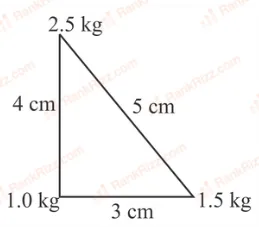
Three point particles of masses 1.0 kg, 1.5 kg and 2.5 kg are placed at three corners of a right angle triangle of sides 4.0 cm, 3.0 cm and 5.0 cm as shown in the figure. The centre of mass of the system is at a point:

Figure for JEE Main 2020 Physics question on Centre of mass of a system of particles
  1. A

    0.6 cm right and 2.0 cm above 1 kg mass.

  2. B

    1.5 cm right and 1.2 cm above 1 kg mass.

  3. C

    2.0 cm right and 0.9 cm above 1 kg mass.

  4. D

    0.9 cm right and 2.0 cm above 1 kg mass.

Q3Rolling with friction, slipping and impulsive forces

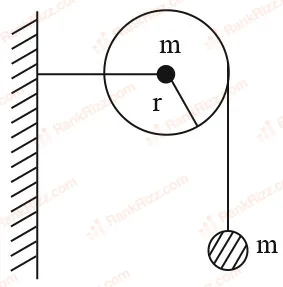
As shown in the figure, a bob of mass m is tied to a massless string whose other end portion is wound on a fly wheel (disc) of radius r and mass m. When released from rest the bob starts falling vertically. When it has covered a distance of h, the angular speed of the wheel will be:

Figure for JEE Main 2020 Physics question on Rolling with friction, slipping and impulsive forces
  1. A

    1r4gh3\frac{1}{r}\sqrt{\frac{4gh}{3}}

  2. B

    r32ghr\sqrt{\frac{3}{2gh}}

  3. C

    1r2gh3\frac{1}{r}\sqrt{\frac{2gh}{3}}

  4. D

    r34ghr\sqrt{\frac{3}{4gh}}

Q4Moment of inertia of standard bodies and composite systems

The radius of gyration of a uniform rod of length ll, about an axis passing through a point l4\frac{l}{4} away from the centre of the rod, and perpendicular to it, is:

  1. A

    14l\frac{1}{4}l

  2. B

    18l\frac{1}{8}l

  3. C

    748 l\sqrt{\frac{7}{48}}\,l

  4. D

    38 l\sqrt{\frac{3}{8}}\,l

Q5Escape speed

A satellite of mass MM is launched vertically upwards with an initial speed uu from the surface of the earth. After it reaches height RR (RR = radius of the earth), it ejects a rocket of mass M10\frac{M}{10} so that subsequently the satellite moves in a circular orbit. The kinetic energy of the rocket is (GG is the gravitational constant; MeM_e is the mass of the earth):

  1. A

    M20(u2+113200GMeR)\frac{M}{20}\left(u^2 + \frac{113}{200}\frac{GM_e}{R}\right)

  2. B

    5M(u2−119200GMeR)5M\left(u^2 - \frac{119}{200}\frac{GM_e}{R}\right)

  3. C

    3M8(u+5GMe6R)2\frac{3M}{8}\left(u + \sqrt{\frac{5GM_e}{6R}}\right)^2

  4. D

    M20(u−2GMe3R)2\frac{M}{20}\left(u - \sqrt{\frac{2GM_e}{3R}}\right)^2

Q6Progressive waves: wave equation, phase and intensity

Speed of a transverse wave on a straight wire (mass 6.0 g, length 60 cm and area of cross-section 1.0 mm2^2) is 90 m s−1^{-1}. If the Young's modulus of wire is 16×101116 \times 10^{11} N m−2^{-2}, the extension of wire over its natural length is:

  1. A

    0.03 mm

  2. B

    0.02 mm

  3. C

    0.04 mm

  4. D

    0.01 mm

Q7Isothermal and adiabatic processes

A litre of dry air at STP expands adiabatically to a volume of 3 litres. If γ=1.40\gamma = 1.40, the work done by air is: (31.4=4.65553^{1.4} = 4.6555) [Take air to be an ideal gas]

  1. A

    60.7 J

  2. B

    90.5 J

  3. C

    100.8 J

  4. D

    48 J

Q8Molar specific heats of gases, Mayer's relation and gas mixtures

Two moles of an ideal gas, with CpCv=53\frac{C_p}{C_v} = \frac{5}{3}, are mixed with three moles of another ideal gas CpCv=43\frac{C_p}{C_v} = \frac{4}{3}. The value of CpCv\frac{C_p}{C_v} for the mixture is

  1. A

    1.45

  2. B

    1.50

  3. C

    1.47

  4. D

    1.42

Q9Electric field of continuous charge distributions

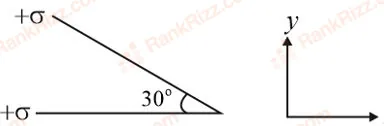
Two infinite planes each with uniform surface charge density +σ+\sigma are kept in such a way that the angle between them is 30∘^\circ. The electric field in the region shown between them is given by:

Figure for JEE Main 2020 Physics question on Electric field of continuous charge distributions
  1. A

    σ2ε0[(1+3)y^−x^2]\frac{\sigma}{2\varepsilon_0}\left[\left(1+\sqrt{3}\right)\hat{y} - \frac{\hat{x}}{2}\right]

  2. B

    σε0[(1+32)y^+x^2]\frac{\sigma}{\varepsilon_0}\left[\left(1+\frac{\sqrt{3}}{2}\right)\hat{y} + \frac{\hat{x}}{2}\right]

  3. C

    σ2ε0[(1+3)y^+x^2]\frac{\sigma}{2\varepsilon_0}\left[\left(1+\sqrt{3}\right)\hat{y} + \frac{\hat{x}}{2}\right]

  4. D

    σ2ε0[(1−32)y^−x^2]\frac{\sigma}{2\varepsilon_0}\left[\left(1-\frac{\sqrt{3}}{2}\right)\hat{y} - \frac{\hat{x}}{2}\right]

Q10Capacitors with dielectrics

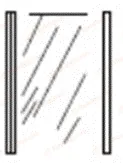
A parallel plate capacitor has plates of area A separated by distance d between them. It is filled with a dielectric which has a dielectric constant that varies as K(x)=K0(1+αx)K(x) = K_0(1 + \alpha x) where xx is the distance measured from one of the plates. If (αd)≪1(\alpha d) \ll 1, the total capacitance of the system is best given by the expression:

Figure for JEE Main 2020 Physics question on Capacitors with dielectrics
  1. A

    AK0ε0d(1+αd2)\frac{AK_0\varepsilon_0}{d}\left(1 + \frac{\alpha d}{2}\right)

  2. B

    AK0ε0d[1+(αd2)2]\frac{AK_0\varepsilon_0}{d}\left[1 + \left(\frac{\alpha d}{2}\right)^2\right]

  3. C

    AK0ε0d(1+α2d22)\frac{AK_0\varepsilon_0}{d}\left(1 + \frac{\alpha^2 d^2}{2}\right)

  4. D

    AK0ε0d(1+αd)\frac{AK_0\varepsilon_0}{d}(1 + \alpha d)

Q11Kirchhoff's laws and circuit analysis

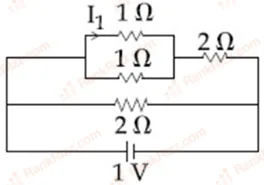
The current I1I_1 (in A) flowing through 1Ω\Omega resistor in the following circuit is:

Figure for JEE Main 2020 Physics question on Kirchhoff's laws and circuit analysis
  1. A

    0.4

  2. B

    0.5

  3. C

    0.2

  4. D

    0.25

Q12Magnetic flux, Faraday's law and Lenz's law

A long solenoid of radius R carries a time (t)(t) dependent current I(t)=I0t(1−t)I(t) = I_0 t(1 - t). A ring of radius 2R is placed coaxially near its middle. During the time interval 0≤t≤10 \le t \le 1, the induced current (IR)(I_R) and the induced EMF (VR)(V_R) in the ring change as:

  1. A

    Direction of IRI_R remains unchanged and VRV_R is maximum at t=0.5t = 0.5

  2. B

    At t=0.25t = 0.25 direction of IRI_R reverses and VRV_R is maximum

  3. C

    Direction of IRI_R remains unchanged and VRV_R is zero at t=0.25t = 0.25

  4. D

    At t=0.5t = 0.5 direction of IRI_R reverses and VRV_R is zero

Q13Magnetic flux, Faraday's law and Lenz's law

Consider a circular coil of wire carrying constant current I, forming a magnetic dipole. The magnetic flux through an infinite plane that contains the circular coil and excluding the circular coil area is given by ϕi\phi_i. The magnetic flux through the area of the circular coil area is given by ϕ0\phi_0. Which of the following option is correct?

  1. A

    ϕi=ϕ0\phi_i = \phi_0

  2. B

    ϕi>ϕ0\phi_i > \phi_0

  3. C

    ϕi<ϕ0\phi_i < \phi_0

  4. D

    ϕi=−ϕ0\phi_i = -\phi_0

Q14Series LCR circuits: impedance and phase

A LCR circuit behaves like a clamped harmonic oscillator. Comparing it with a physical spring-mass damped oscillator having damping constant 'b', the correct equivalence would be:

  1. A

    L↔m,C↔k,R↔bL \leftrightarrow m, C \leftrightarrow k, R \leftrightarrow b

  2. B

    L↔1b,C↔1m,R↔1kL \leftrightarrow \frac{1}{b}, C \leftrightarrow \frac{1}{m}, R \leftrightarrow \frac{1}{k}

  3. C

    L↔k,C↔b,R↔mL \leftrightarrow k, C \leftrightarrow b, R \leftrightarrow m

  4. D

    L↔m,C↔1k,R↔bL \leftrightarrow m, C \leftrightarrow \frac{1}{k}, R \leftrightarrow b

Q15Properties of EM waves: fields, energy, intensity and momentum

If the magnetic field in a plane electromagnetic wave is given by B⃗=3×10⁻⁸sin⁡(1.6×10³x+48×1010t)j^ T\vec{B} = 3 \times 10^{-8} \sin(1.6 \times 10^3 x + 48 \times 10^{10} t)\hat{j}\,T, then what will be the expression for electric field?

  1. A

    E⃗=(60sin⁡(1.6×10³x+48×1010t)k^  Vm)\vec{E} = \left(60 \sin(1.6 \times 10^3 x + 48 \times 10^{10} t)\hat{k}\; \frac{V}{m}\right)

  2. B

    E⃗=(9sin⁡(1.6×10³x+48×1010t)k^  Vm)\vec{E} = \left(9 \sin(1.6 \times 10^3 x + 48 \times 10^{10} t)\hat{k}\; \frac{V}{m}\right)

  3. C

    E⃗=(3×10⁻⁸sin⁡(1.6×10³x+48×1010t)j^  Vm)\vec{E} = \left(3 \times 10^{-8} \sin(1.6 \times 10^3 x + 48 \times 10^{10} t)\hat{j}\; \frac{V}{m}\right)

  4. D

    E⃗=(3×10⁻⁸sin⁡(1.6×10³x+48×1010t)i^  Vm)\vec{E} = \left(3 \times 10^{-8} \sin(1.6 \times 10^3 x + 48 \times 10^{10} t)\hat{i}\; \frac{V}{m}\right)

Q16Optical instruments: microscopes and telescopes

If we need a magnification of 375 from a compound microscope of tube length 150mm and an objective of focal length 5mm, the focal length of the eye-piece, should be close to:

  1. A

    22 mm

  2. B

    2 mm

  3. C

    4 mm

  4. D

    33 mm

Q17Polarisation: Malus's law and Brewster's law

A polarizer - analyser set is adjusted such that the intensity of light coming out of the analyser is just 36% of the original intensity. Assuming that the polarizer - analyser set does not absorb any light, the angle by which the analyser needs to be rotated further, to reduce the output intensity to zero, is (sin⁡−1(35)=37∘\sin^{-1}\left(\frac{3}{5}\right) = 37^\circ)

  1. A

    53∘^\circ

  2. B

    37∘^\circ

  3. C

    90∘^\circ

  4. D

    45∘^\circ

Q18Single slit diffraction

Visible light of wavelength 6000×10−86000 \times 10^{-8} cm falls normally on a single slit and produces a diffraction pattern. It is found that the second diffraction minimum is at 60∘^\circ from the central maximum. If the first minimum is produced at θ1\theta_1, then θ1\theta_1 is close to

  1. A

    20∘^\circ

  2. B

    30∘^\circ

  3. C

    25∘^\circ

  4. D

    45∘^\circ

Q19Hydrogen spectrum and spectral series

The time period of revolution of electron in its ground state orbit in a hydrogen atom is 1.6×10−161.6 \times 10^{-16} s. The frequency of revolution of the electron in its first excited state (in s−1^{-1}) is:

  1. A

    1.6×10141.6 \times 10^{14}

  2. B

    7.8×10147.8 \times 10^{14}

  3. C

    6.2×10156.2 \times 10^{15}

  4. D

    5.6×10125.6 \times 10^{12}

Q20Logic gates and digital circuits

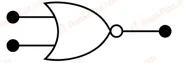
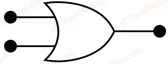
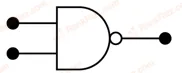
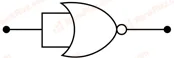
Which of the following gives a reversible operation?

  1. A
    Figure for JEE Main 2020 Physics question on Logic gates and digital circuits
  2. B
    Figure for JEE Main 2020 Physics question on Logic gates and digital circuits
  3. C
    Figure for JEE Main 2020 Physics question on Logic gates and digital circuits
  4. D
    Figure for JEE Main 2020 Physics question on Logic gates and digital circuits
Q21Conservation of mechanical energy

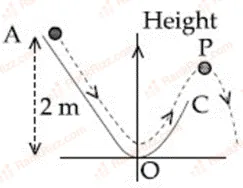
A particle (m = 1 kg) slides down a frictionless track (AOC) starting from rest at a point A (height 2m). After reaching C, the particle continues to move freely in air as a projectile. When it reaches its highest point P (height 1m), the kinetic energy of the particle (in J) is: (Figure drawn is schematic and not to scale; take g=10g = 10 ms−2^{-2})

Figure for JEE Main 2020 Physics question on Conservation of mechanical energy
Q22Temperature scales and thermal expansion

A non-isotropic solid metal cube has coefficients of linear expansion as: 5×10−55 \times 10^{-5}/∘^\circC along the x-axis and 5×10−65 \times 10^{-6}/∘^\circC along the y and the z-axis. If the coefficient of volume expansion of the solid is C×10−6C \times 10^{-6}/∘^\circC then the value of C is

Q23Carnot engine and Carnot cycle

A Carnot engine operates between two reservoirs of temperatures 900K and 300K. The engine performs 1200J of work per cycle. The heat energy (in J) delivered by the engine to the low temperature reservoir, in a cycle, is

Q24Magnetic flux, Faraday's law and Lenz's law

A loop ABCDEFA of straight edges has six corner points A(0, 0, 0), B(5, 0, 0), C(5, 5, 0), D(0, 5, 0), E(0, 5, 5) and F(0, 0, 5). The magnetic field in this region is B⃗=(3i^+4k^)\vec{B} = (3\hat{i} + 4\hat{k}) T. The quantity of flux through the loop ABCDEFA (in Wb) is

Q25Photons: energy, momentum and radiation pressure

A beam of electromagnetic radiation of intensity 6.4×10−56.4 \times 10^{-5} W/cm2^2 is comprised of wavelength, λ=310\lambda = 310 nm. It falls normally on a metal (work function φ=2\varphi = 2 eV) of surface area of 1 cm2^2. If one in 10310^3 photons ejects an electron, total number of electrons ejected in 1s is 10x10^x. (hc=1240hc = 1240 eVnm, 11 eV =1.6×10−19= 1.6 \times 10^{-19} J), then xx is

NEXT IN THIS PAPER →Chemistry, Q26 onwards