JEE ADVANCED 2026 · PAPER 2+4 / −1HARD
JEE Advanced 2026 Chemistry question — Group 18: noble gases and xenon compounds
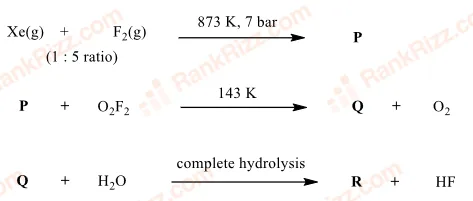
Correct statement(s) about the compounds P, Q and R is(are)
SOLUTION
Key idea: read P, Q and R off the reaction scheme, then each statement is a question about one xenon compound.
- . With xenon and fluorine in a 1 : 5 ratio at 873 K and 7 bar the product is xenon tetrafluoride, so P = .
- . Dioxygen difluoride at 143 K fluorinates it further, so Q = .
- . Complete hydrolysis replaces every fluorine, so R = .
Now the statements.
- (A) True. In , xenon uses 4 of its 8 valence electrons in four Xe–F bonds and keeps 2 lone pairs (square planar, ).
- (B) False. has 6 bond pairs and 1 lone pair on xenon. The lone pair distorts it, so it is a distorted octahedron, not a perfect one.
- (C) True. gives up fluorine readily, so it is a fluorinating agent: .
- (D) True. In , xenon has 3 bonds to oxygen and 1 lone pair: trigonal pyramidal.
Answer: options (A), (C) and (D).
Topic: Group 18: noble gases and xenon compounds