JEE ADVANCED 2010 · PAPER 1EASY
JEE Advanced 2010 Chemistry question — Proteins and enzymes
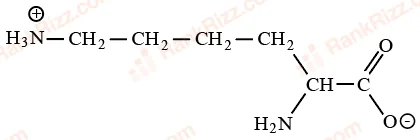
The total number of basic groups in the following form of lysine is
SOLUTION
Key idea: A basic group is one that can accept a proton, meaning it has a free lone pair or a negative charge. A group that is already protonated () acts as an acid, not a base.
- The form shown is .
- Count the groups:
- -: already protonated, so not basic.
- -: has a free lone pair, so it is basic.
- : carboxylate, the conjugate base of the acid, so it is basic.
- There are 2 basic groups.
Answer: 2
Topic: Proteins and enzymes