RankRizz

JEE Advanced 2025 Paper 2 Question Paper

All 48 questions of JEE Advanced 2025 Paper 2, in the order they were asked, one subject to a page. Pick an answer on any question to check it against the key. Free to read, nothing to download.

Questions

48

Physics · Chemistry · Maths

Answer key

32

questions with a checked key

Price

Free

no sign-up

Physics

Q1Dimensional formulae of physical quantities

A temperature difference can generate e.m.f. in some materials. Let SS be the e.m.f. produced per unit temperature difference between the ends of a wire, σ\sigma the electrical conductivity and κ\kappa the thermal conductivity of the material of the wire. Taking MM, LL, TT, II and KK as dimensions of mass, length, time, current and temperature, respectively, the dimensional formula of the quantity Z=S2σκZ = \frac{S^2 \sigma}{\kappa} is:

  1. A

    [M0L0T0I0K0][M^0 L^0 T^0 I^0 K^0]

  2. B

    [M0L0T0I0K−1][M^0 L^0 T^0 I^0 K^{-1}]

  3. C

    [M1L2T−2I−1K−1][M^1 L^2 T^{-2} I^{-1} K^{-1}]

  4. D

    [M1L2T−4I−1K−1][M^1 L^2 T^{-4} I^{-1} K^{-1}]

Q2Electric flux and Gauss's law

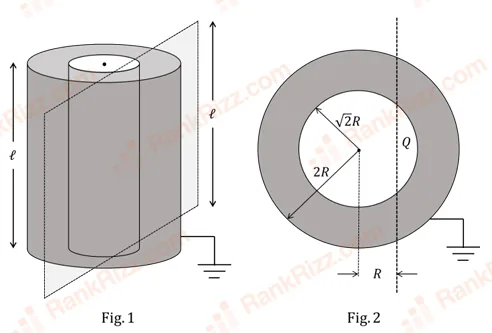
Two co-axial conducting cylinders of same length ℓ\ell with radii 2R\sqrt{2}R and 2R2R are kept, as shown in Fig. 1. The charge on the inner cylinder is QQ and the outer cylinder is grounded. The annular region between the cylinders is filled with a material of dielectric constant κ=5\kappa = 5. Consider an imaginary plane of the same length ℓ\ell at a distance RR from the common axis of the cylinders. This plane is parallel to the axis of the cylinders. The cross-sectional view of this arrangement is shown in Fig. 2. Ignoring edge effects, the flux of the electric field through the plane is (ϵ0\epsilon_0 is the permittivity of free space):

Figure for JEE Advanced 2025 Physics question on Electric flux and Gauss's law
  1. A

    Q30ϵ0\frac{Q}{30\epsilon_0}

  2. B

    Q15ϵ0\frac{Q}{15\epsilon_0}

  3. C

    Q60ϵ0\frac{Q}{60\epsilon_0}

  4. D

    Q120ϵ0\frac{Q}{120\epsilon_0}

Q3Spring-block oscillations

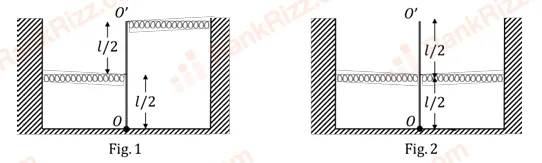
As shown in the figures, a uniform rod OO′OO' of length ll is hinged at the point OO and held in place vertically between two walls using two massless springs of same spring constant. The springs are connected at the midpoint and at the top-end (O′O') of the rod, as shown in Fig. 1 and the rod is made to oscillate by a small angular displacement. The frequency of oscillation of the rod is f1f_1. On the other hand, if both the springs are connected at the midpoint of the rod, as shown in Fig. 2 and the rod is made to oscillate by a small angular displacement, then the frequency of oscillation is f2f_2.

Ignoring gravity and assuming motion only in the plane of the diagram, the value of f1f2\frac{f_1}{f_2} is:

Figure for JEE Advanced 2025 Physics question on Spring-block oscillations
  1. A

    22

  2. B

    2\sqrt{2}

  3. C

    52\sqrt{\frac{5}{2}}

  4. D

    25\sqrt{\frac{2}{5}}

Q4Kepler's laws and planetary motion

Consider a star of mass m2m_2 kg revolving in a circular orbit around another star of mass m1m_1 kg with m1≫m2m_1 \gg m_2. The heavier star slowly acquires mass from the lighter star at a constant rate of γ\gamma kg/s. In this transfer process, there is no other loss of mass. If the separation between the centers of the stars is rr, then its relative rate of change 1rdrdt\frac{1}{r}\frac{dr}{dt} (in s−1^{-1}) is given by:

  1. A

    −3γ2m2-\frac{3\gamma}{2m_2}

  2. B

    −2γm2-\frac{2\gamma}{m_2}

  3. C

    −2γm1-\frac{2\gamma}{m_1}

  4. D

    −3γ2m1-\frac{3\gamma}{2m_1}

Q5Relation between field and potential, equipotential surfaces

A positive point charge of 10−810^{-8} C is kept at a distance of 20 cm from the center of a neutral conducting sphere of radius 10 cm. The sphere is then grounded and the charge on the sphere is measured. The grounding is then removed and subsequently the point charge is moved a distance of 10 cm further away from the center of the sphere along the radial direction. Taking 14πϵ0=9×10⁹\frac{1}{4\pi\epsilon_0} = 9 \times 10^9 Nm2^2/C2^2 (where ϵ0\epsilon_0 is the permittivity of free space), which of the following statements is/are correct:

  1. A

    Before the grounding, the electrostatic potential of the sphere is 450 V.

  2. B

    Charge flowing from the sphere to the ground because of grounding is 5×10−95 \times 10^{-9} C.

  3. C

    After the grounding is removed, the charge on the sphere is −5×10⁻⁹-5 \times 10^{-9} C.

  4. D

    The final electrostatic potential of the sphere is 300 V.

Q6Spherical mirrors: mirror formula and magnification

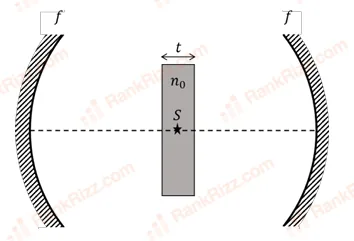
Two identical concave mirrors each of focal length ff are facing each other as shown in the schematic diagram. The focal length ff is much larger than the size of the mirrors. A glass slab of thickness tt and refractive index n0n_0 is kept equidistant from the mirrors and perpendicular to their common principal axis. A monochromatic point light source SS is embedded at the center of the slab on the principal axis, as shown in the schematic diagram. For the image to be formed on SS itself, which of the following distances between the two mirrors is/are correct:

Figure for JEE Advanced 2025 Physics question on Spherical mirrors: mirror formula and magnification
  1. A

    4f+(1−1n0)t4f + \left(1 - \frac{1}{n_0}\right)t

  2. B

    2f+(1−1n0)t2f + \left(1 - \frac{1}{n_0}\right)t

  3. C

    4f+(n0−1)t4f + (n_0 - 1)t

  4. D

    2f+(n0−1)t2f + (n_0 - 1)t

Q7Electric field of continuous charge distributions

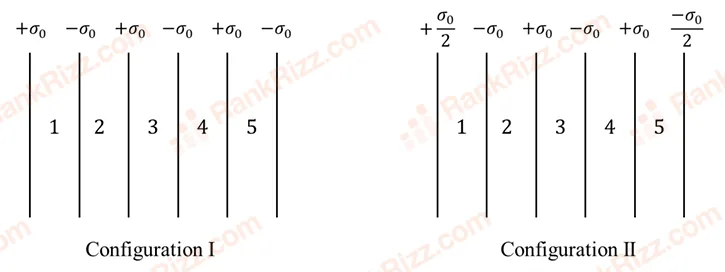
Six infinitely large and thin non-conducting sheets are fixed in configurations I and II. As shown in the figure, the sheets carry uniform surface charge densities which are indicated in terms of σ0\sigma_0. The separation between any two consecutive sheets is 1 μ1 \, \mum. The various regions between the sheets are denoted as 1, 2, 3, 4 and 5. If σ0=9 μ\sigma_0 = 9 \, \muC/m2^2, then which of the following statements is/are correct:

(Take permittivity of free space ϵ0=9×10⁻¹²\epsilon_0 = 9 \times 10^{-12} F/m)

Figure for JEE Advanced 2025 Physics question on Electric field of continuous charge distributions
  1. A

    In region 4 of the configuration I, the magnitude of the electric field is zero.

  2. B

    In region 3 of the configuration II, the magnitude of the electric field is σ0ϵ0\frac{\sigma_0}{\epsilon_0}.

  3. C

    Potential difference between the first and the last sheets of the configuration I is 5 V.

  4. D

    Potential difference between the first and the last sheets of the configuration II is zero.

Q8Carnot engine and Carnot cycle

The efficiency of a Carnot engine operating with a hot reservoir kept at a temperature of 1000 K is 0.4. It extracts 150 J of heat per cycle from the hot reservoir. The work extracted from this engine is being fully used to run a heat pump which has a coefficient of performance 10. The hot reservoir of the heat pump is at a temperature of 300 K. Which of the following statements is/are correct:

  1. A

    Work extracted from the Carnot engine in one cycle is 60 J.

  2. B

    Temperature of the cold reservoir of the Carnot engine is 600 K.

  3. C

    Temperature of the cold reservoir of the heat pump is 270 K.

  4. D

    Heat supplied to the hot reservoir of the heat pump in one cycle is 540 J.

Q9Magnetic dipole moment of current loops and torque on loops

A conducting solid sphere of radius RR and mass MM carries a charge QQ. The sphere is rotating about an axis passing through its center with a uniform angular speed ω\omega. The ratio of the magnitudes of the magnetic dipole moment to the angular momentum about the same axis is given as αQ2M\alpha \frac{Q}{2M}. The value of α\alpha is ______.

Q10Photons: energy, momentum and radiation pressure

A hydrogen atom, initially at rest in its ground state, absorbs a photon of frequency ν1\nu_1 and ejects the electron with a kinetic energy of 10 eV. The electron then combines with a positron at rest to form a positronium atom in its ground state and simultaneously emits a photon of frequency ν2\nu_2. The center of mass of the resulting positronium atom moves with a kinetic energy of 5 eV. It is given that positron has the same mass as that of electron and the positronium atom can be considered as a Bohr atom, in which the electron and the positron orbit around their center of mass. Considering no other energy loss during the whole process, the difference between the two photon energies (in eV) is ______.

Q11Multi-step processes and gas-piston-spring systems

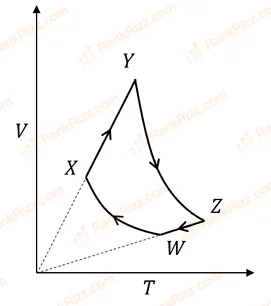
An ideal monatomic gas of nn moles is taken through a cycle WXYZWWXYZW consisting of consecutive adiabatic and isobaric quasi-static processes, as shown in the schematic VV-TT diagram. The volume of the gas at WW, XX and YY points are, 64 cm3^3, 125 cm3^3 and 250 cm3^3, respectively. If the absolute temperature of the gas TWT_W at the point WW is such that nRTW=1nRT_W = 1 J (RR is the universal gas constant), then the amount of heat absorbed (in J) by the gas along the path XYXY is ______.

Figure for JEE Advanced 2025 Physics question on Multi-step processes and gas-piston-spring systems
Q12Escape speed

A geostationary satellite above the equator is orbiting around the earth at a fixed distance r1r_1 from the center of the earth. A second satellite is orbiting in the equatorial plane in the opposite direction to the earth's rotation, at a distance r2r_2 from the center of the earth, such that r1=1.21 r2r_1 = 1.21 \, r_2. The time period of the second satellite as measured from the geostationary satellite is 24p\frac{24}{p} hours. The value of pp is ______.

Q13Zeroth and first law of thermodynamics

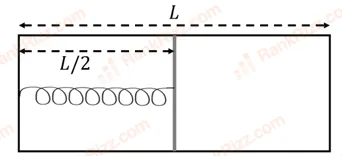
The left and right compartments of a thermally isolated container of length LL are separated by a thermally conducting, movable piston of area AA. The left and right compartments are filled with 32\frac{3}{2} and 1 moles of an ideal gas, respectively. In the left compartment the piston is attached to a spring with spring constant kk and natural length 2L5\frac{2L}{5}. In thermodynamic equilibrium, the piston is at a distance L2\frac{L}{2} from the left and right edges of the container as shown in the figure. Under the above conditions, if the pressure in the right compartment is P=kLAαP = \frac{kL}{A} \alpha, then the value of α\alpha is ______.

Figure for JEE Advanced 2025 Physics question on Zeroth and first law of thermodynamics
Q14Young's double slit experiment: fringe width and intensity

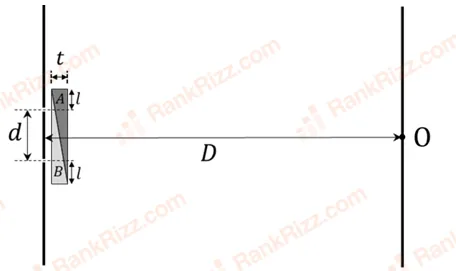
In a Young's double slit experiment, a combination of two glass wedges AA and BB, having refractive indices 1.7 and 1.5, respectively, are placed in front of the slits, as shown in the figure. The separation between the slits is d=2d = 2 mm and the shortest distance between the slits and the screen is D=2D = 2 m. Thickness of the combination of the wedges is t=12 μt = 12 \, \mum. The value of ll as shown in the figure is 1 mm. Neglect any refraction effect at the slanted interface of the wedges. Due to the combination of the wedges, the central maximum shifts (in mm) with respect to O by ______.

Figure for JEE Advanced 2025 Physics question on Young's double slit experiment: fringe width and intensity
Q15Newton's laws, free-body diagrams and equilibrium of a particle

A projectile of mass 200 g is launched in a viscous medium at an angle 60° with the horizontal, with an initial velocity of 270 m/s. It experiences a viscous drag force F⃗=−cv⃗\vec{F} = -c\vec{v} where the drag coefficient c=0.1c = 0.1 kg/s and v⃗\vec{v} is the instantaneous velocity of the projectile. The projectile hits a vertical wall after 2 s. Taking e=2.7e = 2.7, the horizontal distance of the wall from the point of projection (in m) is ______.

Q16Doppler effect in sound

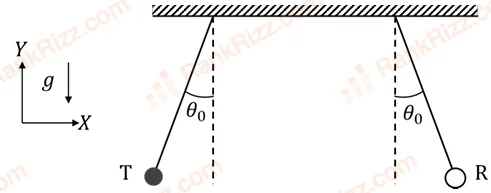
An audio transmitter (T) and a receiver (R) are hung vertically from two identical massless strings of length 8 m with their pivots well separated along the XX axis. They are pulled from the equilibrium position in opposite directions along the XX axis by a small angular amplitude θ0=cos⁡−1(0.9)\theta_0 = \cos^{-1}(0.9) and released simultaneously. If the natural frequency of the transmitter is 660 Hz and the speed of sound in air is 330 m/s, the maximum variation in the frequency (in Hz) as measured by the receiver is ______.

(Take the acceleration due to gravity g=10g = 10 m/s2^2)

Figure for JEE Advanced 2025 Physics question on Doppler effect in sound
NEXT IN THIS PAPER →Chemistry, Q17 onwards