RankRizz

JEE Advanced 2021 Paper 2 Question Paper

All 57 questions of JEE Advanced 2021 Paper 2, in the order they were asked, one subject to a page. Pick an answer on any question to check it against the key. Free to read, nothing to download.

Questions

57

Physics · Chemistry · Maths

Answer key

56

questions with a checked key

Price

Free

no sign-up

Physics

Q1Equilibrium of rigid bodies and toppling

One end of a horizontal uniform beam of weight 𝑊 and length 𝐿 is hinged on a vertical wall at point O and its other end is supported by a light inextensible rope. The other end of the rope is fixed at point Q, at a height 𝐿 above the hinge at point O. A block of weight αW\alpha W is attached at the point P of the beam, as shown in the figure (not to scale). The rope can sustain a maximum tension of (222\sqrt{2})W. Which of the following statement(s) is(are) correct?
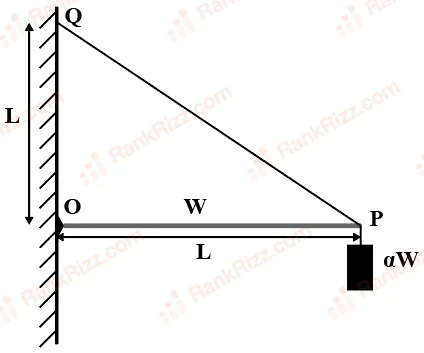
Figure for JEE Advanced 2021 Physics question on Equilibrium of rigid bodies and toppling
  1. A

    The vertical component of reaction force at O does not depend on α\alpha

  2. B

    The horizontal component of reaction force at O is equal to 𝑊 for α=0.5\alpha = 0.5

  3. C

    The tension in the rope is 2𝑊 for α=0.5\alpha = 0.5

  4. D

    The rope breaks if α>1.5\alpha > 1.5

Q2Doppler effect in sound

A source, approaching with speed 𝑢 towards the open end of a stationary pipe of length 𝐿, is emitting a sound of frequency fsf_s. The farther end of the pipe is closed. The speed of sound in air is v and f0f_0 is the fundamental frequency of the pipe. For which of the following combination(s) of u and fsf_s, will the sound reaching the pipe lead to a resonance?

  1. A

    u = 0.8v and fs=f0f_s = f_0

  2. B

    u = 0.8v and fs=2f0f_s = 2 f_0

  3. C

    u = 0.8v and fs=0.5f0f_s = 0.5 f_0

  4. D

    u = 0.8v and fs=1.5f0f_s = 1.5 f_0

Q3Prism: deviation and dispersion

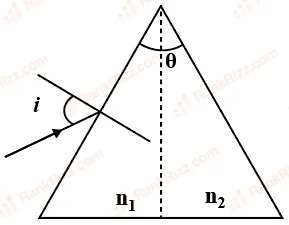
For a prism of prism angle θ=60∘\theta = 60^\circ, the refractive indices of the left half and the right half are, respectively, n1n_1 and n2(n2≥n1)n_2 (n_2 \geq n_1) as shown in the figure. The angle of incidence 𝑖 is chosen such that the incident light rays will have minimum deviation if n1=n2=n=1.5n_1 = n_2 = n = 1.5. For the case of unequal refractive indices, n1=nn_1 = n and n2=n+△nn_2 = n + \triangle n (where △n≪n\triangle n \ll n), the angle of emergence e=i+△ee = i + \triangle e. Which of the following statement(s) is(are) correct?

Figure for JEE Advanced 2021 Physics question on Prism: deviation and dispersion
  1. A

    The value of △e\triangle e (in radians) is greater than that of △n\triangle n

  2. B

    △e\triangle e is proportional to △n\triangle n

  3. C

    △e\triangle e lies between 2.0 and 3.0 milliradians, if △n=2.8×10⁻³\triangle n = 2.8 \times 10^{−3}

  4. D

    △e\triangle e lies between 1.0 and 1.6 milliradians, if △n=2.8×10⁻³\triangle n = 2.8 \times 10^{−3}

Q4Dimensional analysis: deriving and checking relations

A physical quantity S→\overrightarrow{S} is defined as S→=(E→×B→)μ0\overrightarrow{S} = \frac{\left(\overrightarrow{E} \times \overrightarrow{B}\right)}{\mu_0}, where E→\overrightarrow{E} is electric field, B→\overrightarrow{B} is magnetic field and μ0\mu_0 is the permeability of free space. The dimensions of S→\overrightarrow{S} are the same as the dimensions of which of the following quantity(ies) ?

  1. A

    Energycharge×current\frac{Energy}{charge \times current}

  2. B

    ForceLength×Time\frac{Force}{Length \times Time}

  3. C

    EnergyVolume\frac{Energy}{Volume}

  4. D

    PowerArea\frac{Power}{Area}

Q5Nuclear fission, fusion and Q-value

A heavy nucleus N, at rest, undergoes fission N→P+QN \rightarrow P + Q, where P and Q are two lighter nuclei. Let δ=MN−MP−MQ\delta = M_N − M_P − M_Q, where MPM_P, MQM_Q and MNM_N are the masses of P, Q and N, respectively. EP and EQ are the kinetic energies of P and Q, respectively. The speeds of P and Q are vPv_P and vQv_Q, respectively. If c is the speed of light, which of the following statement(s) is(are) correct?

  1. A

    EP+EQ=c2δE_P + E_Q = c^2 \delta

  2. B

    EP=(MPMP+MQ)c2δE_P = \left(\frac{M_P}{M_P + M_Q}\right) c^2 \delta

  3. C

    vPvQ=MQMP\frac{v_P}{v_Q} = \frac{M_Q}{M_P}

  4. D

    The magnitude of momentum for P as well as Q is c2μδc \sqrt{2 \mu \delta}, where μ=MPMQ(MP+MQ)\mu = \frac{M_P M_Q}{(M_P + M_Q)}

Q6Magnetic field of circular loops, arcs and coils

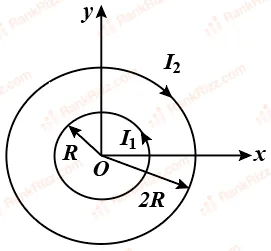
Two concentric circular loops, one of radius R and the other of radius 2R, lie in the xy-plane with the origin as their common center, as shown in the figure. The smaller loop carries current I1I_1 in the anti-clockwise direction and the larger loop carries current I2I_2 in the clockwise direction, with I2>2I1.B→(x,y)I_2 > 2I_1. \overrightarrow{B}(x, y) denotes the magnetic field at a point (x, y) in the xy-plane. Which of the following statement(s) is(are) correct?

Figure for JEE Advanced 2021 Physics question on Magnetic field of circular loops, arcs and coils
  1. A

    B→(x,y)\overrightarrow{B}(x, y) is perpendicular to the xy-plane at any point in the plane

  2. B

    ∣B→(x,y)∣\mid \overrightarrow{B}(x, y)\mid depends on x and y only through the radial distance r=x2+y2r = \sqrt{x^2 + y^2}

  3. C

    ∣B→(x,y)∣\mid \overrightarrow{B}(x, y)\mid is non-zero at all points for r < R

  4. D

    B→(x,y)\overrightarrow{B}(x, y) points normally outward from the xy-plane for all the points between the two loops

Q13Magnetic flux, Faraday's law and Lenz's law

When the dipole 𝑚 is placed at a distance 𝑟 from the center of the loop (as shown in the figure), the current induced in the loop will be proportional to

  1. A

    mr3\frac{m}{r^3}

  2. B

    m2r2\frac{m^2}{r^2}

  3. C

    mr2\frac{m}{r^2}

  4. D

    m2r\frac{m^2}{r}

Q14Magnetic flux, Faraday's law and Lenz's law

The work done in bringing the dipole from infinity to a distance 𝑟 from the center of the loop by the given process is proportional to

  1. A

    mr5\frac{m}{r^5}

  2. B

    m2r5\frac{m^2}{r^5}

  3. C

    m2r6\frac{m^2}{r^6}

  4. D

    m2r7\frac{m^2}{r^7}

Q15Multi-step processes and gas-piston-spring systems

The value of TRTo\frac{T_R}{T_o} is

  1. A

    2\sqrt{2}

  2. B

    3\sqrt{3}

  3. C

    2

  4. D

    3

Q16Ideal gas equation and gas laws

The value of QRTo\frac{Q}{RT_o} is

  1. A

    4(22+1)4(2 \sqrt{2} + 1)

  2. B

    4(22−1)4(2 \sqrt{2} - 1)

  3. C

    (52+1)(5 \sqrt{2} + 1)

  4. D

    (52−1)(5 \sqrt{2} - 1)

Q17Meter bridge

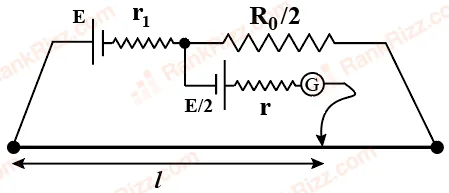
In order to measure the internal resistance r1r_1 of a cell of emf 𝐸, a meter bridge of wire resistance R0=50ΩR_0 = 50 Ω, a resistance R0/2R_0/2, another cell of emf E/2 (internal resistance 𝑟) and a galvanometer G are used in a circuit, as shown in the figure. If the null point is found at l = 72 cm, then the value of r_1 = ___ Ω.

Figure for JEE Advanced 2021 Physics question on Meter bridge
Q18Kepler's laws and planetary motion

The distance between two stars of masses 3MS3 M_S and 6MS6 M_S is 9𝑅. Here 𝑅 is the mean distance between the centers of the Earth and the Sun, and MSM_S is the mass of the Sun. The two stars orbit around their common center of mass in circular orbits with period 𝑛𝑇, where 𝑇 is the period of Earth’s revolution around the Sun.
The value of n is ___.

Q19Photoelectric effect and Einstein's equation

In a photoemission experiment, the maximum kinetic energies of photoelectrons from metals 𝑃, 𝑄 and 𝑅 are EP,EQE_P, E_Q and ERE_R, respectively, and they are related by EP=2EQ=2ERE_P = 2 E_Q = 2 E_R. In this experiment, the same source of monochromatic light is used for metals 𝑃 and 𝑄 while a different source of monochromatic light is used for the metal 𝑅. The work functions for metals 𝑃, 𝑄 and 𝑅 are 4.0 eV, 4.5 eV and 5.5 eV, respectively. The energy of the incident photon used for metal 𝑅, in eV, is ___.

NEXT IN THIS PAPER →Chemistry, Q20 onwards