RankRizz

JEE Advanced 2019 Paper 1 Question Paper

All 54 questions of JEE Advanced 2019 Paper 1, in the order they were asked, one subject to a page. Pick an answer on any question to check it against the key. Free to read, nothing to download.

Questions

54

Physics · Chemistry · Maths

Answer key

35

questions with a checked key

Price

Free

no sign-up

Physics

Q1Kepler's laws and planetary motion

Consider a spherical gaseous cloud of mass density ρ\rho(r) in free space where r is the radial distance from its center. The gaseous cloud is made ofparticles of equal mass m moving in circular orbits about the common center with the same kinetic energy K. The force acting on the particles is their mutual gravitational force. If ρ\rho(r) is constant in time, the particle numberdensity n(r) = ρ\rho(r)/m is
[G is universal gravitational constant]

  1. A

    K2πr2m2G\frac{K}{2 \pi r^2 m^2 G}

  2. B

    Kπr2m2G\frac{K}{\pi r^2 m^2 G}

  3. C

    3Kπr2m2G\frac{3K}{\pi r^2 m^2 G}

  4. D

    K6πr2m2G\frac{K}{6 \pi r^2 m^2 G}

Q2Electric flux and Gauss's law

A thin spherical insulating shell of radius R carries a uniformly distributed charge such that the potential at its surface is V0V_0. A hole with a small area α4πR2(α≪1)\alpha 4 \pi R^2 (\alpha \ll 1) is made on the shell without affecting the rest of the shell. Which one of the following statements is correct?

  1. A

    The potential at the center of the shell is reduced by 2αV02 \alpha V_0

  2. B

    The magnitude ofelectric field at the center of the shell is reduced by αV02R\frac{\alpha V_0}{2R}

  3. C

    The ratio of the potential at the center of the shell to that of the point at 12R\frac{1}{2}R from center towards the hole will be 1−α1−2α\frac{1 - \alpha}{1 - 2 \alpha}

  4. D

    The magnitude of electric field at a point, located on a line passing through the hole and shell’s center, on a distance 2R from the center of the spherical shell will be reduced by αV02R\frac{\alpha V_0}{2R}

Q3Calorimetry and specific heat capacity

A current carrying wire heats a metal rod. The wire provides a constant power (P) to the rod. The metal rod is enclosed in an insulated container. It is observed that the temperature (T) inthe metal rod changes with time (t) as
T(t)=T0(1+βt14),T(t) = T_0 (1 + \beta t^{\frac{1}{4}}),
where β\beta is a constant with appropriate dimension while T0T_0 is a constant with dimension of temperature. The heat capacity of the metal is,

  1. A

    4P(T(t)−T0)3β4T04\frac{4P(T(t) - T_0)^3}{\beta^4 T_0^4}

  2. B

    4P(T(t)−T0)4β4T05\frac{4P(T(t) - T_0)^4}{\beta^4 T_0^5}

  3. C

    4P(T(t)−T0)2β4T03\frac{4P(T(t) - T_0)^2}{\beta^4 T_0^3}

  4. D

    4P(T(t)−T0)β4T02\frac{4P(T(t) - T_0)}{\beta^4 T_0^2}

Q4Radioactivity: decay law, half-life and decay modes

In a radioactive sample, 1940K_{19}^{40}K nuclei either decay into stable 2040Ca_{20}^{40}Ca nuclei with decay constant 4.5×10−194.5 \times 10^{-19} per year or into stable 1840Ar_{18}^{40}Ar nuclei with decay constant 0.5×10−100.5 \times 10^{-10} per year. Given that in this sample all the stable 2040Ca_{20}^{40}Ca and 1840Ar_{18}^{40}Ar nuclei are produced by the 1940K_{19}^{40}K nuclei only. In time t×109t \times 10^9 years, if the ratio of the sum of stable 2040Ca_{20}^{40}Ca and 1840Ar_{18}^{40}Ar nuclei to the radioactive 1940K_{19}^{40}K nuclei is 99, the value of t will be,
[Given: ln⁡10=2.3\ln 10 = 2.3]

  1. A

    1.15

  2. B

    9.2

  3. C

    2.3

  4. D

    4.6

Q5Surface tension and surface energy

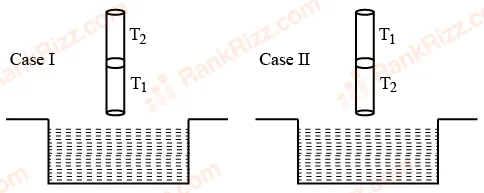
A cylindrical capillary tube of 0.2 mm radius is made by joining two capillaries T1 and T2 of different materials having water contact angles of 0∘0^\circ and 60∘60^\circ, respectively. The capillary tube is dipped vertically in water in two different configurations, case I and II as shown in figure. Which of the following option(s) is(are) correct?
[Surface tension of water = 0.075 N/m, density of water = 1000kg/m31000 kg/m^3, take g=10m/s2g = 10 m/s^2]

Figure for JEE Advanced 2019 Physics question on Surface tension and surface energy
  1. A

    The correction in the height of water column raised in the tube, due to weight of water contained in the meniscus, will be different for both cases.

  2. B

    For case II, if the capillary joint is 5 cm above the water surface, the height of water column raised in the tube will be 3.75 cm. (Neglect the weight of the water in the meniscus)

  3. C

    For case I, if the joint is kept at 8 cm above the water surface, the height of water column in the tube will be 7.5 cm. (Neglect the weight of the water in the meniscus)

  4. D

    For case I, if the capillary joint is 5 cm above the water surface, the height of water column raised in the tube will be more than 8.75 cm. (Neglect the weight of the water in the meniscus)

Q6Motional emf in moving rods and loops

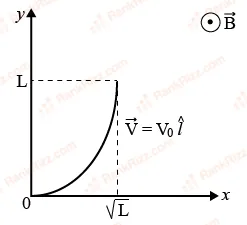
A conducting wire of parabolic shape, initially y=x2y = x^2, is moving with velocity V→=V0l^\overrightarrow{V} = V_0 \widehat{l} in a non-uniform magnetic field B→=B0(1+(yL)β)k^\overrightarrow{B} = B_0 \left( 1 + \left(\frac {y}{L}\right)^\beta \right) \widehat{k} as shown in figure. If V0,B0,LV_0, B_0, L and β\beta are positive constants and △ϕ\triangle\phi is the potential difference developed between the ends of the wire, then the correct statement(s) is/are:

Figure for JEE Advanced 2019 Physics question on Motional emf in moving rods and loops
  1. A

    ∣△ϕ∣=12B0V0L|\triangle\phi| = \frac{1}{2} B_0V_0L for β=0\beta = 0

  2. B

    ∣△ϕ∣=43B0V0L|\triangle\phi| = \frac{4}{3} B_0V_0L for β=2\beta = 2

  3. C

    ∣△ϕ∣|\triangle\phi| remains the same if the parabolic wire is replaced by a straight wire, y = x initially, of length 2L\sqrt 2 L

  4. D

    ∣△ϕ∣|\triangle\phi| is proportionalto the length ofthe wire projected on the y -axis.

Q7Capacitors in DC circuits (steady state)

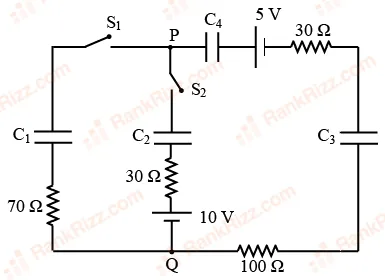
In the circuit shown,initially there is no charge on capacitors and keys S1andS2S_1 and S_2 are open. The values of the capacitors are C1=10μF,C2=30μFandC3=C4=80μF.C_1 = 10 \mu F, C_2 = 30 \mu F and C_3 = C_4 = 80 \mu F.

Figure for JEE Advanced 2019 Physics question on Capacitors in DC circuits (steady state)


Which of the statement(s) is/are correct?

  1. A

    At time t = 0, the key S1S_1 is closed, the instantaneous current in the closed circuit will be 25 mA.

  2. B

    Ifkey S1S_1 is kept closed for long time such that capacitors are fully charged, the voltage across the capacitor C1C_1 will be 4 V.

  3. C

    The key S1S_1 is kept closed for long time such that capacitors are fully charged. Now key S2S_2 is closed, at this time, the instantaneous current across 30Ω30 Ω resistor (between points P and Q) will be 0.2 A (round off to 1st1^{st} decimal place).

  4. D

    If key S1S_1 is kept closed for long time such that capacitors are fully charged, the voltage difference between points P and Q will be 10 V.

Q8Electric flux and Gauss's law

A charged shell of radius R carries a total charge Q. Given ϕ\phi as the flux of electric field through a closed cylindrical surface of height h, radius r and with its center same as that of the shell. Here, center of the cylinder is a point on the axis of the cylinder which is equidistant from its top and bottom surfaces. Which of the following option(s) is/are correct?
[ϵ0\epsilon_0 is the permittivity of free space]

  1. A

    Ifh > 2R andr > R then ϕ=Q/ϵ0\phi = Q/\epsilon_0

  2. B

    Ifh < 8R/5 and r = 3R/5 then ϕ=0\phi = 0

  3. C

    Ifh > 2R andr = 3R/5 then ϕ=Q/5ϵ0\phi = Q/5 \epsilon_0

  4. D

    Ifh > 2R and r = 4R/5 then ϕ=Q/5ϵ0\phi = Q/ 5 \epsilon_0

Q9Multi-step processes and gas-piston-spring systems

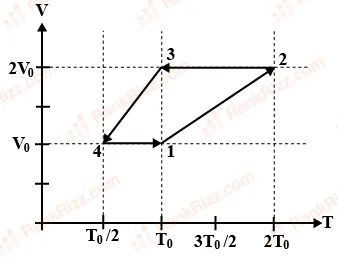
One mole of a monatomic ideal gas goes through a thermodynamic cycle, as shown in the volume versus temperature (V-7 ) diagram. The correct statement(s) is/are:
[R is the gas constant]

Figure for JEE Advanced 2019 Physics question on Multi-step processes and gas-piston-spring systems
  1. A

    Work donein this thermodynamic cycle (1→2→3→4→1)is∣W∣=12RT0(1 \rightarrow 2 \rightarrow 3 \rightarrow 4 \rightarrow 1) is |W| = \frac{1}{2} RT_0

  2. B

    The above thermodynamic cycle exhibits only isochoric and adiabatic processes.

  3. C

    Theratio of heat transfer during processes 1→2→and2→31 \rightarrow 2 \rightarrow and 2 \rightarrow 3 is ∣Q1→2Q2→3∣=53|\frac {Q_1 \rightarrow 2}{Q_2 \rightarrow 3}| = \frac{5}{3}

  4. D

    Theratio of heat transfer during processes 1→2→and3→41 \rightarrow 2 \rightarrow and 3 \rightarrow 4 is ∣Q1→2Q3→4∣=12|\frac {Q_1 \rightarrow 2}{Q_3 \rightarrow 4}| = \frac{1}{2}

Q10Combinations of lenses and mirrors

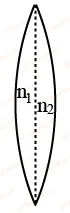
A thin convex lens is made of two materials with refractive indices n1andn2n_1 and n_2 as shown in figure. The radius of curvature of the left and right spherical surfaces are equal. f is the focal length of the lens when n1=n2=n.n_1 = n_2 = n. The focal length is f+△ff + \triangle f when n1=nn_1 = n and n2=n+△nn_2 = n + \triangle n. Assuming △n≪(n—1)\triangle n \ll (n — 1) and 1 < n < 2, the correct statement(s) is/are

Figure for JEE Advanced 2019 Physics question on Combinations of lenses and mirrors
  1. A

    ∣△ff∣<∣△nn∣| \frac {\triangle f}{f}| < | \frac {\triangle n}{n}|

  2. B

    For n=1.5,△n=10−3n = 1.5, \triangle n = 10^{-3} and f = 20 cm,the value of ∣△f∣|\triangle f| will be 0.02 cm (round off to 2nd2^{nd} decimalplace).

  3. C

    If △nn<0then△ff>0\frac {\triangle n}{n} < 0 then \frac {\triangle f}{f} > 0

  4. D

    The relation between △ffand△nn\frac {\triangle f}{f} and \frac {\triangle n}{n} remains unchanged if both the convex surfaces are replaced by concave surfaces of the same radius of curvature.

Q11Dimensional analysis: deriving and checking relations

Let us consider a system of units in which mass and angular momentum are dimensionless. If length has dimension of L, which of the following statement(s) is/are correct?

  1. A

    The dimension of linear momentum L−1L^{-1}

  2. B

    The dimensionof energy is L−2L^{-2}

  3. C

    The dimensionofforce is L−3L^{-3}

  4. D

    The dimension of poweris L−5L^{-5}

Q12Galvanometer conversion to ammeter and voltmeter

Two identical moving coil galvanometers have 10Ω10 Ω resistance and full scale deflection at 2μA2 \mu A current. One of them is converted into a voltmeter of 100 m V full scale reading and the other into an Ammeter of 1mA full scale current using appropriate resistors. These are then used to measure the voltage and current in the Ohm’s law experiment with R=1000ΩR = 1000 Ω resistor by using an ideal cell. Which of the following statement(s) is/are correct?

  1. A

    The resistance of the Voltmeter will be 100kΩ100 kΩ

  2. B

    The resistance of the Ammeterwill be 0.02Ω0.02 Ω (round off to 2nd2^{nd} decimalplace)

  3. C

    The measured value of R willbe 978Ω<R<982Ω978 Ω < R < 982 Ω

  4. D

    If the ideal cell is replaced by a cell having internal resistance of 5Ω5 Ω then the measured value of R will be more than 1000Ω1000 Ω

Q13Work done by constant and variable forces

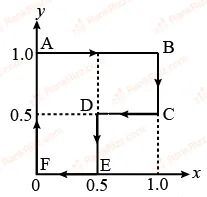
A particle is moved along a path AB-BC-CD-DE-EF-FA, as shownin figure, in presence of a force F→=(αyl^+2αxj^)N\overrightarrow{F} = (\alpha y\widehat{l} + 2\alpha x\widehat{j}) N, where x and y are in meter and α=−1Nm−1\alpha = -1 Nm^{-1}. The work done on the particle by this force F→\overrightarrow{F} will be ___ Joule.

Figure for JEE Advanced 2019 Physics question on Work done by constant and variable forces
Q14Bulk modulus and compressibility

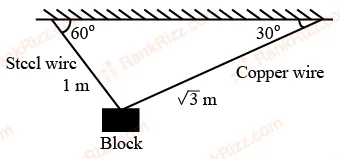
A block of weight 100 N is suspended by copper and steel wires of same cross sectional area 0.5cm20.5 cm^2 and, length 3m\sqrt 3 m and 1 m, respectively. Their other ends are fixed on a ceiling as shown in figure. The angles subtended by copperand steel wires with ceiling are 30∘and60∘30^\circ and 60^\circ, respectively. If elongation in copper wire is (△lC)(\triangle l_C) and elongation in steel wire is (△lS)(\triangle l_S), then the ratio △lC△lS\frac{\triangle l_C}{\triangle l_S} is.
[Young’s modulus for copper andsteel are 1×10¹¹N/m2and2×1011N/m21 \times 10^{11} N/m^2 and 2 \times 10^{11} N/m^2, respectively.]

Figure for JEE Advanced 2019 Physics question on Bulk modulus and compressibility
Q15Doppler effect in sound

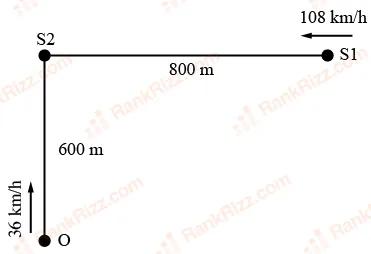
A tram S1, moving with a uniform velocity of 108 km/h, approaches another train S2 standing on a platform. An observer O moves with a uniform velocity of 36 km/h towards S2, as shown in figure. Both the trains are blowing whistles of same frequency 120 Hz. When O is 600 m away from S2 and distance between S1 and S2 is 800 m, the number of beats heard by O is __________.
[Speed of the sound = 330 m/s]

Figure for JEE Advanced 2019 Physics question on Doppler effect in sound
Q16Capacitors with dielectrics

A parallel plate capacitor of capacitance C has spacing d between two plates having area A. The region between the plates is filled with N dielectric layers, parallel to its plates, each with thickness δ=dN\delta = \frac{d}{N}. The dielectric constant of the mthm^{th} layer is Km=K(1+mN)K_m = K \left(1 + \frac {m}{N}\right), For a very large N(>103)N (> 10^3), the capacitance C is α(Kϵ0Adln2)\alpha \left(\frac{K \epsilon_0A}{d ln 2}\right). The value of α\alpha will be _________.
[ϵ0\epsilon_0 is the permittivity of free space]

Q17Calorimetry and specific heat capacity

A liquid at 30∘C30^\circ C is poured very slowly into a Calorimeter that is at temperature of 110∘C110^\circ C . The boiling temperature of the liquid is 80∘C80^\circ C . It is found that the first 5 gm of the liquid completely evaporates. After pouring another 80 gm of the liquid the equilibrium temperature is found to be 50∘C50^\circ C . The ratio of the Latent heat of the liquid to its specific heat will be ∘C^\circ C
[Neglect the heat exchange with surrounding]

Q18Prism: deviation and dispersion

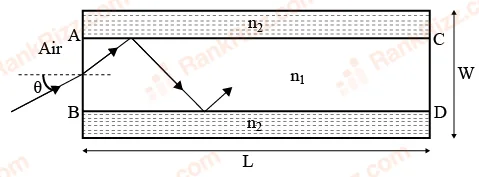
A planar structure of length £ and width W is made of two different optical media of refractive indices n1=1.5andn2=1.44n_1 = 1.5 and n_2 = 1.44 as shown in figure. If L≫WL \gg W, a ray entering from end AB will emerge from end CD only if the total internal reflection condition is met inside the structure. For L = 9.6 m, if the incident angle θ\theta is varied, the maximum time taken by array to exit the plane CD is t×10−9st \times 10^{-9} s, where t is _______.
[ Speed of light c=3×10⁸m/sc = 3 \times 10^8 m/s]

Figure for JEE Advanced 2019 Physics question on Prism: deviation and dispersion
NEXT IN THIS PAPER →Chemistry, Q19 onwards