Q1Multi-step processes and gas-piston-spring systems
5.6 liter of helium gas at STP is adiabatically compressed to 0.7 liter. Taking the initial temperature to be , the work done in the process is-
- A
- B
- C
- D
All 69 questions of JEE Advanced 2011 Paper 1, in the order they were asked, one subject to a page. Pick an answer on any question to check it against the key. Free to read, nothing to download.
Questions
69
Physics · Chemistry · Maths
Answer key
69
questions with a checked key
Price
Free
no sign-up
5.6 liter of helium gas at STP is adiabatically compressed to 0.7 liter. Taking the initial temperature to be , the work done in the process is-
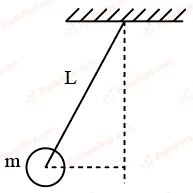
A ball of mass (m) 0.5 kg is attached to the end of a string having length (L) 0.5 m. The ball is rotated on a horizontal circular path about vertical axis. The maximum tension that the string can bear is 324 N. The maximum possible value of angular velocity of ball (in radian/s) is-
9
18
27
36
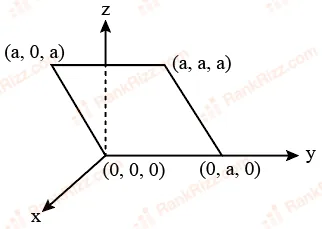
Consider an electric field , where is a constant. The flux through the shaded area (as shown in the figure) due to this field is-
A police car with a siren of frequency 8 kHz is moving with uniform velocity 36 km/hr towards a tall building which reflects the sound waves. The speed of sound in air is 320 m/s. The frequency of the siren heard by the car driver is-
8.50 kHz
8.25 kHz
7.75 kHz
7.50 kHz
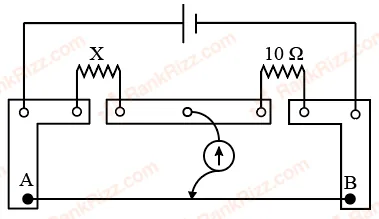
A meter bridge is set-up as shown, to determine an unknown resistance 'X' using a standard 10 ohm resistor. The galvanometer show null point when tapping-key is at 52 cm mark. The end-corrections are 1 cm and 2 cm respectively for the ends A and B. The determine value of 'X' is-
10.2 ohm
10.6 ohm
10.8 ohm
11.1 ohm
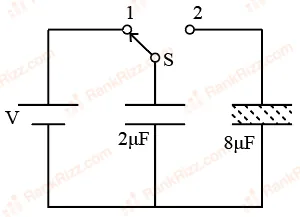
A 2 capacitor is charged as shown in figure. The percentage of its stored energy dissipated after the switch S is turned to position 2 is-
0%
20%
75%
80%
The wavelength of the first spectral line in the Balmer series of hydrogen atom is 6561 Å. The wave length of the second spectral line in the Balmer series of singly-ionized helium atom is-
1215 Å
1640 Å
2430 Å
4687 Å
A spherical metal shall A of radius and a solid metal sphere B of radius are kept far apart and each is given charge '+Q'. Now they are connected by a thin metal wire. Then-
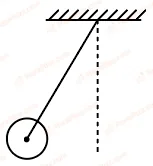
A metal rod of length 'L' and mass 'm' is pivoted at one end. A thin disk of mass 'M' and radius 'R' (< L) is attached at its centre to the free end of the rod. Consider two ways the disc is attached :(case A) The disc is not free to rotate about its center and (case B) the disc is free to rotate about its center. The rod-disc system performs SHM in vertical plane after being released from the same displaced position. Which of the following statement(s) is (are) true ?
Restoring torque in case A = Restoring torque in case B
Restoring torque in case A < Restoring torque in case B
Angular frequency for case A > Angular frequency for case B
Angular frequency for case A < Angular frequency for case B
An electron and a proton are moving on straight parallel paths with same velocity. They enter a semi-infinite region of uniform magnetic field perpendicular to the velocity. Which of the following statement(s) is/are true ?
They will never come out of the magnetic field region
They will come out traveling along parallel paths
They will come out at the same time
They will come out at different times
A composite book is made of slabs A, B, C, D and E of different thermal conductivities (given in terms of a constant K) and sizes (given in terms of length, L) as shown in the figure. All slabs are of same width. Heat 'Q' flow only from left to right through the blocks. Then in steady state-
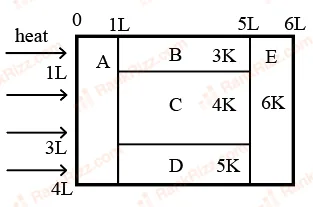
heat flow through A and E slabs are same
heat flow through slab E is maximum
temperature difference across slab E is smallest
heat flow through C = heat flow through B + heat flow through D
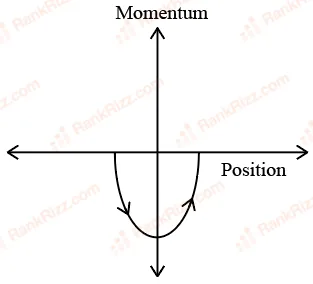
The phase space diagram for a ball thrown vertically up from ground is-
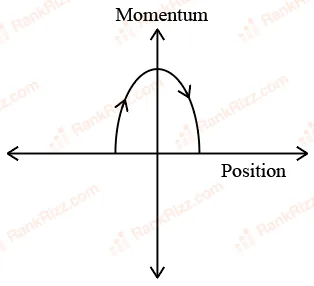
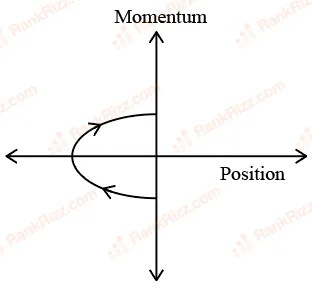
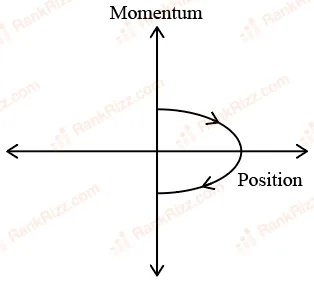
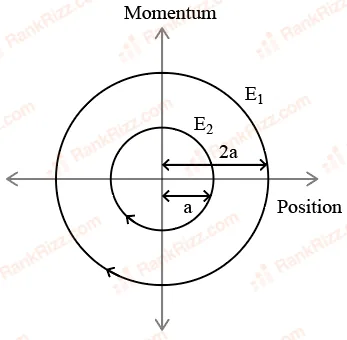
The phase space diagram for simple harmonic motion is a circle centered at the origin. In the figure, the two circles represent the same oscillator but for different initial conditions, and and are the total mechanical energies respectively. Then-
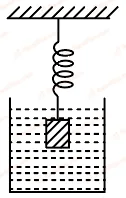
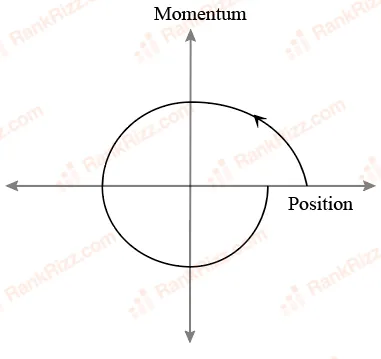
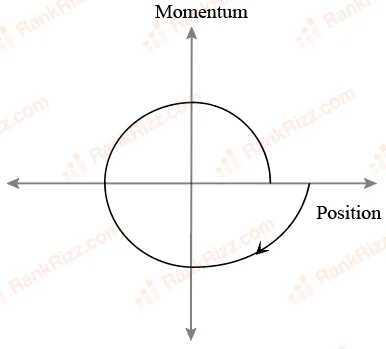
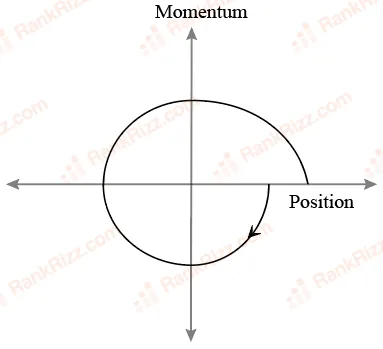
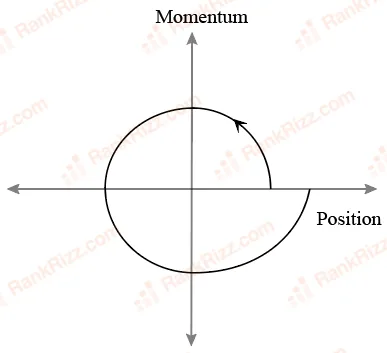
Consider the spring-mass system, with the mass submerged in water, as shown in figure. The phase space diagram for one cycle of this system is-
Taking the electronic charge as 'e' and the permittivity as , use dimensional analysis to determine the correct expression for .
Estimate the wavelength at which plasma reflection will occur for metal having the density of electrons . Take and , where these quantities are in proper SI unit-
800 nm
600 nm
300 nm
200 nm
A block is moving on an inclined plane making an angle with the horizontal and the coefficient of friction is . The force required to just push it up the inclined plane is 3 times the force required to just prevent it from sliding down. If we define N = 10 , then N is.
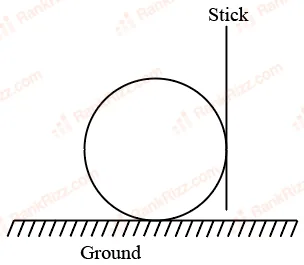
A boy is pushing a ring of mass 2 kg and radius 0.5 m with a stick as shown in the figure. The stick applies a force of 2 N on the ring and rolls it without slipping with an acceleration of 0.3 . The coefficient of friction between the ground and the ring is large enough that rolling always occurs and the coefficient of friction between the stick and the ring is (P/10). The value of P is.
Four point charge, each of +q, are rigidly fixed at the four corners of a square planar soap film of side 'a'. The surface tension of the soap film is . The system of charges and planar film are in equilibrium, and , where 'k' is a constant. Then N is
Four solid spheres each of diameter cm and mass 0.5 kg are placed with their centers at the corners of a square of side 4 cm. The momentum of inertia of the system about the diagonal of the square is , then N is.
The activity of a freshly prepared radioactive sample is disintegrations per second, whose mean life is s. The mass of an atom of this radioisotope is kg. The mass (in mg) of the radioactive sample is.
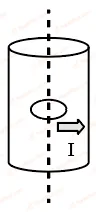
A long circular tube of length 10 m and radius 0.3 carries a current I along its curved surface as shown. A wire-loop of resistance 0.005 ohm and of radius 0.1 m is placed inside the tube with its axis coinciding with the axis of the tube. The current varies as where is constant. If the magnetic moment of the loop is . then 'N' is.
Steel wire of length 'L' at is suspended from the ceiling and then a mass 'm' is hung from its free end. The wire is cooled down from to to region its original length 'L'. The coefficient of linear thermal expansion of the steel is , Young's modulus of steel is and radius of the wire is 1 mm. Assume that L >> diameter of the wire. Then the value of 'm' in kg is nearly.