JEE Main 2005 Physics question — Heat conduction and thermal resistance
The figure shows a system of two concentric spheres of radii and and kept at temperatures and respectively. The radial rate of flow of heat in a substance between the two concentric sphere is proportional to 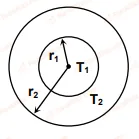
SOLUTION
For steady-state radial heat conduction through a material of thermal conductivity located between two concentric spheres, the heat current is given by Fourier’s law.
At a radius the area of the spherical surface is .
Fourier’s law (in one dimension) is , so
Because the system is in steady state, is the same through every spherical surface between and . Rearrange to separate variables:
Integrate from the inner sphere (radius , temperature ) to the outer sphere (radius , temperature ):
Simplify the bracket:
Solving for the heat current,
Thus the radial rate of heat flow is directly proportional to .
Option C which is: