RankRizz

Semiconductors: energy bands, intrinsic and extrinsic — JEE Main Previous Year Questions

Semiconductors: energy bands, intrinsic and extrinsic has been asked 9 times in JEE Main, in 5 different years between 2004 and 2012, and in none of the last five exam years (2022–2026). That is 4% of Semiconductor Electronics. Last asked in JEE Main 2012. All 9 are multiple choice. All of them are below, newest first, free to read.

Questions

9

Years asked

5

Since

2004

Of the chapter

4%

When JEE Main asked it

Questions on Semiconductors: energy bands, intrinsic and extrinsic in every year it was asked, newest first.

JEE Main questions on Semiconductors: energy bands, intrinsic and extrinsic by year, 2004–2012
YearRelative frequencyQuestions
20121
20071
20063
20051
20043
Total9

Every Semiconductors: energy bands, intrinsic and extrinsic question

1–9 OF 9 · NEWEST FIRST

JEE MAIN 2012Semiconductors: energy bands, intrinsic and extrinsic

This question has Statement 1 and Statement 2. Of the four choices given after the Statements, choose the one that best describes the two Statements. Statement 1: A pure semiconductor has negative temperature coefficient of resistance. Statement 2: On raising the temperature, more charge carriers are released into the conduction band.

  1. A

    Statement 1 is false, Statement 2 is true.

  2. B

    Statement 1 is true, Statement 2 is false.

  3. C

    Statement 1 is true, Statement 2 is true, Statement 2 is not a correct explanation of Statement 1.

  4. D

    Statement 1 is true, Statement 2 is true, Statement 2 is the correct explanation of Statement 1.
JEE MAIN 2007Semiconductors: energy bands, intrinsic and extrinsic

Carbon, silicon and germanium have four valence electrons each. At room temperature which one of the following statements is most appropriate?

  1. A

    The number of free conduction electrons is significant in C but small in Si and Ge.

  2. B

    The number of free conduction electrons is negligibly small in all the three.

  3. C

    The number of free electrons for conduction is significant in all the three.

  4. D

    The number of free electrons for conduction is significant only in Si and Ge but small in C.

JEE MAIN 2006Semiconductors: energy bands, intrinsic and extrinsic

A solid which is transparent to visible light and whose conductivity increases with temperature is formed by

  1. A

    Metallic binding

  2. B

    Ionic binding

  3. C

    Covalent binding

  4. D

    Van der Waals binding

JEE MAIN 2006Semiconductors: energy bands, intrinsic and extrinsic

If the ratio of the concentration of electrons that of holes in a semiconductor is 75\dfrac{7}{5} and the ratio of currents is 74\dfrac{7}{4}, then what is the ratio of their drift velocities?

  1. A

    47\dfrac{4}{7}

  2. B

    58\dfrac{5}{8}

  3. C

    45\dfrac{4}{5}

  4. D

    54\dfrac{5}{4}

JEE MAIN 2006Semiconductors: energy bands, intrinsic and extrinsic

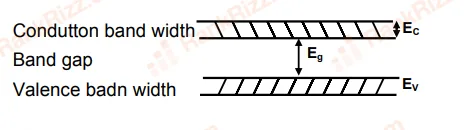
If the lattice constant of this semiconductor is decreased, then which of the following is correct?Figure for JEE Main 2006 Physics question on Semiconductors: energy bands, intrinsic and extrinsic

  1. A

    All Ec,Eg,EvE_c, E_g, E_v decrease

  2. B

    All FFF_F increase

  3. C

    EcE_c, and EvE_v increase but EgE_g decreases

  4. D

    EcE_c, and EvE_v decrease EgE_g increases

JEE MAIN 2005Semiconductors: energy bands, intrinsic and extrinsic

The electrical conductivity of a semiconductor increases when electromagnetic radiation of wavelength shorter than 24802480 nm is incident on it. The band gap (in eV) for the semiconductor is

  1. A

    1.11.1 eV

  2. B

    2.52.5 eV

  3. C

    0.50.5 eV

  4. D

    0.70.7 eV

JEE MAIN 2004Semiconductors: energy bands, intrinsic and extrinsic

The thermistors are usually made of

  1. A

    metals with low temperature coefficient of resistivity

  2. B

    metals with high temperature coefficient of resistivity

  3. C

    metal oxides with high temperature coefficient of resistivity

  4. D

    semiconducting materials having low temperature coefficient of resistivity.

JEE MAIN 2004Semiconductors: energy bands, intrinsic and extrinsic

A piece of copper and another of germanium are cooled from room temperature to 7777 K, the resistance of

  1. A

    each of them increases

  2. B

    each of them decreases

  3. C

    copper decreases and germanium increases

  4. D

    copper increases and germanium decreases

JEE MAIN 2004Semiconductors: energy bands, intrinsic and extrinsic

The manifestation of band structure in solids is due to

  1. A

    Heisenberg's uncertainty principle

  2. B

    Pauli's exclusion principle

  3. C

    Bohr's correspondence principle

  4. D

    Boltzmann's law

Semiconductors: energy bands, intrinsic and extrinsic: common questions

How many Semiconductors questions have come in JEE Main?
Semiconductors has been asked 9 times in JEE Main, in 5 different years between 2004 and 2012. It came up in none of the last five exam years (2022–2026).
Is Semiconductors important for JEE Main?
It is part of Semiconductor Electronics: 9 of the chapter's 253 JEE Main questions (4%). It came up in none of the last five exam years (2022–2026).
When was Semiconductors last asked in JEE Main?
Most recently in JEE Main 2012. Questions on this page are newest first, so the latest ones are at the top.
What kind of Semiconductors questions does JEE Main ask?
All 9 are multiple choice. Each question shows its answer key and worked solution where we have them.