JEE Main 2021 Physics question — p-n junction diode and its characteristics
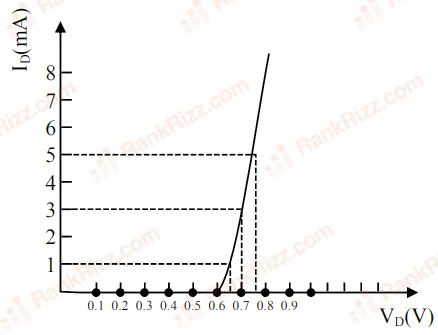
For the forward biased diode characteristics shown in the figure, the dynamic resistance at mA will be ___ .
SOLUTION
We need to determine the dynamic resistance of the forward-biased diode at a diode current of using the provided characteristic curve.
1. Understand the Concept of Dynamic Resistance
Dynamic (or AC) resistance () of a diode represents its resistance under alternating current conditions. Unlike static resistance (), dynamic resistance is defined as the reciprocal of the slope of the forward characteristic curve at that specific operating point:
Where is the change in diode voltage and is the corresponding change in diode current along the linear operating region.
2. Extract Data Points from the Graph
Looking at the linear portion of the forward characteristics passing through the region around , we can identify two clear reference coordinate points on the grid lines:
- Point 1: When , the current is
- Point 2: When , the current is
3. Calculate the Changes ( and )
Now, compute the differences between these two operating states along the straight line segment:
4. Calculate the Dynamic Resistance ()
Substitute the voltage change and current change values back into our main dynamic resistance formula:
Final Answer: