JEE
Coming soon
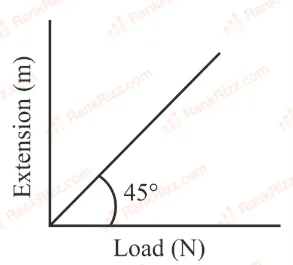
As shown in the figure, in an experiment to determine Young's modulus of a wire, the extension-load curve is plotted. The curve is a straight line passing through the origin and makes an angle of 45° with the load axis. The length of the wire is 62.8 cm and its diameter is 4 mm. The Young's modulus is found to be x×104x \times 10^4x×104 N m−2^{-2}−2. The value of xxx is _____.
Y=StressStrain=F/AΔL/L=(FΔL)⋅LAY = \frac{\text{Stress}}{\text{Strain}} = \frac{F / A}{\Delta L / L} = \left( \frac{F}{\Delta L} \right) \cdot \frac{L}{A}Y=StrainStress=ΔL/LF/A=(ΔLF)⋅AL
Slope=Change in ExtensionChange in Load=ΔLF=tan(45∘)=1\text{Slope} = \frac{\text{Change in Extension}}{\text{Change in Load}} = \frac{\Delta L}{F} = \tan(45^\circ) = 1Slope=Change in LoadChange in Extension=FΔL=tan(45∘)=1
A≈4×3.14×10−6=12.56×10⁻⁶ m2A \approx 4 \times 3.14 \times 10^{-6} = 12.56 \times 10^{-6} \text{ m}^2A≈4×3.14×10−6=12.56×10⁻⁶ m2
Y=(FΔL)⋅LAY = \left( \frac{F}{\Delta L} \right) \cdot \frac{L}{A}Y=(ΔLF)⋅AL
Y=(1)⋅0.62812.56×10−6Y = (1) \cdot \frac{0.628}{12.56 \times 10^{-6}}Y=(1)⋅12.56×10−60.628
Y=0.628×10612.56=0.05×10⁶Y = \frac{0.628 \times 10^6}{12.56} = 0.05 \times 10^6Y=12.560.628×106=0.05×10⁶
Y=5×10⁴ N m−2Y = 5 \times 10^4 \text{ N m}^{-2}Y=5×10⁴ N m−2
x=5x = 5x=5
Topic: Stress, strain, Hooke's law and Young's modulus
QUESTION pyq:494747