JEE Main 2019 Physics question — Motional emf in moving rods and loops
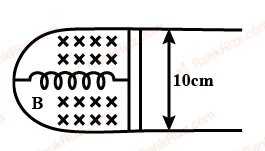
A thin strip 10 cm long is on a U shaped wire of negligible resistance and it is connected to a spring of spring constant 0.5 N m (see figure). The assembly is kept in a uniform magnetic field of 0.1 T. If the strip is pulled from its equilibrium position and released, the number of oscillations it performs before its amplitude decreases by a factor of e is N. If the mass of the strip is 50 grams, its resistance 10 and air drag negligible, N will be close to:
SOLUTION
We have a conducting strip of length sliding on friction-free rails that form a closed circuit of total resistance . The strip is free to move along the rails while a uniform magnetic field of magnitude is directed perpendicular to the plane of the circuit. A light spring of force constant pulls the strip towards its equilibrium position. The mass of the strip is . Air drag is negligible, so the only damping is electromagnetic.
Whenever the strip moves with velocity , the motional emf produced across its ends is given by Faraday’s law of electromagnetic induction,
Ohm’s law then gives the induced current,
The magnetic force on a current-carrying conductor of length in a field is (in magnitude)
Substituting the expression for , we obtain
This force always opposes the velocity (Lenz’s law), so it behaves exactly like a viscous damping force of the form with an effective electromagnetic damping coefficient
Putting in the numerical values,
The strip-spring system therefore obeys the equation for a damped harmonic oscillator,
For small damping (which is true here because is very small) the displacement amplitude decays exponentially as
The time constant for the amplitude to fall by a factor of is therefore
Meanwhile the natural period of oscillation (with weak damping the change in period is negligible) follows from
The number of oscillations completed in a time is , so the number of oscillations completed in one time constant is
Now we substitute every numerical value step by step.
First,
Next, recalling , we have
Because we merely need a value “close to” the answer, we round to the nearest option offered. is closest to
Hence, the correct answer is Option B.