JEE MAIN 2022 · 25 JUL S2+4 / −1EASY
JEE Main 2022 Physics question — Kirchhoff's laws and circuit analysis
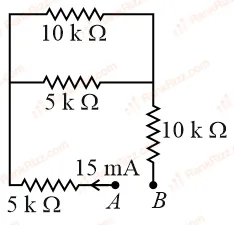
A current of flows in the circuit as shown in figure. The value of potential difference between the points and will be
SOLUTION
We need to find the potential difference between points and () for the given resistor network.
1. Calculate the Equivalent Resistance of the Network
Let's analyze the arrangement of the resistors from the circuit diagram
- The top resistor and the middle resistor are connected in parallel with each other. Let's find their equivalent resistance ():
- This parallel combination () is connected in series with the bottom-left resistor and the right vertical resistor.
Therefore, the total equivalent resistance () of the entire circuit branch connected between terminals and is:
2. Calculate the Potential Difference ()
The total current flowing into the circuit at terminal and exiting at terminal is given as .
Applying Ohm's law () across the entire network between points and :
Since , the units simplify cleanly to volts:
Conclusion
The potential difference between points and is 275 V, which matches Option D.