JEE MAIN 2022 · 25 JUL S1+4 / −1EASY
JEE Main 2022 Physics question — Kirchhoff's laws and circuit analysis
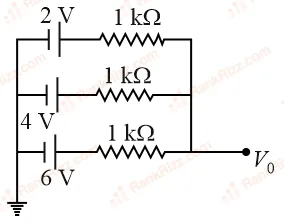
In the given figure, the value of will be ______ V.
SOLUTION
We need to determine the output voltage for the given parallel combination of practical voltage sources (batteries with internal resistances).
1. Identify the Circuit Parameters
From the circuit diagram,we have three branches connected in parallel to the common output node :
- Branch 1: Voltage , Resistance
- Branch 2: Voltage , Resistance
- Branch 3: Voltage , Resistance
All the negative terminals of the batteries are tied together to the ground ().
2. Apply Millman's Theorem
Millman's Theorem states that when multiple voltage sources are connected in parallel, the equivalent voltage () across the common terminals is given by:
Since all the internal resistances are equal (), the expression simplifies directly to the arithmetic mean of the voltages:
Conclusion
The value of is 4 V.