JEE Main 2021 Physics question — RC circuits: charging and discharging
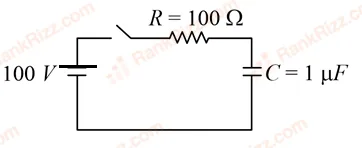
A capacitor of capacitance F is suddenly connected to a battery of 100 V through a resistance . The time taken for the capacitor to be charged to get 50 V is:
(Take ln 2 = 0.69)
SOLUTION
We need to determine the time taken for the capacitor in an RC circuit to charge up to a potential of 50 V.
1. Identify the Given Parameters
From the problem:
- Capacitance () =
- Resistance () =
- Battery Voltage () =
- Target Voltage () =
- Logarithmic constant:
2. Apply the Capacitor Charging Formula
The instantaneous voltage () across a charging capacitor at time is governed by the following transient equation:
Substitute our known parameters into this equation to solve for :
Divide both sides by 100:
3. Solve for Time ()
Take the natural logarithm () of both sides to remove the exponential function:
Now, calculate the circuit's time constant ():
Substitute the value of and back into the time equation:
Conclusion
The time taken for the capacitor to be charged to 50 V is , which corresponds exactly to Option C.