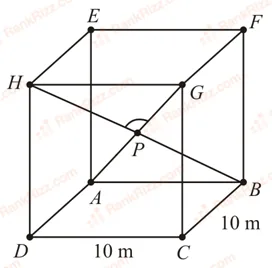
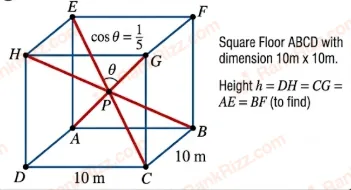
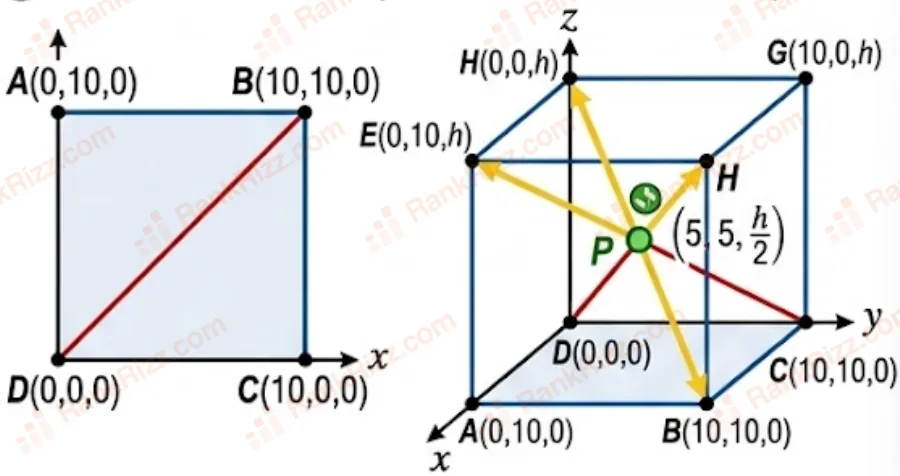
P = ( 0 + 10 2 , 10 + 0 2 , h + 0 2 ) P = \left( \frac{0+10}{2}, \frac{10+0}{2}, \frac{h+0}{2} \right) P = ( 2 0 + 10 , 2 10 + 0 , 2 h + 0 )
= ( 5 , 5 , h 2 ) = \left( 5, 5, \frac{h}{2} \right) = ( 5 , 5 , 2 h )
P G ⃗ = G − P = ( 10 , 0 , h ) − ( 5 , 5 , h 2 ) \vec{PG} = G - P = (10, 0, h) - \left( 5, 5, \frac{h}{2} \right) P G = G − P = ( 10 , 0 , h ) − ( 5 , 5 , 2 h )
= ( 5 , − 5 , h 2 ) = \left( 5, -5, \frac{h}{2} \right) = ( 5 , − 5 , 2 h )
P H ⃗ = H − P = ( 0 , 0 , h ) − ( 5 , 5 , h 2 ) \vec{PH} = H - P = (0, 0, h) - \left( 5, 5, \frac{h}{2} \right) P H = H − P = ( 0 , 0 , h ) − ( 5 , 5 , 2 h )
= ( − 5 , − 5 , h 2 ) = \left( -5, -5, \frac{h}{2} \right) = ( − 5 , − 5 , 2 h )
Angle G P H = θ GPH = \theta GP H = θ cos θ = 1 5 \cos \theta = \frac{1}{5} cos θ = 5 1
Use dot product rule:
P G ⃗ ⋅ P H ⃗ = ∣ P G ⃗ ∣ ∣ P H ⃗ ∣ cos θ \vec{PG} \cdot \vec{PH} = |\vec{PG}| |\vec{PH}| \cos \theta P G ⋅ P H = ∣ P G ∣∣ P H ∣ cos θ
( 5 ) ( − 5 ) + ( − 5 ) ( − 5 ) + h 2 ( h 2 ) = ( 50 + h 2 4 ) 2 ⋅ 1 5 (5)(-5) + (-5)(-5) + \frac{h}{2} \left( \frac{h}{2} \right) = \left( \sqrt{50 + \frac{h^2}{4}} \right)^2 \cdot \frac{1}{5} ( 5 ) ( − 5 ) + ( − 5 ) ( − 5 ) + 2 h ( 2 h ) = ( 50 + 4 h 2 ) 2 ⋅ 5 1
− 25 + 25 + h 2 4 = ( 50 + h 2 4 ) ⋅ 1 5 -25 + 25 + \frac{h^2}{4} = \left( 50 + \frac{h^2}{4} \right) \cdot \frac{1}{5} − 25 + 25 + 4 h 2 = ( 50 + 4 h 2 ) ⋅ 5 1
Multiply by 20:
5 h 2 = 200 + h 2 5h^2 = 200 + h^2 5 h 2 = 200 + h 2
4 h 2 = 200 4h^2 = 200 4 h 2 = 200
h 2 = 50 h^2 = 50 h 2 = 50
h = 50 = 5 ⋅ 2 h = \sqrt{50} = 5 \cdot \sqrt{2} h = 50 = 5 ⋅ 2