JEE Main 2020 Mathematics question — Heights and distances
The angle of elevation of a cloud C from a point P, 200 m above a still lake is 30°. If the angle of depression of the image of C in the lake from the point P is 60°, then PC (in m) is equal to
SOLUTION
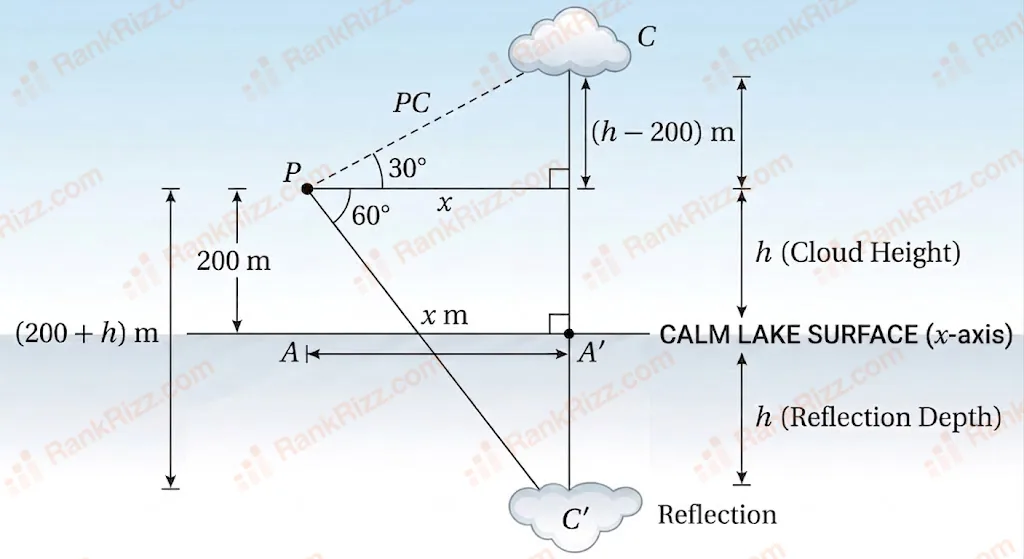
Let the still surface of the lake be a horizontal plane. Choose a point A on this surface such that the given point P lies vertically above A. We are told that P is 200 m above the lake, so PA=200 m.
Let the cloud be C and its image in the lake be C′. Because an image in a perfectly still lake is formed by reflection in the water surface, C and C′ are on the same vertical line through A′, with A′ exactly midway between them. If we denote the height of the cloud above the lake by h metres, then
A′C=h,A′C′=h,andC′ is h metres below the water surface.
Put the horizontal distance of both C and C′ from the foot A as x metres. Thus the coordinates (taking the lake surface as the x-axis and up as positive y) can be visualised as
A(0,0),P(0,200),C(x,h),C′(x,−h).
The angle of elevation of C from P is 30°. By the definition of tangent in a right triangle,
tan30∘=adjacent sideopposite side=x(h−200).
Since tan30∘=31, we get
31=xh−200⟹x=3(h−200).(1)
Next, the angle of depression of the image C′ from P is 60°. The angle of depression equals the angle the line of sight makes below the horizontal. Using the same tangent definition, we have
tan60∘=horizontal distance xvertical drop from P to C′=x200+h.
Because tan60∘=3, this yields
3=x200+h⟹x=3200+h.(2)
Both equations (1) and (2) represent the same value of x, so we equate them:
3(h−200)=3200+h.
Multiplying both sides by 3 to clear the denominator,
3(h−200)=200+h.
Expanding and rearranging step by step,
3h−600=200+h 3h−h=200+600 2h=800 h=400.
So the cloud is 400 m above the lake.
The vertical separation between P and C is therefore
vertical difference=h−200=400−200=200 m.
Substituting h=400 into equation (1) (or equation (2)) to find x,
x=3(h−200)=3×200=2003 m.
Now we know both the horizontal and vertical components of the line segment PC. Using the Pythagoras theorem, which states hypotenuse2=base2+perpendicular2, we have