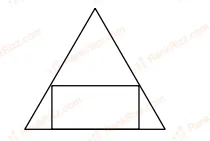
Given:
Side of equilateral triangle,
s = 2 2 s=2\sqrt2 s = 2 2
Height of the triangle:
H = 3 2 s H=\frac{\sqrt3}{2}s H = 2 3 s
= 3 2 ( 2 2 ) =\frac{\sqrt3}{2}(2\sqrt2) = 2 3 ( 2 2 )
= 6 =\sqrt6 = 6
Base of triangle:
B = 2 2 B=2\sqrt2 B = 2 2
Let the inscribed rectangle have:
- width w w w
- height h h h
Using similar triangles,
w B = H − h H \frac{w}{B}=\frac{H-h}{H} B w = H H − h
Hence,
w = B ( 1 − h H ) w=B\left(1-\frac{h}{H}\right) w = B ( 1 − H h )
Area of rectangle:
A = w h A=wh A = w h
= B h ( 1 − h H ) =Bh\left(1-\frac{h}{H}\right) = B h ( 1 − H h )
= B ( h − h 2 H ) =B\left(h-\frac{h^2}{H}\right) = B ( h − H h 2 )
Differentiate with respect to h h h
d A d h = B ( 1 − 2 h H ) \frac{dA}{dh}=B\left(1-\frac{2h}{H}\right) d h d A = B ( 1 − H 2 h )
For maximum area,
d A d h = 0 \frac{dA}{dh}=0 d h d A = 0
1 − 2 h H = 0 1-\frac{2h}{H}=0 1 − H 2 h = 0
h = H 2 h=\frac{H}{2} h = 2 H
Now,
w = B ( 1 − 1 2 ) = B 2 w=B\left(1-\frac12\right)=\frac{B}{2} w = B ( 1 − 2 1 ) = 2 B
Therefore maximum area is
A max = B 2 ⋅ H 2 A_{\max}=\frac{B}{2}\cdot\frac{H}{2} A m a x = 2 B ⋅ 2 H
= B H 4 =\frac{BH}{4} = 4 B H
But,
1 2 B H \frac12 BH 2 1 B H
is the area of the triangle.
Hence,
A max = 1 2 ( Area of triangle ) A_{\max}=\frac12(\text{Area of triangle}) A m a x = 2 1 ( Area of triangle )
Area of equilateral triangle:
= 3 4 s 2 =\frac{\sqrt3}{4}s^2 = 4 3 s 2
= 3 4 ( 2 2 ) 2 =\frac{\sqrt3}{4}(2\sqrt2)^2 = 4 3 ( 2 2 ) 2
= 3 4 ⋅ 8 =\frac{\sqrt3}{4}\cdot8 = 4 3 ⋅ 8
= 2 3 =2\sqrt3 = 2 3
Thus,
A max = 2 3 2 A_{\max}=\frac{2\sqrt3}{2} A m a x = 2 2 3
= 3 =\sqrt3 = 3
Therefore,
( A max ) 2 = ( 3 ) 2 (A_{\max})^2=(\sqrt3)^2 ( A m a x ) 2 = ( 3 ) 2
= 3 =3 = 3
Hence, the required answer is
3 \boxed{3} 3