RankRizz

Oxidising/reducing agents and types of redox reactions — JEE Main Previous Year Questions

Oxidising/reducing agents and types of redox reactions has been asked 15 times in JEE Main, in 8 different years between 2004 and 2026, and in all of the last five exam years (2022–2026), 12 questions in all. That is 17% of Redox Reactions. Last asked in JEE Main 02 Apr 2026, Shift 1. 14 are multiple choice and 1 numerical-value; 8 easy and 5 medium by our difficulty labels. All of them are below, newest first, free to read.

Questions

15

Years asked

8

Since

2004

Of the chapter

17%

When JEE Main asked it

Questions on Oxidising/reducing agents and types of redox reactions in every year it was asked, newest first.

JEE Main questions on Oxidising/reducing agents and types of redox reactions by year, 2004–2026
YearRelative frequencyQuestions
20262
20252
20245
20231
20222
20191
20061
20041
Total15

Every Oxidising/reducing agents and types of redox reactions question

1–15 OF 15 · NEWEST FIRST

JEE MAIN 2026 · 02 APR S1Oxidising/reducing agents and types of redox reactions

Given below are two statements : 

Statement (I) : Oxidising power of halogens decreases in the order F2_2 > Cl2_2 > Br2_2 > I2_2, which is the basis of "Layer test". 

Statement (II) : "Layer test" to identify Br2_2 and I2_2 in aqueous solution involves the oxidation of bromide or iodide into Br2_2 or I2_2 respectively with Cl2_2, which is a type of displacement redox reaction. 

In the light of the above statements, choose the correct answer from the options given below :

  1. A

    Both Statement I and Statement II are true

  2. B

    Both Statement I and Statement II are false

  3. C

    Statement I is true but Statement II is false

  4. D

    Statement I is false but Statement II is true
JEE MAIN 2026 · 24 JAN S2Oxidising/reducing agents and types of redox reactions

One mole of Cl2(g)Cl_{2}(g) was passed into 2 L of cold 2M KOH solution. After the reaction, the concentrations of Cl−Cl^{-} , ClO−ClO^{-} and OH−OH^{-} are respectively (assume volume remains constant)

  1. A

    0.5M, 0.5M, lM

  2. B

    0.75M, 0.75M, lM

  3. C

    0.5M, 0.5M, 0.5M

  4. D

    lM, lM, 1M

JEE MAIN 2025 · 28 JAN S1Oxidising/reducing agents and types of redox reactions

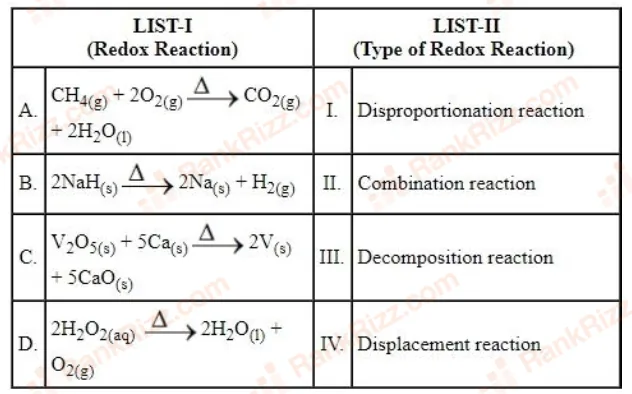
Match the LIST-I with LIST-II

page11_img2


Choose the correct answer from the options given below:

  1. A

    A-II, B-III, C-I, D-IV

  2. B

    A-III, B-IV, C-I, D-II

  3. C

    A-IV, B-I, C-II, D-III

  4. D

    A-II, B-III, C-IV, D-I

JEE MAIN 2025 · 22 JAN S2Oxidising/reducing agents and types of redox reactions

The species which does not undergo disproportionation reaction is :

  1. A

    ClO3−ClO_{3}^{-}

  2. B

    ClO−ClO^{-}

  3. C

    ClO2−ClO_{2}^{-}

  4. D

    ClO4−ClO_{4}^{-}

JEE MAIN 2024 · 06 APR S2Oxidising/reducing agents and types of redox reactions

The number of ions from the following that are expected to behave as oxidising agent is : Sn4+,Sn2+,Pb2+,Tl3+,Pb4+,Tl+Sn^{4+}, Sn^{2+}, Pb^{2+}, Tl^{3+}, Pb^{4+}, Tl^{+}

  1. A

    33

  2. B

    22

  3. C

    11

  4. D

    44

JEE MAIN 2024 · 06 APR S2Oxidising/reducing agents and types of redox reactions

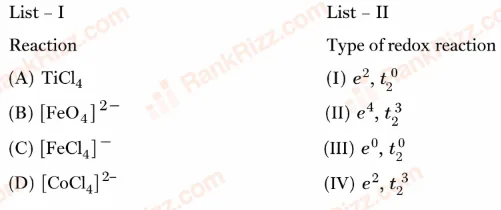
Match List - I with List - II.

Figure for JEE Main 2024 Chemistry question on Oxidising/reducing agents and types of redox reactions

Choose the correct answer from the options given below :

  1. A

    (A)-(III), (B)-(IV), (C)-(II), (D)-(I)

  2. B

    (A)-(IV), (B)-(III), (C)-(I), (D)-(II)

  3. C

    (A)-(III), (B)-(I), (C)-(IV), (D)-(II)

  4. D

    (A)-(I), (B)-(III), (C)-(IV), (D)-(II)

JEE MAIN 2024 · 01 FEB S1Oxidising/reducing agents and types of redox reactions

Which of the following reactions are disproportionation reactions? (1) Cu+→Cu2++CuCu^+ \rightarrow Cu^{2+} + Cu (2) 3MnO42−+4H+→2MnO4−+MnO2+2H2O3MnO_4^{2-} + 4H^+ \rightarrow 2MnO_4^- + MnO_2 + 2H_2O (3) 2KMnO4→K2MnO4+MnO2+O22KMnO_4 \rightarrow K_2MnO_4 + MnO_2 + O_2 (4) 2MnO4−+3Mn2++2H2O→5MnO2+4H+2MnO_4^- + 3Mn^{2+} + 2H_2O \rightarrow 5MnO_2 + 4H^+. Choose the correct answer from the options given below:

  1. A

    1, 2

  2. B

    2, 3, 4

  3. C

    1, 2, 4

  4. D

    1, 4

JEE MAIN 2024 · 31 JAN S2Oxidising/reducing agents and types of redox reactions

Given below are two statements:
Statement I: S8S_8 solid undergoes disproportionation reaction under alkaline conditions to form S2−S^{2-} and S2O32−S_2O_3^{2-}
Statement II: ClO4−ClO_4^{-} can undergo disproportionation reaction under acidic condition.
In the light of the above statements, choose the most appropriate answer from the options given below:

  1. A

    Statement I is correct but statement II is incorrect

  2. B

    Statement I is incorrect but statement II is correct

  3. C

    Both statement I and statement II are incorrect

  4. D

    Both statement I and statement II are correct

JEE MAIN 2024 · 30 JAN S2Oxidising/reducing agents and types of redox reactions

Total number of species from the following which can undergo disproportionation reaction: H2O2H_2O_2, ClO3−ClO_3^-, P4P_4, Cl2Cl_2, AgAg, Cu+1Cu^{+1}, F2F_2, NO2NO_2, K+K^+

JEE MAIN 2023 · 06 APR S1Oxidising/reducing agents and types of redox reactions

Which of the following options are correct for the reaction?
2Au(CN)2 −(aq)+Zn(s)→2Au(s)+Zn(CN)4 2−(aq)2Au(CN)_2 ^-(aq) + Zn(s) \rightarrow 2Au(s) + Zn(CN)_4 ^{2-}(aq)
A. Redox reaction
B. Displacement reaction
C. Decomposition reaction
D. Combination reaction

  1. A

    A only

  2. B

    A and D only

  3. C

    A and B only

  4. D

    C and D only

JEE MAIN 2022 · 26 JUL S1Oxidising/reducing agents and types of redox reactions

Which of the given reactions is not an example of disproportionation reaction?

  1. A

    2H2O2→2H2O+O22H_2O_2 \rightarrow 2H_2O + O_2

  2. B

    2NO2+H2O→HNO3+HNO22NO_2 + H_2O \rightarrow HNO_3 + HNO_2

  3. C

    MnO4−+4H++3e−→MnO2+2H2OMnO_4^- + 4H^+ + 3e^- \rightarrow MnO_2 + 2H_2O

  4. D

    3MnO42−+4H+→2MnO4−+MnO2+2H2O3MnO_4^{2-} + 4H^+ \rightarrow 2MnO_4^- + MnO_2 + 2H_2O

JEE MAIN 2022 · 26 JUN S2Oxidising/reducing agents and types of redox reactions

Which one of the following is an example of disproportionation reaction?

  1. A

    3MnO42−+4H+→2MnO4−+MnO2+2H2O3MnO_4^{2-} + 4H^+ \to 2MnO_4^- + MnO_2 + 2H_2O

  2. B

    MnO4−+4H++4e−→MnO2+2H2OMnO_4^- + 4H^+ + 4e^- \to MnO_2 + 2H_2O

  3. C

    10I−+2MnO4−+16H+→2Mn2++8H2O+6I210I^- + 2MnO_4^- + 16H^+ \to 2Mn^{2+} + 8H_2O + 6I_2

  4. D

    8MnO4−+3S2O32−+H2O→8MnO2+6SO42−+2OH−8MnO_4^- + 3S_2O_3^{2-} + H_2O \to 8MnO_2 + 6SO_4^{2-} + 2OH^-

JEE MAIN 2019 · 12 APR S1Oxidising/reducing agents and types of redox reactions

An example of a disproportionation reaction is

  1. A

    2KMnO4→K2MnO4+MnO2+O22KMnO_4 \to K_2MnO_4 + MnO_2 + O_2

  2. B

    2MnO4−+10I−+16H+→2Mn2++5I2+8H2O2MnO_4^- + 10I^- + 16H^+ \to 2Mn^{2+} + 5I_2 + 8H_2O

  3. C

    2 CuBr →\to CuBr2_2 + Cu

  4. D

    2 NaBr + Cl2_2 →\to 2NaCl + Br2_2

JEE MAIN 2006Oxidising/reducing agents and types of redox reactions

Which of the following chemical reactions depicts the oxidizing behaviour of H2SO4H_2SO_4?

  1. A

    2HI+H2SO4⟶I2+SO2+2H2O2HI + H_2SO_4 \longrightarrow I_2 + SO_2 + 2H_2O

  2. B

    Ca(OH)2+H2SO4⟶CaSO4+2H2OCa(OH)_2 + H_2SO_4 \longrightarrow CaSO_4 + 2H_2O

  3. C

    NaCl+H2SO4⟶NaHSO4+HClNaCl + H_2SO_4 \longrightarrow NaHSO_4 + HCl

  4. D

    2PCl5+H2SO4⟶2POCl3+2HCl+SO2Cl22PCl_5 + H_2SO_4 \longrightarrow 2POCl_3 + 2HCl + SO_2Cl_2

JEE MAIN 2004Oxidising/reducing agents and types of redox reactions

Excess of KI reacts with CuSO4CuSO_4 solution and then Na2S2O3Na_2S_2O_3 solution is added to it. Which of the statements is incorrect for this reaction?

  1. A

    Cu2I2Cu_2I_2 is reduced

  2. B

    Evolved I2I_2 is reduced

  3. C

    Na2S2O3Na_2S_2O_3 is oxidized

  4. D

    CuI2CuI_2 is formed

Oxidising/reducing agents and types of redox reactions: common questions

How many Oxidising/reducing agents and types of redox reactions questions have come in JEE Main?
Oxidising/reducing agents and types of redox reactions has been asked 15 times in JEE Main, in 8 different years between 2004 and 2026. It came up in all of the last five exam years (2022–2026), 12 questions in all.
Is Oxidising/reducing agents and types of redox reactions important for JEE Main?
It is part of Redox Reactions: 15 of the chapter's 89 JEE Main questions (17%). It came up in all of the last five exam years (2022–2026), 12 questions in all.
When was Oxidising/reducing agents and types of redox reactions last asked in JEE Main?
Most recently in JEE Main 02 Apr 2026, Shift 1. Questions on this page are newest first, so the latest ones are at the top.
What kind of Oxidising/reducing agents and types of redox reactions questions does JEE Main ask?
14 are multiple choice and 1 numerical-value; 8 easy and 5 medium by our difficulty labels. Each question shows its answer key and worked solution where we have them.