JEE Main 2024 Chemistry question — Methods of purification of organic compounds
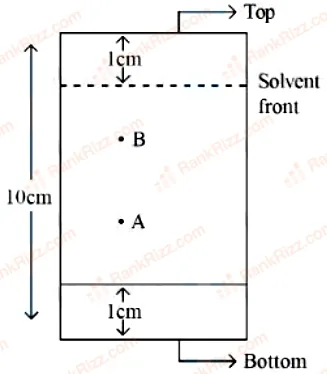
In the given TLC, the distance of spot A & B are & , from the bottom of TLC plate, respectively. value of B is times more than A. The value of is ______.
SOLUTION
Step 1: Find the Distance Traveled by the Solvent Front
From the provided TLC diagram:
- Total height of the plate:
- Distance from bottom edge to baseline:
- Distance from top edge to solvent front:
The total distance traveled by the solvent from the baseline is:
Step 2: Calculate the Values for Spots A and B
The value is calculated as the distance traveled by the compound from the baseline divided by the distance traveled by the solvent front from the baseline.
-
For Spot A:
Distance from bottom edge = , so distance from baseline = .
-
For Spot B:
Distance from bottom edge = , so distance from baseline = .
Step 3: Solve for
The problem states that the value of B is a multiple of A expressed as:
Substitute the calculated values into the relation:
Conclusion:
Comparing the relative positions shows that the value of B is exactly times that of A, which gives a value of for .
Answer: 15