JEE MAIN 2020 · 07 JAN S2+4 / −1MEDIUM
JEE Main 2020 Chemistry question — Haloarenes
Consider the following reactions:
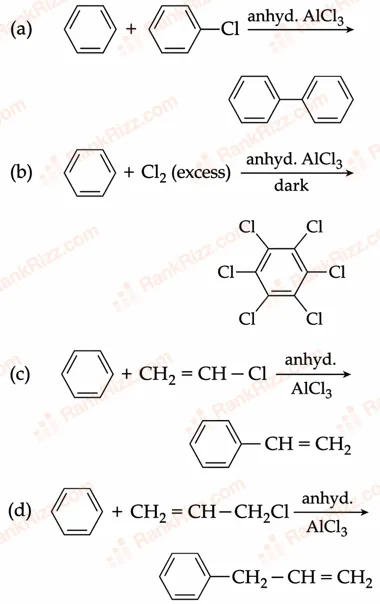
Which of these reactions are possible?
SOLUTION
Key idea: Friedel–Crafts reactions need an electrophile that can actually generate; aryl and vinyl halides cannot form carbocations.
- (a) : aryl C–Cl has partial double-bond character and a phenyl cation is very unstable → no Friedel–Crafts arylation. Biphenyl is not formed. ✗
- (b) , , dark: electrophilic substitution by repeats until all six H are replaced → hexachlorobenzene . ✓
- (c) : vinyl C–Cl is strengthened by resonance and a vinyl cation is unstable → no styrene formed this way. ✗
- (d) : forms the resonance-stabilised allyl cation, which alkylates benzene → allylbenzene . ✓
- Possible: (b) and (d).
Answer: (D) (b) and (d)
Topic: Haloarenes