JEE Main 2022 Chemistry question — Haloarenes
In the given reaction sequence, the major product 'C' is :
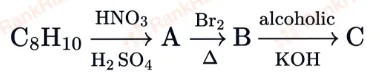
SOLUTION
Here is the complete step-by-step solution to the reaction sequence in LaTeX format.
1. Identification of Starting Material ()
The degree of unsaturation (Double Bond Equivalent) for is:
A typically indicates a benzene ring. Since there are 8 carbons, the compound is an alkylbenzene. The structure that standard textbook problems generally target for this specific sequence (nitration followed by side-chain bromination and elimination) is ethylbenzene, .
2. Step-by-Step Reaction Mechanism
Step 1: Nitration to form Compound A
When ethylbenzene reacts with a nitrating mixture, electrophilic aromatic substitution occurs. The ethyl group is an ortho/para-directing activator. Due to steric hindrance at the ortho-position, the major product is the para-isomer.
Step 2: Free Radical Bromination to form Compound B
When compound A reacts with Br2 in the presence of heat or light, free radical substitution takes place selectively at the benzylic carbon because the benzylic radical is highly stabilized by resonance with the aromatic ring.
- Structure of B: 1-bromo-1-(4-nitrophenyl)ethane
Step 3: Dehydrohalogenation to form Compound C
When compound B is treated with alcoholic KOH (a strong base), an E2 elimination reaction occurs. The base abstracts a proton from the beta-carbon, expelling the bromide ion to form a stable conjugated alkene (a styrene derivative).
- Structure of C: p-nitrostyrene (4-nitrostyrene)
Topic: Haloarenes