JEE
Coming soon
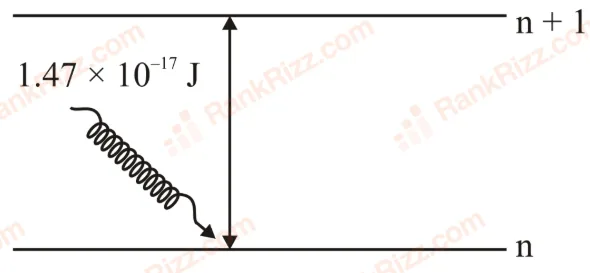
The electron in the nth^{th}th orbit of Li2+^{2+}2+ is excited to (n+1) orbit using the radiation of energy 1.47×10−171.47 \times 10^{-17}1.47×10⁻¹⁷ J (as shown in the diagram). The value of n is _______ Given: RH=2.18×10⁻¹⁸R_H = 2.18 \times 10^{-18}RH=2.18×10⁻¹⁸ J
For Li²⁺ (Z=3), energy levels: En=−RHZ2n2=−9RHn2E_n = -R_H \frac{Z^2}{n^2} = -\frac{9R_H}{n^2}En=−RHn2Z2=−n29RH
Energy for transition n →\rightarrow→ n+1:
ΔE=9RH(1n2−1(n+1)2)=1.47×10⁻¹⁷\Delta E = 9R_H\left(\frac{1}{n^2} - \frac{1}{(n+1)^2}\right) = 1.47 \times 10^{-17}ΔE=9RH(n21−(n+1)21)=1.47×10⁻¹⁷
1n2−1(n+1)2=1.47×10−179×2.18×10−18=1.471.962=0.75\frac{1}{n^2} - \frac{1}{(n+1)^2} = \frac{1.47 \times 10^{-17}}{9 \times 2.18 \times 10^{-18}} = \frac{1.47}{1.962} = 0.75n21−(n+1)21=9×2.18×10−181.47×10−17=1.9621.47=0.75
Try n=1: 1−1/4=0.751 - 1/4 = 0.751−1/4=0.75 ✓
The value of n is 1.
Topic: Bohr model of hydrogen-like species
QUESTION pyq:495956