JEE Main 2020 Chemistry question — Diazonium salts
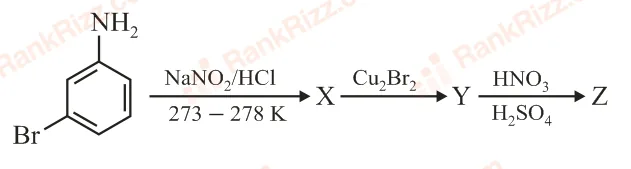
The major product Z obtained in the following reaction scheme is:
SOLUTION
-
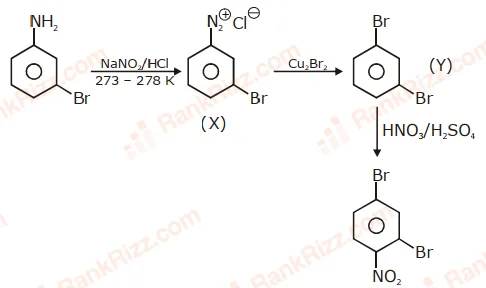
Step 1: Diazotization (Formation of X)
When 3-bromoaniline is treated with at a low temperature (), the primary aromatic amino group () is converted into a diazonium salt:
-
Step 2: Sandmeyer Reaction (Formation of Y)
Treating the diazonium intermediate with cuprous bromide () replaces the diazonium group () with a bromine atom ():
-
Step 3: Electrophilic Aromatic Nitration (Formation of Z)
Reacting 1,3-dibromobenzene with a nitrating mixture () introduces a nitro group () onto the benzene ring. The orientation is guided by the existing bromine substituents:
- Bromine atoms are ortho/para-directing.
- In 1,3-dibromobenzene, position 4 is ortho to one bromine atom and para to the other, making it highly activated by their cooperative electronic effects.
- Position 2 (between both bromine atoms) is highly sterically hindered, minimizing any substitution there.
Conclusion:
The sequence converts the amino group into a halogen atom and directs the subsequent nitration to the most sterically accessible and electronically activated position, yielding 1,3-dibromo-4-nitrobenzene.
Answer: Option B
Topic: Diazonium salts