JEE Main 2020 Chemistry question — Reactions and tests of amines
The major products A and B in the following reactions are
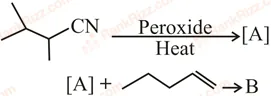
SOLUTION

Step 1: Hydrogen Abstraction (Formation of Radical A)
When the starting nitrile, 2,3-dimethylbutanenitrile (), is heated with a peroxide initiator, the peroxide decomposes to form free radicals. These radicals abstract the most reactive hydrogen atom from the nitrile:
- The hydrogen atom at the -position (adjacent to the cyano group) has a significantly lower bond dissociation energy because the resulting radical is stabilized by resonance delocalization into the -system of the nitrile group ().
- Therefore, abstraction happens exclusively at the -position to yield the stable -cyano radical intermediate:
-
Step 2: Radical Addition to Alkene (Formation of B)
The highly stable carbon radical A acts as a nucleophilic radical and adds to the terminal, less sterically hindered carbon of pent-1-ene (). This forms a new carbon-carbon bond and generates a secondary alkyl radical:
-
Step 3: Chain Propagation
This newly formed secondary alkyl radical then abstracts a hydrogen atom from another molecule of the starting nitrile compound, completing the radical chain mechanism and yielding the final addition product B:
Conclusion:
The reaction proceeds via preferential formation of the resonance-stabilized alpha-cyano radical intermediate followed by anti-Markovnikov-like radical addition across the terminal alkene, matching the structures given in Option B.
Answer: Option B