JEE MAIN 2025 · 22 JAN S2+4 / −1MEDIUM
JEE Main 2025 Chemistry question — Reactions and tests of amines
Match the Compounds (List - I) with the appropriate Catalyst/Reagents (List - II) for their reduction into corresponding amines.
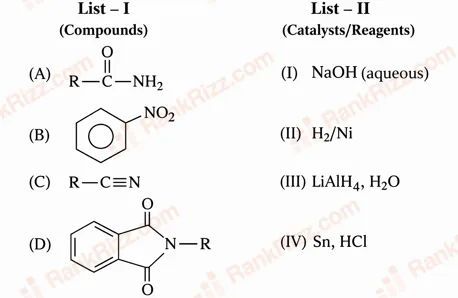
Choose the correct answer from the options given below :
SOLUTION
(A) Amide (III)
- Why this reagent: is a powerful nucleophilic reducing agent capable of reducing the highly stable bond of an amide all the way to a group to yield a primary amine.
- Why others fail: is usually not strong enough to reduce amides efficiently under standard conditions. is specifically used for nitro groups and won't touch the amide carbonyl. would simply cause hydrolysis to a carboxylate salt and ammonia, not reduction.
(B) Nitrobenzene (IV)
- Why this reagent: This is a classic laboratory method for preparing aniline. The metal/acid combination ( or ) provides the protons and electrons necessary to reduce to .
- Why others fail: While could technically work, is the preferred "textbook" match for aromatic nitro compounds in this list. is avoided for aromatic nitro compounds because it can lead to azo compounds (coupling) rather than pure amines.
(C) Nitrile (II)
- Why this reagent: Catalytic hydrogenation is the most efficient way to add four hydrogen atoms across the triple bond to produce a primary amine ().
- Why others fail: would hydrolyze the nitrile to an amide and then a carboxylic acid. is not the standard reagent for full nitrile reduction (it is used in the Stephen reduction to stop at the aldehyde, but only with ).
(D) Phthalimide (I)
- Why this reagent: This refers to the final step of the Gabriel Phthalimide Synthesis. Once an alkyl group is attached to the nitrogen, base-catalyzed hydrolysis () is used to break the cyclic imide bonds and release the primary amine.
- Why others fail: The goal here is "cleavage" to release the amine, not "reduction" of the aromatic ring or carbonyls. Reducing agents like or would attack the carbonyl groups of the phthalimide ring itself, destroying the starting material instead of releasing the desired amine.